
Table of Contents
- Patio Installation Timeline: From Start to Finish
- What Factors Affect Patio Construction Time?
- Paver Patio Installation Steps and Labor Hours
- Concrete vs. Paver Patio Installation Duration
- How Long to Wait Before Walking on Pavers
- How to Keep Your Patio Project on Schedule
- Conclusion
- Frequently Asked Questions
Last Updated: September 6, 2026
Planning a backyard renovation often starts with a simple question: how long for patio installation? For most homeowners, a standard paver patio takes between one and two weeks from site preparation to the final sweep of joint sand, though the timeline depends heavily on size, site conditions, and crew size. Below, we break down the timeline step by step, identify hidden delays, and give you a realistic picture of what to expect.
Patio Installation Timeline: From Start to Finish
A typical paver patio installation timeline spans 5 to 10 working days for an average residential project, excluding material delivery lead times or weather delays, which can add a week or more.
The fastest projects are straightforward: a flat backyard, easy equipment access, and a crew of four or more, completing a 300 to 400 square foot patio in about four to five days. Larger installations, complex patterns, or projects with retaining walls and outdoor kitchens require more time.

What Factors Affect Patio Construction Time?
The factors affecting patio construction time fall into two categories: the physical work itself and the logistical variables that surround it.
Site Preparation and Excavation
Site preparation is the most labor-intensive phase. Excavation removes existing grass, soil, and debris to a depth of typically 8 to 12 inches for a residential patio.
Poor soil, hidden utility lines, or tree roots discovered during excavation can add days. Proper grading and drainage must be established before any base material goes down; a patio built on an unprepared sub-base will settle, shift, and crack within a few years.
Size, Accessibility, and Weather
Square footage directly drives labor hours. A 150 square foot patio might take two days, while a 1,000 square foot installation with a custom pattern could take two weeks.
Site accessibility is a factor most guides ignore. If your backyard requires wheelbarrowing materials through a narrow gate, every step takes longer, and equipment like mini excavators can only work where they can physically reach.
Weather is the other wildcard. Rain halts paver installation because the base and sand must be dry for proper compaction. In the summer months, afternoon thunderstorms can disrupt an entire week of work. The National Weather Service climate data shows that the Katy and Cypress area averages significant rainfall during the summer, making spring and fall the most predictable seasons for scheduling.
Paver Patio Installation Steps and Labor Hours
The paver patio installation steps follow a consistent sequence regardless of the project.
- Design and layout (1 to 2 days): Marking the patio boundaries, confirming the slope for drainage, and finalizing the paver pattern.
- Excavation (1 to 2 days): Removing soil to the required depth, accounting for the base layer and paver thickness.
- Sub-base installation (1 to 2 days): Spreading and compacting crushed stone or gravel in layers, typically 4 to 6 inches.
- Base layer and leveling (1 day): Adding a layer of coarse sand and screeding it to a precise, consistent grade.
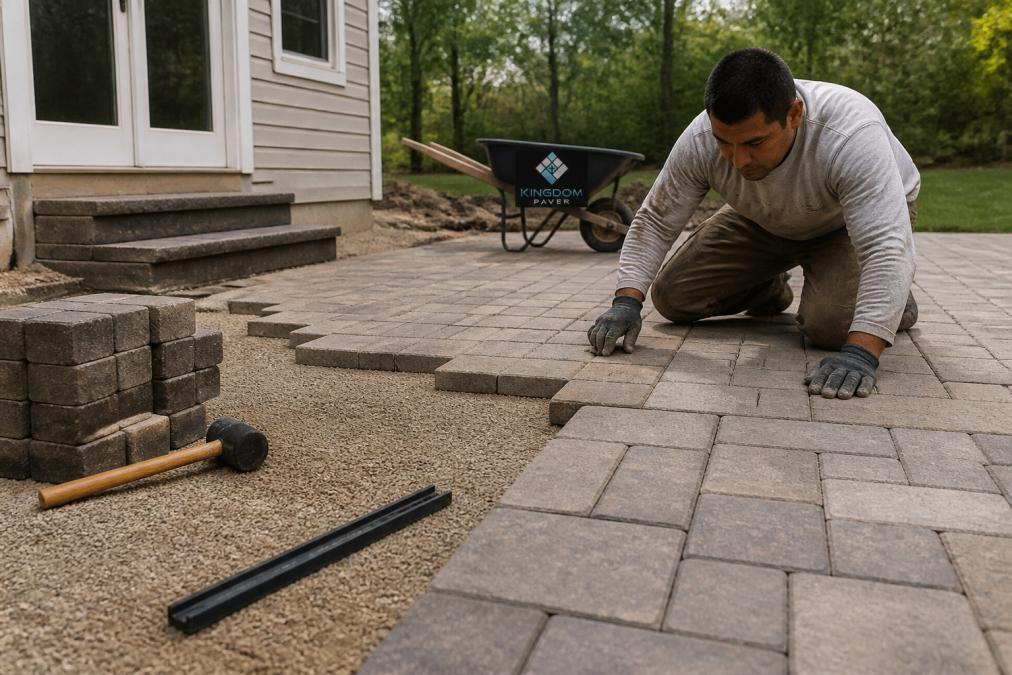
- Paver installation (1 to 3 days): Laying pavers in the chosen pattern, cutting edge pieces to fit, and checking for level as you go.
- Edge restraints and joint sand (1 day): Securing the perimeter, sweeping joint sand into the gaps, and compacting the surface.
- Sealing and finishing (1 day): Applying sealer if desired and cleaning the surface for final inspection.
A professional crew of three to five people can typically install 100 to 150 square feet of pavers per day once the base is prepared. The base work, less visible but more critical, often takes as long as the paver laying itself.
Ask your contractor about the sub-base thickness they plan to install. A minimum of 4 inches of compacted crushed stone is standard for a residential patio. Anything less may save time during installation but often leads to settling and cracked pavers down the road.
Concrete vs. Paver Patio Installation Duration
The headline difference between concrete and pavers is the curing period, but the real scheduling pain point is the gap between “installation complete” and “ready for furniture.” The total timeline for a concrete patio extends well beyond the last trowel pass.
The Concrete Curing Clock
A poured concrete slab undergoes a chemical hydration process that continues for years, but the critical early windows are rigid:
- 24 to 48 hours: The surface is hard enough to walk on carefully, but it is still green and susceptible to damage. Any heavy foot traffic, pets, or dropped tools can leave permanent marks.
- 7 days: The slab reaches roughly 70% of its design strength. Light foot traffic and lightweight furniture (plastic or aluminum) are generally acceptable, but you should still avoid dragging anything across the surface.
- 28 days: Concrete reaches its full design compressive strength (typically 3,000 to 4,000 psi for residential slabs). This is the safe point for placing heavy items like a full-size grill, a fire pit, or a hot tub. Placing a 500-pound grill on a 7-day-old slab can cause micro-cracking that shows up as surface crazing within a year.
A common pattern is for contractors to finish the pour on a Friday and call the project “done,” leaving the homeowner with a patio they cannot use for another three weeks.
Paver Readiness: The Joint Sand Factor
Pavers are ready for foot traffic the same day, but the “furniture-ready” threshold differs. The interlocking system relies on joint sand settling into the gaps; immediately after installation, the sand is loose and only partially compacted.
- Same day: Walking is fine. The surface is stable under foot.
- 48 to 72 hours: Light furniture (chairs, small tables) can be placed, but avoid sliding or dragging them. The sand needs a few compaction cycles from foot traffic to lock in.
- 1 week of normal use: The joint sand has settled to near-final density. This is the safe point for a rolling grill, a heavy planter, or a patio heater.
- 2 weeks: Edge restraints have fully seated, and the base has settled under the initial load cycles. This is the recommended wait before driving a vehicle on a paver driveway.
The Real Total Timeline Comparison
| Patio Type | Active Work Time | Ready for Light Use | Ready for Heavy Furniture | Total Calendar Timeline |
|---|---|---|---|---|
| Paver patio | 3 to 5 days | Same day | 1 week | 5 to 10 working days |
| Poured concrete | 2 to 3 days | 7 days | 28 days | 4 to 6 weeks |
If you are scheduling a backyard event, ask your contractor for two dates: the last day of active work and the first day the patio can handle a loaded grill or a crowd of guests. For concrete, those dates are often a month apart. For pavers, they are usually within a week.
Repair and Adjustment Timelines
Another overlooked difference is post-installation repair. A cracked paver can be lifted and replaced in under an hour, and the patio is immediately usable again. A cracked concrete slab requires cutting out the damaged section, re-pouring, and waiting another 7 to 28 days before that area is load-bearing.
How Long to Wait Before Walking on Pavers
You can walk on a newly installed paver patio immediately after installation. Unlike concrete, pavers do not require a curing period because the units are already cured when they arrive.
The caveat is that heavy equipment, such as a grill on wheels or a large planter, should wait until the joint sand has settled, which takes about a week of normal use. The sand locks the pavers together; placing heavy items too soon may dislodge it and create surface movement.
For how long to wait before walking on pavers, the answer is simple: the same day. For driving on a paver driveway, wait 24 to 48 hours to allow the edge restraints and compacted base to settle fully.
How to Keep Your Patio Project on Schedule
The physical installation is rarely what pushes a patio past its deadline. The delays that stretch projects from two weeks to six weeks are almost always logistical: municipal approvals, material availability, and site access.
Permitting and Inspection Wait Times
Most residential paver patios under 200 square feet and without structural changes do not require a permit. But once your project crosses a local threshold, often 200 to 400 square feet, you enter a review process that operates on government time, not contractor time.
A typical residential building permit for a patio follows this pattern:
- Application submission (Day 1): Your contractor or you file the application with the local building department, including a site plan showing property lines, setbacks, and drainage.
- Plan review (3 to 10 business days): The department checks your plan against local zoning codes, setback requirements, and drainage ordinances. If your property is in a flood zone or has an easement, this review can take longer.
- Permit issuance (1 to 2 days after approval): You pay the fee and receive the permit number.
- Rough-in inspection (if applicable): For patios with electrical work (outdoor kitchens, lighting), an inspection is required after the conduit is laid but before the base is compacted. This inspection must be scheduled 24 to 48 hours in advance.
- Final inspection (after installation): Some municipalities require a final sign-off before you can use the patio.
In practice, the permitting process adds 1 to 3 weeks to the front of your project. File the permit application before ordering materials or scheduling the crew.
Check with your local building department about setback requirements before you finalize your patio design. A patio that encroaches on a required setback can be ordered removed, which turns a 2-week project into a 2-month ordeal of appeals and rework.
Material Delivery Lead Times
Standard concrete pavers from major manufacturers (Belgard, Techo-Bloc, Pavestone) are typically stocked by local distributors and can be delivered within 2 to 5 business days. But selecting a specialty product changes the timeline dramatically:
- Imported natural stone (travertine, bluestone, flagstone): 2 to 6 weeks, depending on the quarry and port availability.
- Custom color or texture pavers (manufactured to order): 3 to 8 weeks.
- Large-format pavers (24×24 inches or larger): Often special order, 2 to 4 weeks.
- Base stone and sand: Usually same-week delivery, but a shortage of a specific grade of crushed stone can delay the base installation.
A common failure mode is ordering pavers and base materials from different suppliers without coordinating delivery dates, leaving the crew waiting days for pavers. Have your contractor confirm all material delivery dates in writing before excavation starts.
Site Accessibility: The Hidden Labor Multiplier
If your backyard is accessible through a 6-foot-wide gate with a straight path, a crew can use a mini excavator and plate compactor, and the project moves at a normal pace. But a 3-foot side gate changes the math completely:
- Excavation by hand: A mini excavator can remove 20 to 30 cubic yards of soil per day. A hand crew with shovels and wheelbarrows moves 3 to 5 cubic yards per day. For a 400-square-foot patio requiring 8 inches of excavation (about 10 cubic yards), that is 2 to 3 days of machine work versus 2 to 4 days of manual labor.
- Material hauling: A ton of base stone is roughly 0.7 cubic yards. A wheelbarrow carries about 0.1 cubic yards. If you cannot get a dump truck close to the patio site, every ton of stone means 10 wheelbarrow trips. A typical patio needs 3 to 5 tons of base material, which translates to 30 to 50 wheelbarrow loads just for the stone.
- Compaction: A plate compactor weighs 150 to 200 pounds. If it cannot be wheeled through the access path, it must be carried in pieces and reassembled on site, adding half a day to the schedule.
Before you sign a contract, walk your contractor through the access path. Ask specifically: “Can you get a mini excavator to the patio site?” If the answer is no, expect the labor estimate to increase by 30 to 50% and the timeline to stretch by several days.
The Buffer Strategy
Even with perfect planning, weather and municipal schedules are outside your control. A realistic buffer is 5 to 7 additional calendar days on top of the contractor’s estimate, not pessimism, but the difference between a project that finishes early and one that feels late. Build the buffer into your expectations, not the contract.
Conclusion
A paver patio installation is a 1 to 2 week project for most homes, driven by site preparation, square footage, and weather. The fastest way to stay on schedule is to work with an experienced crew that plans for the logistical delays that derail DIY projects.
At Kingdom Paver, our team brings over a decade of experience to every patio, walkway, and outdoor kitchen we build in the Katy and Cypress area. We handle the full scope of work, including site preparation, grading, and drainage, so you know exactly who is accountable for the result. Contact Kingdom Paver today for a timeline tailored to your outdoor living space.
Frequently Asked Questions
How long does it take to install a 20×20 paver patio?
A standard 20×20 (400 square feet) paver patio typically takes 3 to 5 days for a professional crew. This includes one day for site preparation and excavation, a day to lay the sub-base and sand, a day for paver installation, and a final day for edge restraints, joint sand, and compaction. The exact timeline depends on site accessibility, soil conditions, and the complexity of the paver layout.
How long before I can walk on a newly laid paver patio?
You can walk on a paver patio immediately after installation for light foot traffic, but wait at least 24 hours for the joint sand to settle before heavy use. Avoid dragging heavy furniture or driving equipment on the new surface for about a week. If your patio includes concrete elements like a curb or steps, wait 48 hours before walking on those sections.
What can delay a professional paver installation?
The most common delays are weather. Rain interrupts excavation and prevents proper compaction of the sub-base. Material delivery lead times can also push out a start date. Site accessibility issues, like a narrow side gate that prevents equipment from reaching the backyard, add labor hours. Permitting and required inspections for larger patios also add time to the overall project timeline.


