Paver Driveway vs Concrete Cost: Side-by-Side Comparison
The paver driveway vs concrete cost debate extends far beyond the initial invoice. Homeowners who focus only on upfront installation costs miss the full picture: maintenance cycles, repair complexity, and how each material performs over a 20-to-30-year lifespan. At Kingdom Paver, we’ve worked through this comparison with hundreds of homeowners, and the answer is rarely one-size-fits-all.
Paver driveways generally carry a higher upfront investment than poured concrete due to material costs and labor-intensive installation. Concrete driveways offer a faster pour and lower starting price for a basic slab. But here’s what most guides get wrong: they stop the comparison at installation day.
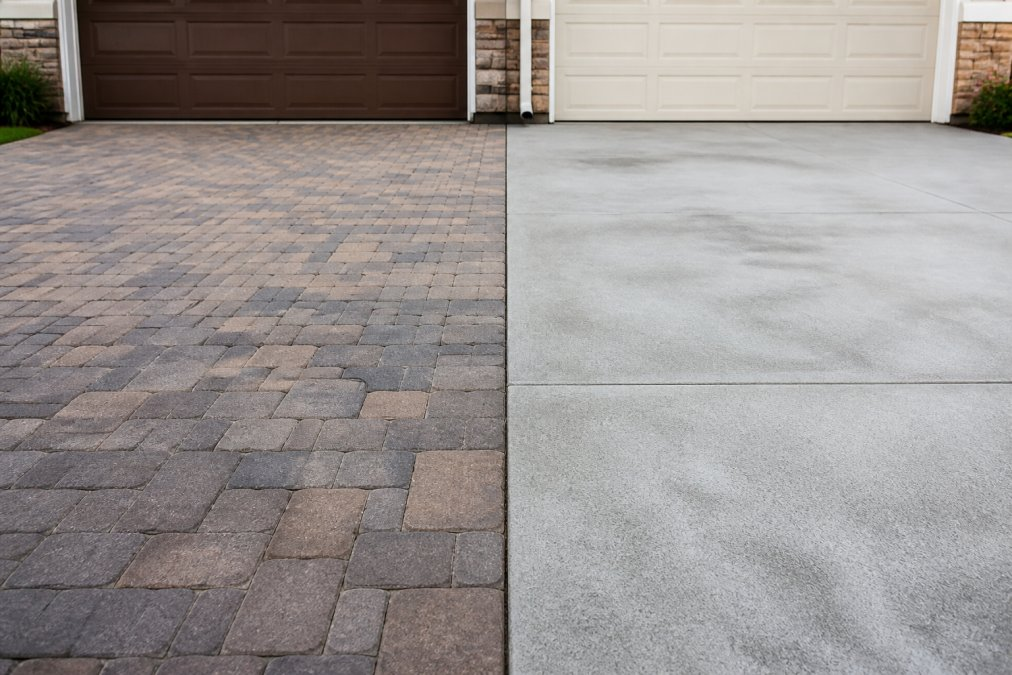
Split-view of a well-maintained interlocking stone paver driveway on the left and a smooth poured concrete driveway on the right, both leading to suburban homes with neat green lawns on a bright afternoon
The table below gives you a direct side-by-side view across the factors that actually drive total cost of ownership.
Factor
Paver Driveway
Concrete Driveway
Upfront cost per sq. ft.
Higher
Lower
Installation timeline
2-5 days
1-3 days (plus cure time)
Lifespan (maintained)
25-50 years
25-30 years
Crack repair
Replace individual units
Patch or full resurfacing
Freeze-thaw performance
Excellent (flex joints)
Prone to cracking
Drainage options
Permeable pavers available
Limited without add-ons
Resale value / curb appeal
High
Moderate
DIY feasibility
Moderate
Low
Long-term maintenance cost
Low-moderate
Moderate-high
The verdict on paver driveway vs concrete cost changes significantly once you account for repair expenses over a decade. Pavers cost more to install; concrete can cost more to maintain.
Paver Driveway Installation Cost Per Square Foot
Paver driveway installation cost per square foot varies based on material selection, sub-base preparation, and local labor rates. According to HomeAdvisor’s driveway cost guide, installed paver driveways typically run between $10 and $70 per square foot. A standard two-car driveway covers roughly 400 to 600 square feet, so total project costs vary considerably.
The material tier you choose drives a large portion of that range. Basic concrete pavers sit at the lower end, while premium products from manufacturers like Belgard, Techo-Bloc, and Unilock with high-definition textures or permeable construction push costs higher.
Sub-base preparation is the other major cost driver. Proper excavation, compaction, and aggregate base installation are non-negotiable for a paver driveway that doesn’t sink or shift. Skimping on the sub-base is the single most common reason pavers fail within a few years.
What Drives Paver Pricing Up or Down
Several variables move the final price significantly:
Paver style and profile: Tumbled, textured, or large-format pavers require more precise placement and cost more per unit
Pattern complexity: Herringbone and circular patterns are more labor-intensive than running bond layouts
Edging and border work: Contrasting borders add material and installation time
Site conditions: Slopes, poor drainage, and existing hardscaping removal increase excavation costs
Joint sand type: Polymeric joint sand costs more than standard sand but resists weed growth and erosion far better
Pro Tip Specify polymeric joint sand in your contract. Many contractors default to standard sand to reduce material cost, but standard sand washes out within a few seasons and requires regular refilling. The upgrade cost is minor compared to long-term maintenance savings.
Regional Cost Variance Factors
Labor rates vary widely across the country, and material shipping costs affect prices in areas far from manufacturing hubs. In high cost-of-living metro areas, labor can represent more than half the total project cost. Soil conditions also create regional variance, areas with expansive clay soils, high water tables, or deep frost lines require more extensive sub-base preparation. For a precise quote reflecting your specific site and region, contact a local installer directly.
Concrete Driveway Lifespan and Maintenance Costs
A properly poured concrete slab with adequate thickness (4 to 6 inches), a well-compacted aggregate base, and appropriate control joints can last 25 to 30 years. Without those fundamentals, problems appear much sooner.
Sealing the surface every 2 to 5 years helps preserve the finish and slows moisture penetration. The real costs emerge when cracking starts, which is a matter of when, not if.
Cracking, Repair, and Resurfacing Expenses
Cracking is concrete’s most significant long-term liability. Concrete is rigid; ground movement, settling, and freeze-thaw cycles stress the slab. Once a crack forms, water infiltration accelerates damage. Repair options range from hairline crack filling (cosmetic only) to structural crack repair (patches rarely match the original finish) to resurfacing (mid-range cost but limited lifespan) to full tear-out and replacement (most expensive, often unavoidable when cracking is widespread).
Unlike pavers, where a single damaged unit can be lifted and replaced with a matching piece, concrete repairs are almost always noticeable. That affects both curb appeal and resale value. As documented in the National Ready Mixed Concrete Association’s maintenance guidance, proper joint placement and sealant application are the two most effective ways to extend concrete driveway lifespan.
Stamped Concrete vs Pavers Cost: Where the Gap Narrows
Stamped concrete is often pitched as a budget-friendly alternative to pavers that achieves a similar aesthetic. The reality is more nuanced.
Stamped concrete costs more per square foot than plain poured concrete due to decorative labor, pigment, and release agents. At the high end of stamped concrete pricing, the gap between stamped concrete and entry-level pavers narrows considerably.
What stamped concrete cannot replicate is repairability. If a section cracks or chips, matching the original color and pattern during repair is extremely difficult. Color fading is also a known issue: the surface finish tends to lose vibrancy over time, requiring periodic resealing.
Pavers hold their color better because pigment runs through the full unit rather than sitting on the surface. Techo-Bloc’s HD2 technology and Unilock’s Enduracolor system are specifically engineered for long-term color retention under UV exposure and de-icing salt use.
Key Takeaway Stamped concrete and pavers can look similar on installation day. Five years later, the difference in color retention, repairability, and surface condition becomes obvious. Factor that into your decision, not just the day-one price.
Durability, Climate, and Long-Term Performance
Durability is where the paver driveway vs concrete comparison shifts most decisively in pavers’ favor for many climates. Pavers are individual interlocking units set in a flexible system. That flexibility is an engineering advantage.
Freeze-Thaw Cycles and Structural Integrity
Freeze-thaw cycles are the primary enemy of poured concrete driveways. Water infiltrates surface cracks, expands when frozen, and widens cracks with each cycle. In cold climates, a concrete driveway that looks fine in year three can show significant deterioration by year seven.
Paver systems handle freeze-thaw stress differently. Flexible joints between individual units allow minor movement without fracturing the surface. When a paver shifts or cracks, the repair is surgical: lift the affected unit, re-level the bedding sand, and reset or replace that specific piece. The surrounding area remains unaffected.
Standard poured concrete is essentially impermeable: rainwater runs off the surface into storm drains, contributing to runoff and drainage issues. On sloped sites or properties with water pooling problems, this matters.
Permeable pavers offer a direct solution. Products designed with open joints or porous aggregate allow water to filter through the surface and into the sub-base, where it percolates naturally. This reduces surface runoff, helps manage water pooling, and can contribute to better site drainage without additional infrastructure.
Paver Driveway vs Concrete: Pros, Cons, and Curb Appeal
Curb appeal directly affects property value and buyer perception. The paver driveway vs concrete comparison on aesthetics is not close: pavers offer significantly more design flexibility with a range of colors, textures, and patterns that stamped concrete approximates but rarely matches over time.
Close-up of a freshly installed decorative paver driveway with uniform joint sand lines, warm earth-tone colors, and neat brick-pattern edging along a home's garage entrance on a clear sunny day
Pros and Cons of Paver Driveways
Pros:
Individual units can be replaced without disturbing the surrounding surface
Aesthetic versatility: wide range of colors, textures, and laying patterns
Flexible joint system handles ground movement and freeze-thaw cycles well
Permeable options improve on-site drainage
Strong positive impact on curb appeal and resale value
Long driveway lifespan when properly installed and maintained
Cons:
Higher upfront investment than basic poured concrete
Weeds can grow in joints without polymeric sand or regular maintenance
Joint sand may require periodic replenishment
Watch Out A paver driveway installed on an inadequate sub-base will sink and shift within a few years. Always verify that your contractor includes proper excavation depth and compacted aggregate base in the scope of work before signing.
Pros and Cons of Concrete Driveways
Pros:
Lower initial installation cost per square foot
Faster installation timeline
Durable under normal conditions with proper thickness and joint placement
Low early-year maintenance requirements
Widely available contractors in most markets
Cons:
Prone to cracking from ground movement, settling, and freeze-thaw stress
Repairs are visible and rarely match the original surface finish
Decorative finishes fade and require regular resealing
Full tear-out and replacement is expensive when the slab fails
Limited drainage options without additional site work
DIY vs. Professional Installation: What You Should Know
DIY paver installation is more feasible than DIY concrete work, but "feasible" and "advisable" are different things. Pouring a concrete driveway requires specialized equipment, precise mixing ratios, and finishing experience. Most homeowners should not attempt it.
Paver installation is physically demanding but technically accessible for experienced DIYers. The process involves excavation to the correct depth, compacted aggregate base installation (typically 4-6 inches minimum), bedding sand layer (typically 1 inch, screeded flat), paver placement in the chosen pattern, edge restraint installation, and joint sand compaction.
The risk in DIY paver work is almost always in the sub-base. Inadequate excavation depth, insufficient compaction, or uneven bedding sand creates a surface that looks fine initially but develops dips and instability within a few seasons. For most homeowners, professional installation delivers better long-term results and eliminates the risk of sub-base failures that void material warranties.
Which Driveway Option Is Right for You?
The right choice between paver driveway vs concrete depends on three factors: budget structure, climate, and how long you plan to stay in the home.
Your Situation
Better Choice
Reason
Lower upfront budget, mild climate
Concrete
Lower installation cost, adequate for stable soils
Better aesthetics than plain concrete, lower than pavers
Homeowners planning to stay in their home for more than a decade generally find that the total cost of ownership for pavers compares favorably to concrete once repair and resurfacing costs are factored in. For properties with drainage challenges, sloped driveways, or areas prone to water pooling, permeable pavers address the problem structurally.
A common mistake is choosing based on the lowest quote without comparing the scope of work. Ask every contractor to detail the sub-base preparation in writing before comparing prices.
For homeowners who want a clear recommendation backed by on-the-ground experience, reach out to Kingdom Paver for a site assessment. The team evaluates soil conditions, drainage, and site grade before recommending a material or installation approach, so the solution fits the property rather than just the budget.
Choosing between a paver driveway and concrete is a long-term financial decision, not just a style preference. Both materials can deliver excellent results when installed correctly; the differences in repairability, climate performance, and drainage options are what separate them over time. Kingdom Paver specializes in professional paver driveway installation with proper sub-base preparation and custom design options built around your site’s specific conditions. Contact Kingdom Paver to get a detailed quote and see exactly what a properly installed paver driveway looks like from excavation to final joint sand compaction.
Frequently Asked Questions
Is it cheaper to do a concrete or paver driveway?
A poured concrete driveway typically costs less upfront than a paver driveway. Concrete installation generally runs lower per square foot for materials and labor, while interlocking pavers require more sub-base preparation and labor-intensive placement. However, the total cost of ownership can shift over time: pavers allow individual unit replacement when damaged, while concrete often requires full-section tear-out and repour. Get a project-specific quote to compare both options for your driveway size and site conditions.
What are the disadvantages of a paver driveway?
The main disadvantages of a paver driveway are higher upfront installation cost, more complex sub-base preparation, and the potential for individual stones to shift or settle if the aggregate base is not properly compacted. Joint sand can wash out over time and needs periodic replenishment. Weeds can grow in joints without a quality sealant or polymeric sand. Despite these maintenance tasks, most homeowners find pavers easier to repair than a poured slab, since only affected units need replacement rather than the entire surface.
Does a paver driveway add more resale value than concrete?
Paver driveways generally contribute more to curb appeal and perceived resale value than standard concrete driveways, largely because of their aesthetic versatility and the premium look of interlocking stones. Stamped concrete can close part of that gap visually, but pavers are seen as a longer-lasting, higher-end hardscaping choice by many buyers. The actual resale impact depends on your neighborhood, the quality of installation, and how well the driveway has been maintained over its lifespan.
How does the long-term maintenance cost of pavers compare to concrete?
Concrete driveways require periodic sealing and can develop cracks that need patching or, in serious cases, full resurfacing. Repair costs rise significantly when cracking is widespread. Paver driveways need joint sand replenishment, occasional re-leveling of settled stones, and sealant application every few years. Repair costs for pavers tend to stay lower because individual units can be swapped out. Over a 20-30 year driveway lifespan, total maintenance costs for both materials are often comparable, though pavers avoid the expensive tear-out that concrete sometimes requires.
Can pavers fix drainage and water pooling problems on a sloped driveway?
Permeable pavers are specifically designed to improve drainage by allowing water to pass through the joints and into a prepared aggregate base below, reducing surface runoff and water pooling. Proper excavation, compaction, and grading during installation are essential for this to work effectively. A skilled contractor will assess your driveway's slope and drainage conditions before recommending the right paver type and base system. Permeable paver options from manufacturers like Belgard, Techo-Bloc, and Unilock are built for exactly these situations.