
Table of Contents
- Paver Patio vs Wood Deck: Side-by-Side Comparison
- Paver Patio Installation Cost and Budget Breakdown
- Wood Deck Maintenance Tips and Long-Term Care
- Durability, Climate Suitability, and Structural Integrity
- Deck vs Patio Resale Value and Long-Term Investment
- Design Flexibility, Aesthetics, and Curb Appeal
- Installation Process and Site Preparation Requirements
- Accessibility, Safety, and Slip Resistance
- Frequently Asked Questions
Last Updated: August 31, 2026
Paver Patio vs Wood Deck: Side-by-Side Comparison
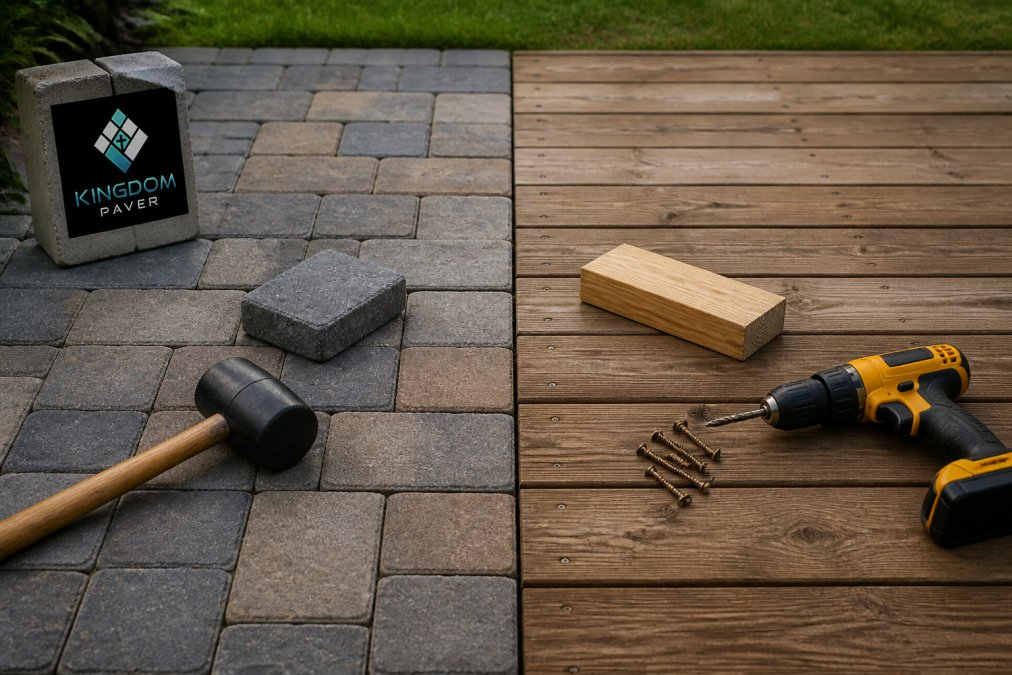
Choosing between a paver patio and a wood deck means deciding between two fundamentally different approaches to hardscaping. A paver patio vs wood deck comparison isn’t just about aesthetics, it’s about durability, maintenance, climate fit, and resale value. At Kingdom Paver, we’ve helped homeowners make this decision for over a decade, and the answer depends almost entirely on your specific situation.
Wood decks offer warmth and natural appeal but demand constant attention. Paver patios require more upfront installation work but are essentially maintenance-free once installed. One costs less initially; the other costs less over 20 years. Neither is universally “better,” but one is almost certainly right for you.
| Feature | Paver Patio | Wood Deck |
|---|---|---|
| Initial Cost (per sq ft) | $5-50 installed | $15-45 installed |
| Annual Maintenance | Minimal (sweeping, occasional sealing) | Significant (staining, sealing, repairs) |
| Lifespan | 25-50+ years | 15-20 years |
| Design Flexibility | Extensive (colors, patterns, styles) | Moderate (wood type, stain) |
| Climate Suitability | Best in freeze-thaw regions | Better in dry climates |
| Resale Value Impact | Strong (durable improvement) | Moderate (depends on condition) |
| Installation Complexity | High (sub-base critical) | Moderate (framing and ledger) |
| Slip Resistance | Excellent (especially important for pools) | Moderate (can be slippery when wet) |
Paver Patio Installation Cost and Budget Breakdown
Paver patio costs depend on three factors: project size, paver quality, and site preparation needs. For custom quotes, Kingdom Paver provides pricing based on your exact square footage and material selections.
The pavers themselves are only part of the equation. Site grading, drainage setup, and proper sub-base installation determine whether your patio lasts 25 years or fails in five. A contractor who skips foundation work might quote lower, but settling and cracking will cost you later.
Interlocking paver systems from brands like Belgard and Unilock offer different price points. Premium options with advanced features like permeable drainage cost more upfront but justify themselves through longevity and easier maintenance. Basic concrete pavers are the budget option; specialty finishes push costs higher.
Labor often exceeds material cost because proper installation is complex. It’s not just laying pavers in a pattern, it’s about slope for drainage, compacting the base to the right density, and ensuring everything sits level. This is where Kingdom Paver’s experience matters. Proper installation prevents settling, cracking, and weed growth that plague poorly installed patios.
Wood Deck Maintenance Tips and Long-Term Care
Wood decks demand a maintenance schedule if you want them to last. The moment you install a pressure-treated lumber deck, you’re committing to annual or biennial upkeep.
Sealing and staining are non-negotiable. Pressure-treated wood resists rot better than untreated lumber, but it’s still wood. Moisture penetration is the enemy. Every year or two, depending on your climate, the deck needs a fresh seal or stain to protect against UV damage, water absorption, and freeze-thaw cycles that crack wood from the inside out.
Rot-resistant wood species like cedar or composite alternatives such as Trex or TimberTech AZEK reduce maintenance somewhat but don’t eliminate it. Composite decking still needs periodic cleaning and may require occasional stain treatment. TimberTech AZEK PVC decking resists mold and mildew better than wood-plastic hybrids, but darker colors can get hot in direct sunlight.
Structural integrity checks are also routine. Every few years, inspect the ledger board where the deck attaches to your house. Water damage here is common and dangerous, a failing ledger can cause the entire deck to pull away. Check joists for soft spots, inspect fasteners for rust, and look for pest damage.
The most common mistake is assuming pressure-treated lumber is maintenance-free. It still needs sealing every 2-3 years to prevent moisture damage and UV degradation.
Durability, Climate Suitability, and Structural Integrity
How Weather Affects Each Option
Wood decks and paver patios respond very differently to climate extremes. In freeze-thaw regions, pavers have the advantage. Concrete pavers are rigid and designed to handle expansion and contraction. A properly installed paver patio with adequate sub-base and drainage survives decades of freeze-thaw cycles.
Wood decks struggle in these conditions. Moisture freezes and expands inside the wood, cracking it from within. This cycle repeats every winter, gradually degrading structural integrity. Even pressure-treated lumber succumbs over time. In freeze-thaw climates, a paver patio is more durable.
In hot, dry climates, the advantage shifts slightly toward wood. Dry heat is less punishing than moisture and freeze-thaw. However, intense UV exposure still damages wood decks, and maintenance doesn’t disappear.
Composite decking options like Trex and TimberTech AZEK were designed for harsh climates. Trex’s recycled material composition resists fading and staining, making it suitable for coastal areas and high-sun regions. TimberTech AZEK’s 100% PVC construction offers superior moisture resistance for humid climates or areas near water.
Moisture, Rot, and Foundation Concerns
Moisture is the primary enemy of wood decks. It causes rot, promotes mold, and weakens structural components. The foundation, posts, joists, and ledger board, must stay dry. Proper drainage and site grading around the deck are critical. Water pooling beneath a deck accelerates rot in the substructure.
Paver patios handle moisture differently. Permeable pavers allow water to drain through the surface, reducing pooling. The sub-base material, typically crushed stone, acts as a drainage layer, channeling water away. This only works if the base is installed correctly. Poor sub-base preparation is the leading cause of paver settling and cracking.
The frost line is critical in colder climates. Posts and foundations must extend below this line to prevent frost heave, the upward movement of soil and structures as it freezes. Wood deck posts that don’t reach below the frost line will shift and settle. Paver patios don’t have posts, but the sub-base must be deep enough to prevent frost heave. Kingdom Paver ensures proper depth and base preparation for your climate zone.
Posts that don’t extend below the frost line will heave upward in winter, creating gaps and instability. Paver bases that are too shallow will shift and crack as the ground moves. Both require proper foundation depth for your climate zone.
Deck vs Patio Resale Value and Long-Term Investment
A new wood deck adds appeal, but its value depreciates quickly if unmaintained. A 10-year-old deck in poor condition with faded stain, visible rot, or structural issues actually reduces home value because buyers see a liability.
A paver patio holds value better. Buyers see a durable, low-maintenance outdoor space. Pavers don’t rot, don’t need annual sealing, and won’t need replacement in 5-10 years. This durability translates to perceived value. A well-installed paver patio looks permanent; a neglected wood deck looks like deferred maintenance.
However, initial paver patio investment is typically higher than a basic wood deck. Over 20 years, the paver patio usually wins financially because you’re not replacing the deck or paying for constant maintenance. If you’re selling in 5 years and the deck is still in good condition, the economics are closer.
The best-case resale scenario is a well-maintained wood deck in a climate where it thrives, or a properly installed paver patio. The worst case is a neglected wood deck.
Design Flexibility, Aesthetics, and Curb Appeal
Wood decks offer a classic, warm aesthetic that many homeowners love. The natural grain and weathering appeal to traditional tastes.
Pavers offer far more design flexibility. You can create patterns, herringbone, running bond, basketweave, impossible with deck boards. You can mix colors and textures. Belgard and Unilock offer extensive collections that let you customize your outdoor space to match your home’s architecture.
Composite decking like Trex and TimberTech AZEK split the difference. They look like wood but come in more color options and don’t fade or stain as easily.

For curb appeal, choose what fits your home. A traditional house suits a wood deck. A modern home often suits pavers better. Mediterranean or contemporary designs almost always benefit from the clean lines and texture options pavers provide. Working with Kingdom Paver helps you choose materials and patterns that enhance your home’s architecture.
Installation Process and Site Preparation Requirements
Sub-Base and Foundation Demands
Paver patios demand more upfront work than wood decks. The foundation is invisible but determines whether your patio lasts 25 years or fails in five.
Site grading comes first. The ground must slope slightly, typically 1-2%, to ensure water drains away and doesn’t pool. This slope is subtle but critical. Poor grading is a common reason patios fail.
Next comes the sub-base: typically 4-6 inches of compacted crushed stone or gravel. It provides a stable foundation, allows water drainage, and distributes weight across a larger area. The key is “compacted”, the base must be tamped to the right density. A loose base will settle unevenly, causing pavers to shift and crack.
On top goes a sand layer, usually polymeric sand that hardens when wet, locking pavers in place and preventing weeds. Pavers sit on this sand. Finally, joints are filled with more sand or polymeric sand.
Wood deck installation is simpler structurally but requires different precision. Posts must be set on footings extending below the frost line. Joists must be properly spaced and supported. The ledger board must have flashing to prevent water from getting behind it and into your home’s structure. Many DIY installers get this wrong, leading to expensive water damage.

Permitting and Legal Requirements
Before installing either option, check local building codes. Many jurisdictions require permits for deck construction, especially if elevated or attached to the house. Paver patios at ground level often don’t require permits, but this varies.
For wood decks, ledger board attachment is heavily regulated. Building codes specify flashing requirements, fastener spacing, and connection to the house’s rim board. Your local building department will inspect this during permitting.
Setback requirements also matter. Some jurisdictions specify how far structures must be from property lines. Verify these before designing your project.
Kingdom Paver handles permitting, ensuring compliance with local codes and protecting you from liability.
Accessibility, Safety, and Slip Resistance
For families with children, elderly relatives, or anyone with mobility concerns, slip resistance matters. Wet wood decks are notoriously slippery. Even with anti-slip tape, wet wood is hazardous, especially for pool decks.
Paver patios have natural texture providing excellent slip resistance, even when wet. Concrete pavers are inherently grippy. Some manufacturers offer specialty finishes with higher slip resistance for pool decks. Unilock’s permeable pavers are designed with slip resistance as a key feature.
Accessibility is another consideration. A ground-level paver patio is accessible to wheelchairs and walkers. A raised wood deck requires ramps and stairs.
Safety also includes structural integrity. A rotting or loose wood deck is a hazard. A properly installed paver patio doesn’t have these failure modes. If a paver cracks, it’s easy to replace, just remove that one paver and install a new one.
Choosing between a paver patio and a wood deck comes down to your climate, budget timeline, and maintenance tolerance. In freeze-thaw climates wanting low-maintenance outdoor space, a paver patio wins. If you love wood aesthetics and live in a dry climate, a well-maintained deck can be beautiful for years.
Kingdom Paver specializes in custom paver patios designed for your specific climate and needs. We handle site grading, proper sub-base installation, drainage planning, and permitting, the details that determine whether your patio lasts 25 years or fails in five. With over a decade of experience, we’ve installed patios still performing flawlessly. Contact Kingdom Paver today for a custom quote and consultation on whether a paver patio is right for your home.
Frequently Asked Questions
Q: Is it cheaper to install a paver patio or a wood deck?
A: Material costs for pavers typically range lower than composite or PVC decking, but wood deck pricing depends on material type. Pressure-treated wood is generally the least expensive upfront, while composite and PVC decking command higher prices. Installation labor, site preparation, and sub-base work affect total cost significantly. For an accurate quote tailored to your property and specific needs, contact Kingdom Paver for a consultation.
Q: What adds more value: a deck or a patio?
A: Both can increase resale value and curb appeal, but paver patios often provide better long-term ROI because they require minimal maintenance and last 25-50+ years with proper installation. Wood decks appreciate your property initially but ongoing maintenance costs and eventual replacement reduce long-term value. The choice depends on your market, climate, and how long you plan to stay.
Q: What are the main maintenance differences between wood decks and paver patios?
A: Wood decks require annual sealing or staining, pressure washing, splinter repairs, and structural inspections of joists and ledger boards. Pavers need occasional sweeping, washing to prevent weed growth, and rare individual paver replacement if damaged. Pressure-treated lumber resists rot but still needs protection. Composite and PVC decking require less maintenance than wood but still need cleaning. Paver patios win on maintenance ease and longevity.
Q: Can a paver patio be installed on uneven or sloped ground?
A: Yes, but site grading and proper sub-base preparation are critical. Uneven terrain requires careful drainage planning to prevent water pooling and foundation settling. A qualified installer assesses frost line depth, soil conditions, and slope to design appropriate grading. Permeable pavers can help manage water runoff on sloped properties. Kingdom Paver specializes in addressing drainage challenges and site-specific concerns to ensure long-term structural integrity.
Q: How does climate affect the choice between pavers and wood decks?
A: In humid climates with heavy rainfall, paver patios outperform wood because they resist rot, mold, and moisture damage. Wood decks in wet regions require more frequent sealing and inspection. Freeze-thaw cycles damage both options if installation ignores frost line depth, but properly installed pavers handle seasonal shifts better. Hot, sunny climates can warp wood and make dark pavers hot underfoot. Your local climate zone should guide material selection and installation technique.
This article was written using GrandRanker


