
Last Updated: November 9, 2026
Quick Summary
Professional hardscape installation can raise a home’s value by up to 15%, according to National Association of Realtors data, while poorly executed or neglected landscaping can lower it by up to 10%. Well-built surfaces also tend to last 20 to 30 years or more, largely because a properly compacted, drained base carries the load.
- Professional landscaping and hardscaping can increase home value by up to 15%, though this figure isn’t isolated to hardscape alone.
- Poorly executed or neglected landscaping can decrease a home’s value by up to 10%.
- Professionally installed hardscapes can last 20 to 30 years or more.
- Most early failures trace back to the base, not the pavers themselves.
- Ask for base depth, compaction method, drainage plan and warranty in writing before comparing bids.
Table of Contents
- How Professional Hardscape Installation Affects Property Value
- Hardscape ROI for Homeowners: What the Numbers Show
- Paver Patio Lifespan: Installation Quality Versus DIY
- Lifecycle Costs and Maintenance Over the Ownership Timeline
- Site Conditions That Decide Whether a Hardscape Lasts
- How to Choose a Hardscape Contractor Who Protects Your Investment
- Scheduling Your Hardscape Project in Katy or Cypress
- Frequently Asked Questions
How Professional Hardscape Installation Affects Property Value
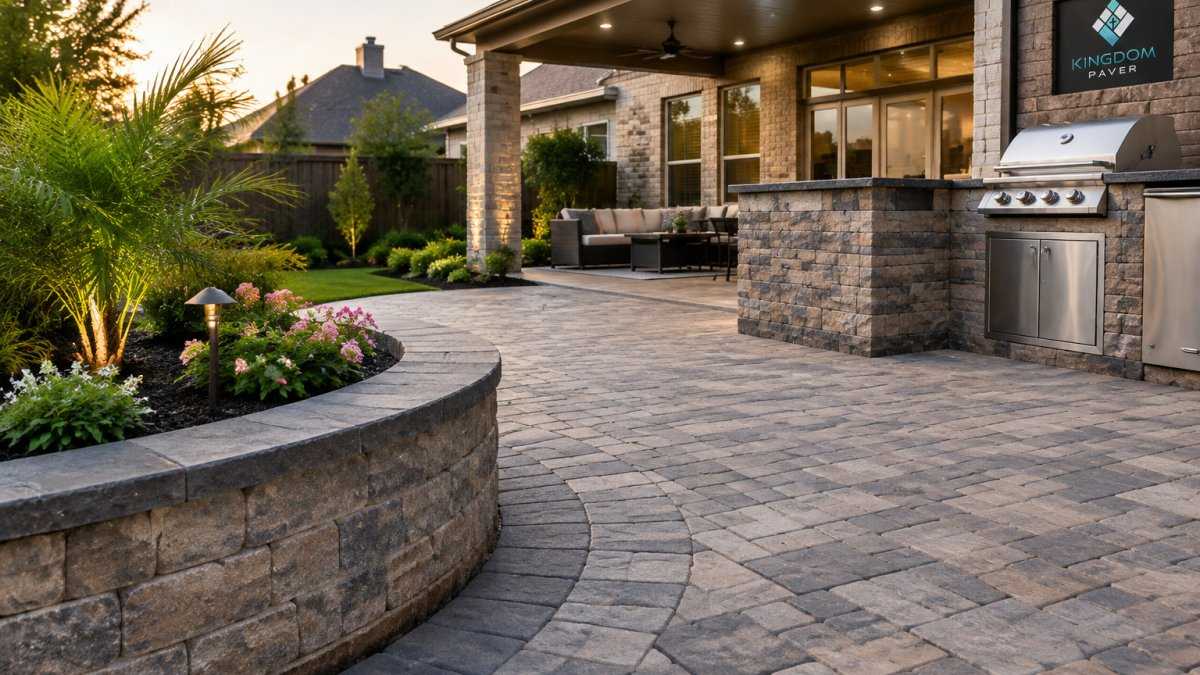
Professional hardscape installation is one of the few home improvements that can change how a property is priced, photographed and perceived before a buyer ever walks through the door. Kingdom Paver has spent a decade building patios, driveways, walkways and outdoor kitchens across Katy and Cypress, and the pattern is consistent: well-built outdoor surfaces make a yard look finished, and a finished yard sells.
The most cited figure comes from analysis of National Association of Realtors data, which suggests National Association of Realtors home value research that professional landscaping and hardscaping can increase home value by up to 15%. Other industry commentary puts the range at 15 to 20%. Treat both as directional. Neither figure isolates hardscape from the rest of the yard, and neither accounts for the local market your home sits in.
What the evidence supports more reliably is the downside. Poorly executed or neglected landscaping can decrease a home’s value by up to 10%, according to a U.S. Realtor study on landscaping and home value reported by Weller Brothers. A cracked, sunken or puddled patio does not just fail to add value. It actively signals deferred maintenance to a buyer’s inspector and appraiser.
Hardscape also affects how a home shows. Clean edges, level surfaces and defined outdoor rooms photograph well and read as usable square footage, which is why the surface you install often matters as much as its size.
Hardscape ROI for Homeowners: What the Numbers Show
Return on investment for hardscape is harder to pin down than the headline percentages suggest, because the cost side varies widely. Typical residential hardscape projects in the U.S. range from about $5,000 to $18,000, or roughly $5 to $25 per square foot, according to Task Masters residential hardscape budget guide. Where a project lands depends on materials, grading, base depth and access.
A simple way to frame the return is to compare the installed cost against the value it protects and adds:
| Factor | What to Check | Why It Matters |
|---|---|---|
| Installed cost | Quote per square foot, including base prep | Sets the baseline for any return |
| Appraisal effect | Whether the surface reads as finished | Drives perceived value at sale |
| Repair avoided | Cost of fixing cracks, heaving and drainage later | Recovers money you would otherwise spend |
| Usable area gained | Square footage you can actually use | Adds functional and marketing value |
The honest answer is that a well-executed surface tends to recover a meaningful share of its cost at sale, while a poor one can cost you more than it was worth. Ask any contractor, including us, for the specific scope and materials behind a quote rather than a single projected return.
Paver Patio Lifespan: Installation Quality Versus DIY
Lifespan is where installation quality becomes measurable. Professionally installed hardscapes can last 20 to 30 years or more, according to Kingdom Paver’s industry durability overview, while DIY installations often fail sooner because the work underneath the surface is rushed or skipped.

Most early failures trace back to the base, not the pavers. A compacted, properly graded base that drains water away from the structure carries the load for decades. A thin, uneven or poorly compacted base lets the surface settle, shift and crack within a few seasons. The pavers you see are the smallest part of the system.
DIY work can succeed, particularly on a small walkway with simple geometry. The difference shows up on larger patios, sloped sites and anything carrying vehicle weight. A professional crew brings the compaction equipment, the grading experience and the sequencing discipline that prevent the failures homeowners usually discover after the first wet winter.
Watch out: sinking pavers are usually a base problem, so resetting only the surface rarely fixes them. Ask whether the base will be excavated and rebuilt before accepting a repair quote.
Lifecycle Costs and Maintenance Over the Ownership Timeline
The cheapest installation is rarely the cheapest surface over twenty years. Lifecycle cost is the sum of the installation, the routine upkeep, and any repairs or full replacement along the way, spread across the years you own the home. Most top-ranking guides stop at that definition. The useful version breaks it into phases so you can compare bids on something more concrete than price per square foot.
Lifecycle costs generally fall into three buckets: installation (one-time), routine upkeep (annual), and repair or replacement (event-driven). The table below shows what each bucket typically contains and how the balance shifts over time.
| Ownership phase | Installation | Routine upkeep | Repair / replacement |
|---|---|---|---|
| Year 0-5 | Full installed cost, including base prep, compaction, edge restraint, and drainage | Annual cleaning, joint sand top-ups, occasional sealing if specified | Rare on a properly built surface; more common on a rushed base |
| Year 5-10 | Already sunk | Same routine items, plus resetting of any displaced units | Heaved or settled sections, cracked units, drainage corrections |
| Year 10-20 | Already sunk | Routine items continue; sealing intervals may shorten in freeze-thaw climates | Sectional rebuilds, base repairs, possible full replacement of a failed installation |
The key insight is that installation quality shifts cost between buckets. A properly built hardscape front-loads cost into the installation bucket and keeps the repair bucket small and predictable. A cheap installation does the opposite: it saves money up front and transfers the difference into unpredictable repairs later, often at a higher total.
A second pattern worth planning for is that routine upkeep is not optional if you want the surface to keep reading as finished. Joint sand washes out, organic matter settles into joints, and sealers wear. None of those are emergencies, but skipping them accelerates the repair bucket. Budget for upkeep as a line item rather than treating it as a surprise.
Watch out: a bid that quotes only the surface cost, pavers, labor, and maybe edge restraint, is hiding the base and drainage work that determines whether you pay once or three times. Ask for the base depth, compaction method, drainage plan, and warranty in writing before comparing totals.
When comparing bids, consider the full lifecycle picture rather than the quote alone.
Site Conditions That Decide Whether a Hardscape Lasts
Site conditions put real stress on any surface, and the ones that matter most are buried or invisible once the project is finished. Soil type determines how the base must be built. Grading determines where water travels. Drainage determines whether that water leaves the structure or pools against it.
The mechanism to understand is that hardscapes fail from the bottom up. Water is the primary agent. When water cannot drain away from the base, it saturates the soil underneath, softens it, and lets the base move. Movement shows up at the surface as settling, heaving, rocking units, and cracks.
Soil type changes how fast that happens. Clay-heavy soils hold water and expand and contract as moisture changes, which puts repeated stress on the base and edge restraint. Sandy or gravelly soils drain faster but can erode if water is concentrated.
Freeze-thaw cycles add a second mechanism. Water that stays in joints or under the surface expands when it freezes and pushes units apart, then contracts and leaves voids. Over repeated cycles, that loosens the surface and opens paths for more water. In climates with hard freezes, base depth, drainage, and joint management matter more, not less.
Sloped yards and recurring puddles are a drainage question first and a paving question second. Surface materials alone will not fix water that has nowhere to go. Expect a serious contractor to diagnose drainage before recommending a surface, and to explain in writing where water will go during a heavy rain.
Watch out: a contractor who quotes a surface without asking about soil, slope, and where water stands after a storm is guessing. Those three answers should drive the base specification, and the base specification should appear in your written scope.
Erosion and soil movement are the slow version of the same problem. A hardscape that sheds water correctly protects the soil around it. One that does not can wash out planting beds, undermine edges, and create the puddles that signal a failing installation.
How to Choose a Hardscape Contractor Who Protects Your Investment
Choosing the contractor matters more than choosing the material. Look for a company that will assess your site, explain its base and drainage method in writing, and tell you what its workmanship covers after completion. Ask for the warranty terms in writing so you can see what happens if a problem appears after the project is done, and compare those terms against any other bid.
Ask who will perform the work. Subcontracting is common in construction, so confirm who will be on your site.
Local experience can matter here. A contractor familiar with Katy and Cypress soil and rainfall can speak to which base specifications hold up. Compare contractors before deciding, especially if warranty service would require a company that is hard to reach.
Finally, ask for a written scope that lists base depth, compaction, edge restraint, drainage and sealing. A vague quote is a signal to keep looking.
Scheduling Your Hardscape Project in Katy or Cypress
Timing affects both the quality of the work and the time you spend without your outdoor space. Project durations depend on the size and complexity of the job, site access, and weather, so ask for a timeline tied to specific phases.
Plan around the season you actually want to use the yard. Installing before a summer of entertaining means booking early enough to absorb weather delays. Rain can halt base work and joint sanding, so build buffer into the schedule instead of assuming a clean run.
Your next step is to request a site assessment and a written, itemized proposal. You can [book a hardscape consultation | kingdompaver.com] to review your yard, drainage and goals, and get a scope you can compare against other bids. Kingdom Paver serves Katy and Cypress with patios, driveways, walkways, flowerbeds and custom outdoor kitchens. Contact Kingdom Paver through its website for current pricing or a quote for your specific project.
Frequently Asked Questions
Does professional hardscape installation increase home resale value?
Well-executed hardscaping can improve how buyers perceive a property, particularly curb appeal and usable outdoor space. Published estimates vary widely. Treat any single figure as an upper-end estimate rather than a guarantee. Value depends on the quality of the work, the condition of the rest of the property, and the local market. Poorly maintained or badly built features can also reduce appeal, so installation quality matters as much as the decision to add hardscape.
How long do professionally installed paver patios last?
Professionally installed hardscapes can last for many years. Lifespan depends on a properly compacted base, correct drainage, joint sand maintenance, and sealing where appropriate. Shortcuts in base preparation are the most common reason pavers settle, shift, or crack early. Ask any contractor what base depth and compaction method they use, and whether the warranty covers settling. Pricing depends on quantity, materials, dates, and delivery, so request a written quote from Kingdom Paver for current pricing.
How do I know a hardscape contractor will protect my investment?
Start by asking whether the company performs the work with its own crews or subcontracts it, since many homeowners have been left with unfinished projects after subcontracting. Request references you can contact, confirm the warranty terms in writing, and ask how drainage and grading are handled, especially on sloped lots. A clear written scope, a realistic schedule, and specific answers about base preparation are stronger signals than the number of online reviews alone.
Can pavers fix drainage problems on a sloped driveway?
Pavers alone do not solve drainage. Water pooling usually comes from grading, runoff direction, or missing drainage paths. A proper installation accounts for slope and sets the base and surface so that water is directed away from structures. Have the site evaluated before choosing materials, because a paver surface built over a poor grade will still hold water. Ask Kingdom Paver about assessing your specific slope and runoff before you finalize the design.


