
Last Updated: November 10, 2026
Quick Summary
Choose pavers for freeze thaw climates by looking for low water absorption, high density, and strong compressive strength, then verify those claims with test data. Concrete pavers tested to ASTM C936 or C1782 are a common option, and porcelain has very low absorption. Match thickness and base depth to the load, and protect the surface from deicing salt.
- Ask for the rated water absorption figure before buying, since less water means less to freeze.
- Request ASTM C936 or ASTM C1782 test documentation and confirm compliance in writing.
- Porcelain pavers absorb almost no water, which suits cold climates.
- Driveways need thicker pavers and a deeper aggregate base than walkways or patios.
- Use the smallest amount of deicer needed, avoid unlabeled products, and seal concrete regularly.
Table of Contents
- How Freeze-Thaw Cycles Damage Pavers
- Key Properties of Freeze-Thaw-Resistant Pavers
- Comparing Concrete, Porcelain, Natural Stone and Clay Brick
- Matching Paver Thickness and Base to Patios, Walkways and Driveways
- Choosing Permeable Pavers for Drainage and Water Management
- Applying Polymeric Sand Correctly in Cold-Climate Installations
- Protecting Pavers from Ice Melt Damage and Deicing Salt
- Booking Your Freeze-Thaw Paver Project with Kingdom Paver
- Frequently Asked Questions
How Freeze-Thaw Cycles Damage Pavers
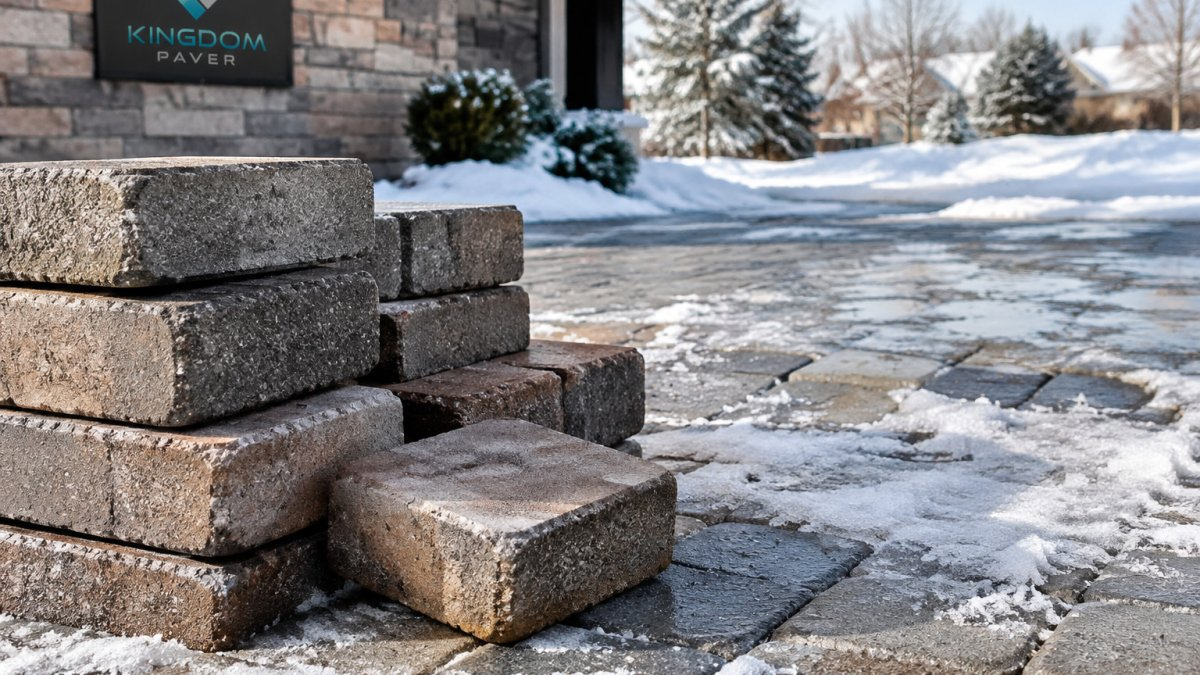
Freeze-thaw damage is the main reason pavers fail in cold climates. Water gets into small pores in the paver, freezes, expands, and pushes the surface apart from inside. Over many winters in freeze thaw climates, that pressure causes spalling, cracking, and heaving.
Dense, well-tested concrete pavers are generally better suited to handle this stress. Grounds Design’s 2026 hardscaping report notes that concrete pavers can withstand 70 or more freeze-thaw cycles per year (Grounds Design 2026 Hardscaping Statistics report). The real question is which paver you buy, because quality varies a lot between products.
Watch out: a paver that looks solid can still absorb water. Water absorption, not appearance, decides how well it survives winter.
Key Properties of Freeze-Thaw-Resistant Pavers
Look for three properties: low water absorption, high density, and strong compressive strength. A paver that takes in less water has less to freeze, so there is less damage to cause.
Industry guidance supports this. A Interlocking Concrete Pavement Institute guidance on freeze-thaw performance ties paver durability to material testing rather than surface finish.
Water Absorption and Material Density
Water absorption is the best quick test you can run on a product. Ask for the rated absorption figure before you buy.
- Lower absorption means less freezing water inside the paver
- Denser material resists the expansion that breaks surfaces apart
- Porcelain pavers are often cited for very low absorption, which suits cold climates
Porcelain pavers absorb almost no water, which helps prevent the expansion and contraction damage common in other materials (NT Pavers guidance on porcelain pavers).
Verifying ASTM C936 and C1782 Compliance
Ask your supplier for test documentation. The two standards to look for are ASTM C936 for concrete interlocking pavers and ASTM C1782 for segmental paving slabs. Rochester Concrete Products reports that buyers now prioritize materials tested to these standards (Rochester Concrete Products paver standards overview).
Confirm the product meets the standard in writing. A claim on a sales sheet is not the same as a tested result.
Comparing Concrete, Porcelain, Natural Stone and Clay Brick
Material choice sets the ceiling for freeze-thaw performance, but the labels on a sales floor rarely tell you enough to compare options. The useful comparison comes from four measurable properties: water absorption, compressive strength, thickness, and the freeze-thaw test result the manufacturer reports. Each one tells you something different, so read them together.
Water absorption is the percentage of the paver’s dry weight that it takes in when soaked. A lower number means less water available to freeze inside the unit. Porcelain typically sits at the lowest end of the range, while concrete and natural stone vary widely by formulation and source. Clay brick can be very low when it is fired to a high grade, but a low-grade brick may absorb far more.
Compressive strength matters because a paver that cracks under load will also crack under frost heave. Concrete pavers are usually specified by a minimum strength in pounds per square inch, and you should confirm that figure on the product data sheet rather than assuming it. Thickness works alongside strength: a thicker unit spreads load and tolerates more movement in the base, which is why driveway products are usually heavier than patio products.
Freeze-thaw ratings are where most buyers get confused. A rating usually comes from a laboratory test in which saturated samples are cycled between freezing and thawing, and the result is reported as surface loss or the number of cycles survived before a defined level of damage. Ask what test method and exit criterion the rating uses. A rating from one method cannot be compared directly with a rating from another.
Here is how the materials compare on the properties that matter most:
| Material | Typical Water Absorption | Strength Range | Freeze-Thaw Documentation | Main Risk |
|---|---|---|---|---|
| Concrete | Moderate, depends on mix | Specified by product | Request ASTM C936 or C1782 test data | Surface scaling if unsealed |
| Porcelain | Very low | Typically high | Request manufacturer test report | Higher material cost |
| Natural stone | Varies widely by stone and quarry | Varies widely | Often limited; request test samples | Inconsistency between batches |
| Clay brick | Low only when high-grade | Depends on firing grade | Confirm freeze-thaw grade in writing | Low-grade units can spall |
Read the table as a starting point, not a verdict. A concrete paver with documented low absorption and a tested freeze-thaw result can outperform an untested natural stone. Always check the rating for the exact product you plan to buy, not the material category.
Matching Paver Thickness and Base to Patios, Walkways and Driveways
Thickness and base depth should match the load. A walkway carries foot traffic, a patio carries furniture and grills, and a driveway carries vehicles. Each needs a different setup.

- Walkways and patios: thinner pavers on a compacted base
- Driveways: thicker pavers and a deeper aggregate base
A crew member compacting a gravel base is the step that most often gets skipped. A weak base causes settling, and settling leads to cracks and heaving after freeze-thaw cycles.
Choosing Permeable Pavers for Drainage and Water Management
Standing water is one of the fastest ways to damage pavers in winter. Permeable pavers let water drain through the surface into the base, which reduces ice buildup and frost pressure in freeze thaw climates.
Slope also matters. Water should move away from the house and off the paved area. If your driveway already pools water, a permeable system and proper grading can solve part of the problem, but a drainage survey is the right first step.
Applying Polymeric Sand Correctly in Cold-Climate Installations
Polymeric sand locks the joints between pavers and resists washout. Apply it dry, sweep it into the joints, and mist it according to the manufacturer’s instructions. Joints that are not fully filled let water and weeds in, and that water can freeze under the surface.
Check the joints after the first few rains and top up any low spots.
Protecting Pavers from Ice Melt Damage and Deicing Salt
Deicing chemicals are one of the most common causes of surface damage on paved areas in cold climates, and the damage is often blamed on freezing alone. Salt lowers the freezing point of water, so brine stays liquid longer and soaks into the pores of the paver. When that brine freezes again, the crystal growth at or near the surface can lift thin layers off the face of the unit. This is called scaling, and it is most visible on concrete that was not sealed or was sealed poorly.
Different salts behave differently. Sodium chloride is the most common and is aggressive on unsealed concrete. Calcium chloride releases heat as it dissolves and works at lower temperatures, but it can also be harsh on surfaces when used heavily. Magnesium chloride is often described as gentler on concrete, though it is not harmless. Read the product label and avoid any product that does not state what it contains. Use the smallest amount that gives the traction you need, and spread it evenly rather than piling it in one spot.
Snow removal tools cause a second kind of damage. Metal shovel edges and steel plow blades chip the top edges of pavers and scrape off sealer. Use a plastic-edged shovel, set plow blades a little above the surface, and keep the blade moving rather than digging into joints. Where a plow runs regularly, ask the operator to adjust the blade height in writing.
Sealing reduces how much salt brine a paver absorbs, which slows scaling. Choose a penetrating sealer for most concrete pavers, since it protects the material without changing its look, and reapply it according to the manufacturer’s schedule rather than waiting for visible wear. A film-forming sealer can trap moisture if applied to a surface that is not dry, so follow the surface preparation steps on the label.
Watch out: if a paver flakes after the first winter with salt, the usual cause is a combination of unsealed surface and aggressive product, not a single defective unit. Check the label on your deicer and the sealing history of the area before you assume the paver itself failed.
Booking Your Freeze-Thaw Paver Project with Kingdom Paver
Kingdom Paver has ten years of experience building patios, driveways, walkways, and custom outdoor kitchens in Katy and Cypress.
Pricing depends on quantity, dates, and delivery, so contact Kingdom Paver through the website for current prices or a quote.
Frequently Asked Questions
What type of pavers are best for cold climates?
Dense concrete pavers and porcelain pavers are the most commonly recommended options for cold climates because both absorb very little water. Industry guidance emphasizes low water absorption, since moisture that soaks into a paver expands when it freezes and can cause spalling or cracking. Look for products tested to ASTM C936 for concrete pavers or ASTM C1782 for segmental paving slabs, and ask your installer for the test results before you buy.
When should you not use polymeric sand?
Avoid polymeric sand in joints where the installation will not stay dry enough for the polymers to cure properly, such as areas with persistent standing water or poor drainage. It also should not be applied before rain is forecast or in temperatures outside the manufacturer’s recommended range. In those conditions the sand can haze the paver surface or fail to harden, so plan the joint filling for a dry, mild stretch of weather.
What type of ice melt doesn’t damage pavers?
Calcium chloride and magnesium chloride are generally considered gentler on concrete pavers than sodium chloride, which is ordinary rock salt, but every deicer can contribute to surface scaling if used heavily. Use the smallest amount that works, avoid spreading it over freshly sealed or newly installed pavers, and rinse residue away when the thaw comes. Check the product label for paver compatibility before applying it.
Do permeable pavers perform better in freeze-thaw conditions?
Permeable pavers manage water well because they let meltwater drain through the joints and into the base instead of pooling on the surface, which reduces the freeze-thaw damage that surface water causes. Their performance still depends on a properly graded open-graded base and correct installation. Ask any contractor to show how the base will drain before assuming permeable pavers will solve a freezing problem.


