
Table of Contents
- How to Repair Erosion Along Driveway Edges: Where Do You Start?
- Diagnosing Surface-Edge Washout Versus Erosion Beneath a Slab
- Tools and Materials You Need for an Edge Repair
- Step-by-Step: How to Fix Erosion Under Concrete Driveway Edges
- Gravel Driveway Erosion Control: Water Bars, Drainage, and Stone
- How to Keep a Gravel Driveway From Washing Away Over Time
- When Edge Erosion Needs a Professional Assessment
- Scheduling Your Driveway Edge Repair With Kingdom Paver
- Frequently Asked Questions
Last Updated: November 26, 2026
How to Repair Erosion Along Driveway Edges: Where Do You Start?
Erosion along a driveway edge usually starts with water, not the concrete or gravel itself, so learning how to repair erosion along driveway edges begins with understanding the water.
Here’s the catch. Many homeowners go straight to dumping gravel into the washed-out spot. Adding stone to a washed-out spot is often a temporary fix that does not address the water causing the erosion.
So the real goal is to slow the water down and send it somewhere safe. Once you do that, the repair holds.
Diagnosing Surface-Edge Washout Versus Erosion Beneath a Slab
Not all edge erosion is the same, and the fix depends on which type you have. Start by looking closely at the damage.
- Surface-edge washout: Soil or gravel has been pulled away along the outer edge. The concrete or pavers still look solid from above.
- Erosion beneath a slab: The edge feels hollow when you step near it, or you see cracks, dips, or a sunken lip. Soil has washed out from under the concrete.
Surface washout is usually the easier fix. Erosion under a slab is more serious because the concrete can crack or drop if the support underneath is gone.
Watch out: If the slab rocks or sinks when you step on it, stop digging near the edge. Undermined concrete can break under your weight.
Tools and Materials You Need for an Edge Repair
Most edge repairs need basic tools and a few materials you can pick up at a home supply store.
- Shovel and flat spade
- Garden rake
- Tamper or hand compactor
- Work gloves and safety glasses
- Wheelbarrow
- Level or string line
- Crushed stone or larger angular stone
- Native soil or compactable fill
- Landscape fabric (optional, to slow soil migration)
Pricing for stone and fill depends on quantity, delivery, and your local supplier, so call ahead for current numbers. For current prices or a quote on a larger job, visit the Kingdom Paver website.
Step-by-Step: How to Fix Erosion Under Concrete Driveway Edges
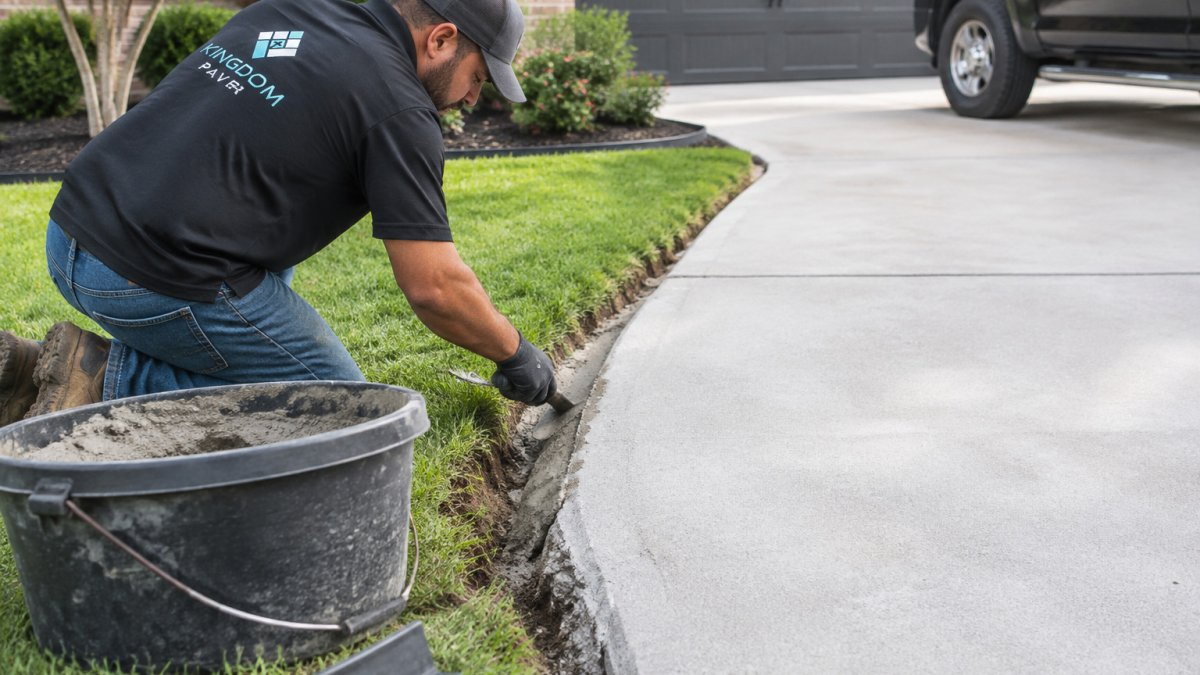
Concrete and asphalt edges often fail when water runs off the slab, drops onto bare soil at the edge, and scours a channel.

Before you dig, check three things. First, confirm the slab is not undermined. Tap the edge with a hammer or the handle of a shovel. Second, call 811 before any digging deeper than 12 inches; buried utilities frequently run along driveway edges. Third, note the slope.
Materials and quantities. For a washout 10 feet long, 12 inches wide, and 6 inches deep, you need roughly 0.2 cubic yards of compactable fill and about 0.1 cubic yards of angular stone. A cubic yard of crushed stone weighs about 1.35 tons, so a 10-foot repair typically calls for two to three 5-gallon buckets of stone, not a full pallet. Buy angular stone in the 3/4-inch to 1-inch range; rounded river rock rolls out of the channel under runoff. For fill, use a granular base material such as crushed stone base or engineered fill, not topsoil, which compacts poorly and shrinks when wet.
- Clear the area. Remove loose debris, mud, and any broken concrete or asphalt fragments along the edge. Cut back any turf that overhangs the washout so you can see the full depth.
- Measure the damage. Record length, width, and depth at the deepest point. Multiply length × width × depth in feet, then divide by 27 to get cubic yards. Add 15 percent for compaction loss.
- Redirect the water first. Before filling, cut a shallow swale (a broad, shallow ditch) along the edge that slopes away from the slab at roughly 2 percent, about 1/4 inch per foot. If the slab sits at the bottom of a slope, a 4-inch perforated drain pipe wrapped in filter fabric and bedded in gravel, daylighting to a safe outlet, moves water without surface erosion.
- Fill in layers. Add compactable fill in lifts of no more than 2 inches. Compact each lift with a hand tamper or plate compactor until it stops settling, typically 8 to 10 passes with a hand tamper. Overfilling in one lift is the most common cause of a repair that sinks within a season.
- Add larger angular stone at the edge. Place a 4- to 6-inch-wide band of 3/4-inch to 1-inch crushed angular stone along the slab edge, flush with the surrounding grade. This band absorbs runoff energy and locks together instead of washing out.
- Check the slope. After compaction, lay a straightedge or string line across the repaired area. The finished surface should fall away from the slab at about 2 percent. Water that ponds against the slab will find the same seam and reopen the washout.
- Inspect after the next heavy rain. Look for new channels, soft spots, or settling along the repair. A repair that fails after one storm usually means the drainage step was skipped or the outlet is blocked.
Watch out: If the slab rocks or sinks when you step on it, or if the washout extends more than 12 inches under the slab, stop.
The table below summarises the main steps for fixing erosion under concrete driveway edges, along with the key quantities and specs the article gives.
| Step | What to do | Key detail |
|---|---|---|
| 1. Check first | Tap edge; call 811 before digging deeper than 12 inches | Hollow ring means undermining |
| 2. Clear area | Remove debris and broken fragments | Cut back overhanging turf |
| 3. Measure damage | Multiply length × width × depth, divide by 27 | Add 15 percent for compaction loss |
| 4. Redirect water | Cut swale sloping about 2 percent away from slab | About 1/4 inch per foot |
| 5. Fill in layers | Compact lifts of no more than 2 inches | Typically 8 to 10 hand-tamper passes |
| 6. Add edge stone | Place 4 to 6 inch band of 3/4 to 1 inch angular stone | Flush with surrounding grade |
| 7. Check slope | Lay straightedge or string line across repair | Fall of about 2 percent |
| 8. Inspect after rain | Look for channels, soft spots or settling | Failure usually means skipped drainage |
Gravel Driveway Erosion Control: Water Bars, Drainage, and Stone
Gravel edges erode because loose stone has no cohesion. Every rain event moves fine particles downhill, and the edge is where the water exits.
Water bars are low ridges set across the driveway at an angle to divert runoff off the surface.
Side ditches and outlets. A water bar only works if the water it diverts has somewhere to go.
Stone sizing at the edge. Use 3/4-inch to 1-inch crushed angular stone for the edge band, not pea gravel or river rock.
Downspouts. A roof downspout that discharges within 10 feet of a gravel driveway edge delivers concentrated flow that will cut a channel in one season. Extend the downspout to a splash block or buried drain line that discharges at least 10 feet from the driveway and slopes away from the foundation.
Installing Water Bars for Gravel Driveways
- Pick a spot on the slope where runoff naturally collects, usually just above a steep section or where the driveway curves.
- Dig a shallow trench across the driveway at about 30 degrees to the centerline.
- Pile the removed soil into a ridge on the downhill side, 6 to 8 inches high.
- Pack the ridge firmly and cover the uphill face with angular stone.
- Tie the bar into the side ditch so diverted water has a clear path to the outlet.
- Space additional bars every 10 to 30 feet depending on grade, and inspect them after every heavy rain.
Watch out: Installing water bars straight across instead of at an angle, or failing to connect them to a ditch with a real outlet, just moves the erosion problem a few feet downhill. Water that pools at the end of a water bar will saturate the driveway base and create a soft spot that fails under vehicle weight.
How to Keep a Gravel Driveway From Washing Away Over Time
Prevention matters more than repair. A gravel driveway that’s maintained regularly will last far longer than one you only fix after damage shows up.
- Regrade the surface every few months to keep it level and sloped toward drainage.
- Top up thin spots before they turn into ruts.
- Clear out ditches and culverts so water can flow freely.
- Use larger angular stone at the edges, not just fine gravel.
- Plant ground cover along bare banks to hold the soil in place.
Keep an eye on problem areas after heavy storms. Small channels are easy to fix. Deep ones usually mean the drainage underneath needs work.
When Edge Erosion Needs a Professional Assessment
Some repairs are worth handing off to a pro. Call for help if you notice any of these:
- The concrete slab is cracked, sunken, or shifting underfoot.
- Erosion runs more than a few feet along the driveway or reaches deep under the edge.
- Water pools on the driveway or runs toward your home’s foundation.
- The slope is steep enough that you can’t safely work on it.
- The same spot keeps washing out even after you’ve added fill and stone.
A professional can measure the slope, design the drainage, and handle heavy compaction. Our driveway drainage repair guide covers fixing pools and slopes if you want to see what that work involves. That’s the kind of work that’s hard to do well on a weekend. Kingdom Paver offers custom building solutions for homeowners in Katy and Cypress, and you can get current pricing by visiting the Kingdom Paver website for a quote.
Scheduling Your Driveway Edge Repair With Kingdom Paver
If you’d rather not handle the repair yourself, Kingdom Paver can assess your driveway and recommend the right fix. Kingdom Paver has a decade of experience building patios, driveways, walkways, and outdoor living spaces for homeowners in Katy and Cypress.
Start by visiting the Kingdom Paver website to request a quote. Tell us where you’re seeing erosion, how long it’s been happening, and whether water pools after rain. That information helps us plan the right repair before we ever touch the driveway.
Frequently Asked Questions
How do you fix erosion under a concrete driveway?
Erosion under a concrete driveway usually means water has washed soil out from beneath the slab, leaving voids that can crack or sink the concrete. Start by finding where the water enters and exits, then redirect runoff with a crosspipe or a shallow swale so it stops flowing under the slab. Once the water is controlled, fill the voids with compacted stone or a flowable fill material, working in lifts so the base stays firm. If the slab is already cracked, sunken or hollow-sounding when tapped, a professional assessment is the safer next step before you try to lift or pour anything.
How do you keep a gravel driveway from washing away?
A gravel driveway keeps its shape when loose stone is locked in place and water is moved off the surface quickly. Use larger angular crushed stone at the edges, because it interlocks better than round gravel and resists being pushed out by runoff. Add water bars or crowned grading so rain leaves the surface before it gathers speed, and keep ditches and culverts clear. Top up thin spots after heavy storms, since a driveway that loses its base layer washes out much faster than one with a full depth of stone.
What are water bars for a gravel driveway?
Water bars are shallow diagonal ridges or trenches built across a gravel driveway that break up the flow of runoff and divert it to the side. They are most useful on sloped sections where water would otherwise run down the center and carry stone away. A typical installation uses compacted soil or stone set at a slight angle, with an outlet on the lower side that releases the water onto stable ground or into a drainage channel. Check water bars after each major rain, because they can silt up and need to be cleared to keep working.
How can you prevent erosion on a sloped driveway?
On a sloped driveway, the goal is to slow runoff and keep it from concentrating along one edge. Install water bars or crosspipes at intervals so water cannot build momentum, and grade the surface so it sheds toward a planned outlet rather than the driveway edge. Plant ground cover or set edging stone along the slope to hold soil in place. If the slope is steep or water pools at the bottom, consult a professional before the washout becomes a larger structural problem.


