
Last Updated: November 24, 2026
Quick Summary
You choose the right landscaping gravel by matching stone size, stone shape, and drainage to the job, and treating color as the last decision. Pea gravel suits sitting areas and playgrounds, crushed angular stone holds driveways and paths, and larger grades handle drainage and fill.
- Angular crushed stone interlocks under compaction, while rounded stone slides and never truly locks.
- Number 57 stone runs from roughly a quarter inch up to about an inch with no fines.
- Excavate 4 to 6 inches of compacted base plus 2 to 3 inches of surface gravel for a walkway.
- Grade subsoil at roughly a 2 percent slope, about a quarter inch of fall per foot.
- Spread base material in lifts no deeper than 2 to 3 inches and compact each one.
Table of Contents
- How Do You Choose the Right Gravel for Landscaping?
- Start With the Job, Not the Color
- Landscaping Gravel Sizes and What Each One Does
- Pea Gravel: Smooth Underfoot, Tricky on Slopes
- Rounded vs. Angular Stone: Shape Decides Stability
- The Cheapest Gravel for Landscaping (and Where It Falls Short)
- The Best Gravel for a Backyard With Dogs
- Drainage, Base Layers, and Edging That Keep Gravel in Place
- Matching Gravel Color to Your Home and Hardscape
- Frequently Asked Questions
How Do You Choose the Right Gravel for Landscaping?
You choose the right gravel for landscaping by matching three things to the job: stone size, stone shape, and how the surface will drain. Color comes last. Get those three right and the material lasts for years; get them wrong and you will be re-raking a rutted mess every spring.
Gravel questions come up often in the planning stage of outdoor projects, and the same three decisions usually determine how well a surface performs. Many homeowners start with a color swatch, but outcomes tend to be better when the use case comes first.
Here is the short version: pea gravel suits sitting areas and playgrounds, crushed angular stone holds driveways and paths, and larger grades handle drainage and fill.
Start With the Job, Not the Color
The single most common mistake is picking gravel by appearance and then discovering it will not stay put. A smooth round stone looks great in a bag and behaves badly under a car tire or on a slope.
Work through four questions before you look at a single sample:
- What travels over it? Foot traffic, pets, bicycles, and vehicles each demand a different stone.
- How steep is the ground? Anything with pitch pushes round stone downhill.
- Where does water go? Gravel is a drainage surface, not a dam.
- How will you edge it? Loose stone needs a hard border or it migrates into the lawn.
If you are still weighing gravel against pavers, concrete, or flagstone for a patio, our guide to the best materials for backyard patios lays out the trade-offs side by side before you commit to a surface.
Landscaping Gravel Sizes and What Each One Does
Landscaping gravel sizes run from fine screenings under a quarter inch up to large decorative rock several inches across, and the size you pick controls stability, drainage, and comfort underfoot.

Most suppliers describe size with a gradation number rather than a measurement. That number tells you the range of particle sizes in the load, not one uniform stone.
Reading Gradation Numbers Like 57 and 67
A gradation number describes how the stone is screened, and it is the detail most homeowners skip. Number 57 stone, for example, is a blend that runs from roughly a quarter inch up to about an inch, with no fines mixed in.
Number 67 runs slightly larger at the top end and is common for drainage and decorative beds.
Gravel size controls stability, drainage, and comfort, and suppliers usually describe it with a gradation number rather than a measurement.
| Gradation | Size range | Best for |
|---|---|---|
| Number 57 | Roughly a quarter inch up to about an inch, no fines | Driveways and base layers |
| Number 67 | Slightly larger at the top end | Drainage and decorative beds |
| Fine screenings | Under a quarter inch | Not stated in article |
| Large decorative rock | Several inches across | Not stated in article |
Pea Gravel: Smooth Underfoot, Tricky on Slopes
Pea gravel is small, rounded stone roughly the size of a pea, and it is the most comfortable landscaping gravel to walk on barefoot.
The catch is stability. Round stone rolls. On any grade steeper than gentle, pea gravel migrates downhill with rain and foot traffic, and it will not lock together under a wheel. It also tracks indoors on shoes and pet paws.
Pea gravel generally works best on level sitting areas, decorative borders, and paths with firm edging. If your walkway plan includes curves and a slope, our custom walkway design and build guide covers the edging and base details that keep loose stone where you put it.
Rounded vs. Angular Stone: Shape Decides Stability
Stone shape decides whether a gravel surface stays put, and it matters more than size.
That is the whole argument in one line: angular for anything structural, rounded for anything decorative or barefoot.
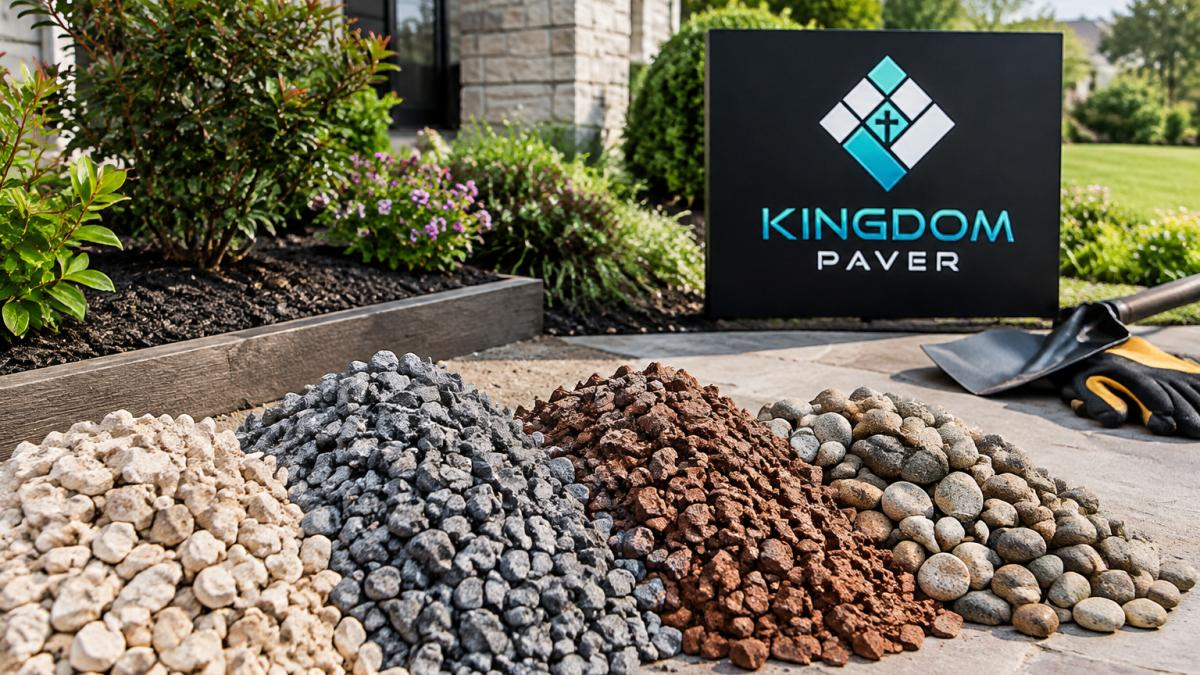
A few practical notes on common landscaping gravel types:
- Crushed stone is the default for driveways, path bases, and high-traffic areas because compaction binds it.
- River gravel looks natural in dry creek beds and pond edges where nothing rolls over it.
- Decomposed granite packs into a firm, almost concrete-like surface and suits paths, though it can be dusty.
- Marble chips and lava rock are decorative choices, not structural ones.
What most guides miss is that mixing shapes in one bed causes problems. The round stone works its way to the surface over time and the surface loosens.
The Cheapest Gravel for Landscaping (and Where It Falls Short)
Crushed stone and quarry screenings are often less expensive per ton than decorative stone, because they are commonly produced as byproducts rather than selected for appearance. Cheap does not mean wrong, it means the material is doing a job, not winning a beauty contest.
Estimate Quantity Before You Compare Prices
Price per ton only means something once you know how many tons you need. Gravel is sold by weight, and the coverage depends on depth and stone density. Rounded decorative stone covers somewhat less per ton because it packs less densely.
Bulk Versus Bagged
Bagged gravel suits small beds and touch-ups, while bulk delivery is usually more practical for larger areas. Delivery fees and minimum order sizes vary by supplier, so ask for the delivered price when comparing options.
Where the Cheap Route Falls Short
Crushed limestone or recycled concrete makes an excellent base under a patio or driveway extension, where nobody sees it. The savings evaporate if you use bargain stone as a visible surface and then pay to top-dress it later because it looks flat. Two honest limits:
- Color range is narrow. Base-grade crushed stone comes in whatever the local quarry produces.
- Fines create dust and mud. Material with a high fines content packs hard but turns messy when wet.
If the goal is replacing lawn with something lower-maintenance, our piece on alternatives to grass for backyard landscaping compares gravel against other groundcovers on cost and upkeep.
The Best Gravel for a Backyard With Dogs
The best gravel for a backyard with dogs is a smooth, medium-grade rounded stone with a firm edging, laid over a stable base.
Comfort is the first filter. Pea gravel and small river rock feel good under a running dog.
Drainage is the second filter.
Watch out: avoid large jagged decorative rock in pet areas. It is hard on paws and nearly impossible to rake clean.
Drainage, Base Layers, and Edging That Keep Gravel in Place
Gravel stays in place when it sits on a properly graded, compacted base and is held by a rigid edge. Skip either one and the surface ruts, spreads, and migrates within a season. The build order is not negotiable, and the details below are where most DIY gravel jobs go wrong.
Step 1: Excavate to Full Depth
Dig out the combined depth of base, bedding, and surface stone, typically 4 to 6 inches of compacted base plus 2 to 3 inches of surface gravel for a walkway, and 6 to 8 inches of base plus 3 to 4 inches of surface for a driveway. Excavating only for the visible stone is the single most common cause of a gravel surface that sinks and ruts.
Watch out: tree roots and buried utilities can complicate excavation. Call 811 before you dig and keep the base at least a few feet from established trunks.
Step 2: Grade the Subsoil for Water
Shape the exposed subsoil so water flows away from the house, patio, and driveway at roughly a 2 percent slope, about a quarter inch of fall per foot. Flat subgrade traps water under the base, and no amount of gravel on top will fix it. If your ground holds water, our guide to driveway drainage for clay soil explains what actually moves water in heavy soil.
Step 3: Lay and Compact the Base in Lifts
Use a crushed angular base material such as #57 or a graded crushed stone with fines, and spread it in lifts no deeper than 2 to 3 inches. Compact each lift with a plate compactor or vibratory roller before adding the next. Compacting a single thick layer leaves loose material at the bottom that settles later. A common pattern is to water the base lightly before compaction so the fines bind.
Step 4: Set Rigid Edging
Loose stone needs a hard border. Common options are steel edging pinned into the base, aluminum edging for curves, and mortared stone or concrete curbs for driveways. Edging should sit flush with or slightly below the finished gravel surface and be anchored into the compacted base, not just pressed into topsoil. Flexible plastic edging alone rarely holds on slopes or under vehicle traffic.
Step 5: Spread and Compact the Surface Stone
Spread the surface gravel to its finished depth, rake it to the intended slope, and compact it lightly. For angular crushed stone, compaction locks the particles together; for rounded stone, compaction only settles it, which is why round gravel needs edging and a level site to perform. Keep the finished surface about an inch below adjacent pavement or lawn so stone does not spill onto hardscape.
Diagnosing a Failing Surface
If an existing gravel area is already draining poorly or rutting, the cause is usually a missing base, a flat subgrade, or failed edging rather than the stone itself. The signs of poor patio drainage and how to fix them will help you diagnose it before you add more stone.
Matching Gravel Color to Your Home and Hardscape
Color is the last decision, not the first, and it should tie the gravel to the materials already on the property.
Order samples and view them wet and dry, in the actual light of your yard.
Gravel is only as good as the base beneath it, and that is the part most homeowners cannot see.
Kingdom Paver serves the Katy and Cypress areas with patios, walkways, driveways, and custom outdoor living builds.
Frequently Asked Questions
What type of gravel is best for landscaping?
There is no single best type, because the right landscaping gravel depends on where it goes. Angular crushed stone locks together and holds up on driveways and high-traffic paths. Pea gravel and river rock feel better underfoot around patios and flowerbeds but shift on slopes. Decomposed granite compacts into a firm, smooth surface for walkways. Match the stone to the load it carries and how often people walk on it, then pick a color that suits your home.
Is 3/8-inch or 3/4-inch gravel better for a driveway?
For a driveway, 3/4-inch crushed stone is usually the better base because the larger pieces interlock and resist shifting under vehicle weight. A 3/8-inch stone can work as a top dressing over a compacted base, giving a smoother finish, but it alone will not carry a car without rutting. Many driveways use both: 3/4-inch stone for the base layer and a smaller angular stone on top.
Can I just put gravel over dirt?
You can, but it usually fails within a season. Gravel spread straight onto soil sinks as the ground shifts, and weeds push through within weeks. A proper install removes the top few inches of soil, lays a compacted base, and adds edging to hold the stone in place. A woven landscape fabric under decorative gravel slows weed growth. Skipping these steps is the most common reason gravel paths turn into a muddy mess.
What gravel is easiest to walk on?
Pea gravel and decomposed granite are the most comfortable underfoot. Pea gravel has smooth, rounded stones that feel soft through thin soles, though it shifts on slopes and is hard to push a wheelchair or stroller across. Decomposed granite compacts into a firm, stable surface that stays smooth and is easier for wheels and aging knees. For a backyard path used daily, decomposed granite is often the more practical choice.


