Regrading a residential driveway typically costs about $8.42 to $10.80 per square foot as of May 2026, though the surface type and drainage needs can move the total substantially. Gravel is the cheapest to regrade driveway surfaces, while concrete is the most expensive. Address drainage before any surface work begins.
Basic driveway grading runs about $8.42 to $10.80 per square foot as of May 2026.
Gravel regrading costs roughly $3 to $7 per square foot.
Asphalt regrading costs roughly $9 to $16 per square foot.
Concrete regrading costs roughly $14 to $25 per square foot.
Measure the widest points of your driveway to get an accurate square footage.
Is your driveway pooling water?Kingdom Paver regrades driveways in Katy and Cypress with drainage-first assessments.
How Much Does It Cost to Regrade a Residential Driveway?
The final cost of regrading a driveway depends on how you plan to regrade driveway surfaces on your property. Most of that spread depends on how far the surface must be reshaped and whether drainage problems need to be fixed first. Kingdom Paver serves homeowners across Katy and Cypress, and the price you pay depends on the specific slope, soil, and water flow on your property.
Expect a rough range before you get a quote, but treat it as a starting point. Angi’s driveway regrading cost estimate for a 640-square-foot, two-car driveway notes that drainage issues should be addressed before any surface work begins. Ignoring that step often means paying twice, once for the regrade and again when water starts pooling in the same spots.
Kingdom Paver evaluates the grade, the drainage path, and the surface condition before recommending a scope. That assessment is what turns a broad price range into an accurate number for your driveway.
Cost to Regrade a Residential Driveway Per Square Foot
A basic driveway grading service runs about $8.42 to $10.80 per square foot as of May 2026, according to Homewyse’s driveway grading cost guide. That blended rate is a starting point, but the surface you are regrading changes the number substantially, and most published ranges never break it out. Here is how the work and the price differ by surface type.
Driveway surface
Typical regrading scope
Practical per-square-foot range
Gravel
Scarify, reshape, add and compact new aggregate
$3 to $7
Asphalt
Mill or lift edges, correct base, patch and re-seal
$9 to $16
Concrete
Saw-cut, lift or remove slabs, regrade base, repour
$14 to $25
Practical per-square-foot range
Gravel $3 to $7
Asphalt $9 to $16
Concrete $14 to $25
Gravel is the cheapest to regrade because the surface is loose and can be reworked with a box blade or skid steer rather than cut and replaced. Asphalt sits in the middle: the base can often be corrected, but the edges usually need milling and the surface needs patching and re-sealing afterward. Concrete is the most expensive because correcting the grade almost always means cutting out and repouring at least part of the slab, and the removed concrete has to be hauled off.
How to measure your driveway area
Per-square-foot pricing only works if you measure accurately. Measure the length and width in feet at the widest points, then multiply to get square footage. A driveway 20 feet wide and 32 feet long covers 640 square feet.
Most driveways are not perfect rectangles, so break an irregular shape into smaller rectangles, measure each one, and add the results. For a driveway that widens into a turnaround or parking pad, measure the main run and the pad separately. If the driveway slopes, measure the horizontal footprint rather than the distance along the slope, contractors price the area they have to work, not the surface distance you walk.
Watch out: measuring at the narrowest point instead of the widest understates the area and can make a bid look cheaper than it will be once the contractor measures on site.
Using the rate to compare bids
Per-square-foot figures are most useful when every contractor quotes in the same units. Ask each bidder to state the measured area, the rate applied, and whether the quote includes material hauling, fill, compaction, and any drainage correction. A bid that quotes a lump sum without an area and rate is hard to compare against one that does, and the difference between two bids is often a missing line item rather than a better price.
Factors That Change the Price of Driveway Regrading
Several variables push a regrading project toward the low or high end of the range. The biggest is the existing slope. A driveway that needs only a small correction costs far less than one that must be rebuilt to direct water away from the house.
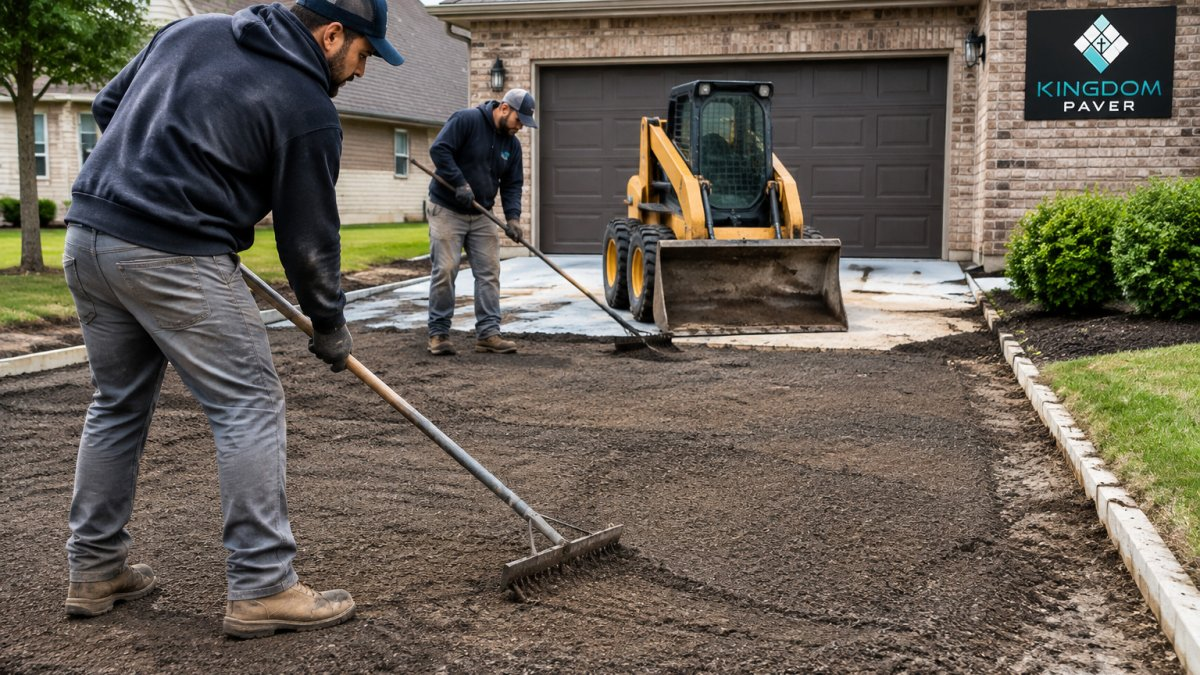
Worker using a rake on a residential driveway that needs a regrade driveway service to fix drainage issues.
Drainage is the next major factor. When water pools in a low spot, the fix may involve adding fill, installing a drain, or regrading the surrounding yard, and each of those adds labor and material. Our guide anchor: Driveway Drainage Repair: Fix Pools and Slopes explains what drainage repair involves and when it becomes necessary.
Access and site conditions also matter. Tight spaces, heavy equipment limits, and soil that needs replacing all raise labor costs. Some homeowners look at cheaper fixes first, and anchor: 7 Ways to Improve Driveway Drainage Without Regrading covers options that may solve a pooling problem without a full regrade.
Driveway Grading Cost Calculator: Estimating Your Project Budget
A simple budget starts with area and rate, then adds allowances for the work that per-square-foot pricing leaves out. Build it in four steps: measure the area, apply a surface-specific rate, add drainage and fill allowances, and add a contingency for what the excavation reveals.
The point of the table is not to predict your exact price but to show which line items a real quote should contain, and which ones a suspiciously low bid has probably left out.
What a contractor quote should include
A complete regrading quote is a scope document, not just a number. Ask each contractor to put the following in writing so you can compare bids line by line:
The measured area and the rate applied to it
The grading scope: what gets cut, what gets filled, and the target slope
Fill and aggregate quantities, with the source and type specified
Compaction method and how many passes
Drainage work: swales, French drains, catch basins, or downspout extensions
Hauling and disposal of spoils and removed surface material
Restoration: seed, sod, gravel, or pavement patching at the edges
Permits, utility locating, and any property-line work
Start date, duration, and payment schedule
Watch out: a bid that lists only “regrade driveway” with a lump sum is the one most likely to grow through change orders once the crew finds soft soil or a buried utility.
Sanity-checking the number
Compare each bid’s total against your own line-item build. If a quote comes in far below the others, check whether drainage, hauling, or compaction is missing. If it comes in far above, ask which line items are driving the difference.
Driveway Regrading vs. Repaving: Which Do You Need?
Regrading reshapes the existing surface so water flows correctly. Repaving replaces the surface itself. If the driveway is structurally sound but sloped wrong or pooling, regrading is usually the cheaper route.
Repaving costs substantially more. A full replacement typically costs considerably more than a regrade on a similar driveway. If the surface is cracked through, sinking, or failing, regrading alone will not solve the problem.
Late winter through spring and early fall are the most practical windows for regrading in Texas. Soil is workable, and the ground is less likely to be saturated from heavy rain. Summer heat can make compaction harder and slow crews down, while very wet periods can delay work and make it harder to achieve the correct slope.
Schedule the work before you plan outdoor gatherings, not during them. A regrade usually leaves the surface disturbed for several days, so give it time to settle before you park on it or use the space for entertaining.
Getting a Driveway Regrading Quote From Kingdom Paver
Request a quote by contacting Kingdom Paver through the website. You can find our phone number, email, and service area on the contact page. We serve the Katy and Cypress area and will review your driveway’s slope, drainage, and surface before quoting a price. Pricing depends on the size of the job, the drainage work involved, and the scheduling window, so contact us for a figure that fits your property.
When you compare quotes, ask each contractor what is included. A complete quote should spell out grading, fill, compaction, drainage correction, and cleanup. A low bid that leaves out drainage often becomes a more expensive project later.
Frequently Asked Questions
How much does it cost to regrade a residential driveway?
Drainage problems should be addressed before surface work begins. Site conditions, slope, and the amount of fill needed can move a project toward either end of the range. Pricing depends on quantity, access, and drainage needs, so request a written quote from Kingdom Paver for current pricing.
Can I regrade my driveway myself?
Minor smoothing of a gravel driveway can be done by hand with a rake, a tamper, and added material, but regrading that changes slope or redirects water usually needs equipment and planning. Poor grading can send runoff toward your house or a neighbor’s lot, so check your property lines and any local permit requirements first. A professional can confirm drainage direction and slope before any work starts, which is often the safer choice for a driveway you drive on daily.
Does regrading a driveway fix drainage problems?
Regrading can fix water pooling when the cause is surface slope, because re-establishing a slope that drains away from the house and garage directs runoff where you want it. It does not solve every problem, though. If water comes from a downspout, a high neighboring lot, or a failing underground drain, those sources need attention as well. Kingdom Paver can review your driveway’s slope and water pattern during a site visit.
When is the best time to regrade a driveway?
Regrading is generally easier when the soil is dry enough to compact properly, so many homeowners schedule work in the drier parts of the year. Avoid grading during heavy rain, since wet soil does not compact well and fresh fill can wash out. Planning ahead also helps if you want the driveway ready before a summer project or event. Ask Kingdom Paver for current scheduling availability when you request a quote.