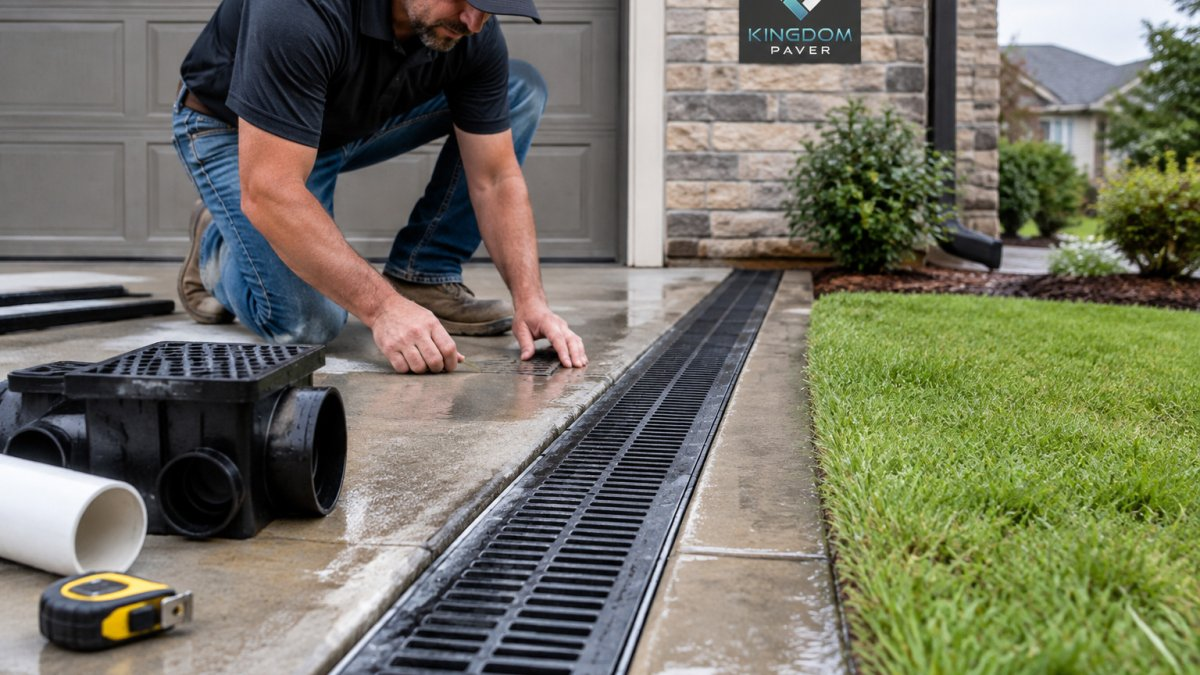
You can improve driveway drainage without regrading by redirecting the water instead of changing the slope. Start by moving downspouts at least 4 feet from the driveway edge, then add a channel drain, catch basin, swale, French drain, or dry well at the low point so water has somewhere to go.
Watch your driveway during a heavy rain to find where water actually enters before spending money.
A driveway needs roughly 1 to 2 percent slope away from the garage, about 1 to 2 inches per 8 feet.
Channel drains suit garage thresholds and low points, with the grate cleared monthly.
French drains work where clay soil will not absorb water, but need a yearly flush.
Any excavation deeper than 12 inches near a utility line, foundation, or property line needs a professional.
Tired of standing water on your driveway?Kingdom Paver designs and installs driveways and patios that drain right the first time.
How to Diagnose Driveway Drainage Problems Before You Fix Them
Improving driveway drainage without regrading starts with finding where the water actually comes from. Most homeowners blame the slope first, but the real culprit is often a downspout dumping roof runoff onto the pavement or a low spot along the driveway edge.
Homeowner inspecting a puddle near a garage to diagnose driveway drainage issues during a rainy afternoon.
Find the Source of the Water
Water pooling on a driveway usually traces back to one of four sources: roof runoff, surface runoff from higher ground, a high water table, or poor soil absorption. Walk your property during a storm and note where water enters the driveway, checking the downspout first, a single downspout can dump hundreds of gallons onto one spot. If you want to understand grading before ruling it out, our guide on how to grade a driveway for proper water flow explains the mechanics.
Check the Slope, Edges, and Downspouts
Your driveway needs a slope of roughly 1 to 2 percent away from the garage. That is about 1 to 2 inches of drop per 8 feet. Grab a level and a tape measure to check. Also look for these common problems:
Downspouts that empty directly onto the driveway surface
Settled soil along the driveway edge that traps water
Cracked joints where water seeps under the slab
Clogged gutters sending sheets of water over the edge
Low spots where the driveway meets the street
How to Fix Water Pooling in Driveway DIY: 7 Solutions That Skip Regrading
You can fix most driveway drainage problems without tearing up the slab. The seven solutions below, ranked from easiest to most involved, redirect water rather than changing the grade, with the installation details, sizing rules, and site constraints that determine whether a fix actually works.
Surface Solutions: Channel Drains, Catch Basins, and Swales
Channel drains are narrow troughs with a grate that sit at the low point of a driveway, sending water through a pipe to a discharge point.
Catch basins are box-shaped pits that collect water and debris, trapping sediment before it reaches the drain pipe.
Swales are shallow, grassy channels that carry water away from the driveway; a dry creek bed does the same job with rock instead of grass.
A French drain is a gravel-filled trench with a perforated pipe that collects groundwater and moves it away, and it is commonly used where clay soil will not absorb water.
A dry well is a buried pit that holds water until the soil absorbs it, suiting small volumes and sites with no good outlet. Its suitability depends on soil and water table conditions.
Watch out: any excavation deeper than 12 inches near a utility line, a foundation, or a property line is a job for a professional with a locate ticket, do not hand-dig blind in those zones.
Standing Water in Driveway After Rain: Why It Happens and What Stops It
Standing water in a driveway after rain comes from water arriving faster than it can leave. The fix is either to slow the inflow or speed the outflow: redirect downspouts at least 4 feet from the driveway edge, then add a surface drain at the low point. For a focused repair walkthrough, our guide on driveway drainage repair for pools and slopes covers the step-by-step process.
Gravel Driveway Drainage Solutions That Work on Flat Ground
Gravel driveways on flat ground need a crown, a slight rise down the center that sheds water to both sides. If your gravel driveway holds water, check these fixes:
Add a crown of 2 to 3 inches at the center
Line the edges with a shallow ditch
Top up low spots with crushed stone, not fill dirt
Install a culvert where the driveway crosses a ditch
Keep the gravel depth at 4 inches or more
Permeable Pavers and Surface Options That Handle Runoff
Permeable pavers let rainwater pass through the joints and into a gravel base below. They suit homeowners who want a durable surface and better water infiltration at the same time. The joint sand matters more than most people realize. Our guide on best sand for paver joints to improve water runoff explains which sand keeps the gaps open. For a deeper look at surface choices, see our paver driveway drainage solutions guide.
Who to Call for Drainage Problems in Yard and Driveway
Call a drainage or hardscape contractor when water threatens your foundation, garage, or a neighboring property. Also call a pro if a French drain needs to cross a utility line or if the outlet point is unclear. Small surface fixes are fair game for most homeowners. Excavation near utilities is not. Check local rules on where you can discharge water before you dig. Many municipalities restrict drainage that sends water onto a neighbor’s lot.
Comparing Costs and Maintenance for Each Drainage Fix
Costs vary by length, soil, and outlet distance, so get a written quote before committing. But the more useful comparison is total effort over the life of the fix, a solution that costs less upfront but needs annual cleaning can cost more in five years than a pricier system that runs itself. Use the framework below to compare the seven fixes on the dimensions that actually decide the outcome.
Compare on Effort, Not Just Price
Rank each option on four factors: installation effort, relative material cost (low, medium, high, not a dollar figure, since local pricing varies), upkeep frequency, and site suitability. A channel drain is moderate effort and cost, with monthly grate clearing. A French drain is high effort and cost, with a yearly flush that, if skipped, can require re-excavation. A swale is low effort and cost, but needs mowing and reseeding and only works with a downhill path to an outlet. A dry well is moderate effort and cost, but needs silt checks and, in clay soil, may never drain well.
Match the Fix to the Site Constraint
The site decides more than the budget. In heavy clay, French drains and dry wells underperform because water cannot move through the soil, a swale or a surface drain to a daylight outlet is often better. On a flat lot with no downhill outlet, a dry well or a pop-up emitter tied to a channel drain may be the only options that do not send water onto a neighbor. In limited space between a garage and a fence, a channel drain at the threshold beats a swale that needs 2 to 3 feet of width.
Weigh Upkeep Over Time
Maintenance is where cheap fixes get expensive. A clogged French drain costs more to fix than a channel drain that takes five minutes to clear; a dry well that silts up may need its gravel replaced; a swale that erodes needs reseeding. Before you choose, ask: How often will this need attention? Who will do that work? And what happens if it is neglected for a season? The answers separate a fix that lasts from a recurring line item.
Confirm the Outlet and the Rules
Every one of these fixes ends at a discharge point, and the outlet is part of the cost and the maintenance. A drain that empties onto a sidewalk, a neighbor’s lot, or a public right-of-way can create a liability and may violate local rules. Confirm where the water will go before you buy materials.
Ask any contractor how the system will be serviced, where the water ends up, and what the yearly upkeep looks like, not just what the install costs.
Get a Drainage Plan Built for Your Driveway
Water always finds the low spot, and it will keep finding yours until someone redirects it. Kingdom Paver has 10 years of experience serving homeowners in Katy and Cypress. Kingdom Paver offers driveways, patios, walkways, and custom building solutions, with affordable pricing. Get started with Kingdom Paver and stop watching that puddle grow every time it rains.
Frequently Asked Questions
How do you fix water pooling in a driveway without regrading?
Start by finding where the water comes from, then match the fix to the problem. A channel drain across the low spot catches surface runoff before it reaches the garage. A French drain beside the driveway moves subsurface water away. Catch basins collect water at a single low point and route it through pipe to a discharge point. Each of these handles driveway drainage without changing the slope of the slab, so you avoid the cost and disruption of tearing out and repouring.
Can a channel drain fix driveway flooding?
A channel drain works well when flooding comes from surface runoff crossing the driveway, such as water running down a slope toward the garage. The grate sits flush with the surface and the trench below carries water to an outlet. It will not fix flooding caused by a high water table or clay soil that will not absorb water. In those cases you need a dry well or a larger subsurface system, and the drain capacity has to match the volume of water you actually get.
What can you do about standing water in a gravel driveway?
Gravel driveway drainage solutions focus on what sits under the stone. A properly built gravel drive needs a base layer of larger drain rock, a layer of geotextile fabric to stop soil from clogging the stone, and a crowned or slightly sloped surface. If water still pools, add a French drain along the low edge with perforated pipe wrapped in fabric and surrounded by gravel. Regrading the base is not always needed if the fabric and drain are installed correctly.
Who should you call for drainage problems in yard and driveway?
Call a hardscape or paving contractor who installs drains as part of driveway work, or a landscape drainage specialist. Ask whether they handle the whole job in-house or subcontract the excavation. For problems that involve the house foundation or a failing retaining wall, a civil engineer or foundation specialist should assess it first. Get a written scope that names the outlet location and confirms where discharged water will go, since local rules on discharge points vary.