
Table of Contents
- How Long Does Paver Patio Installation Actually Take?
- Paver Patio Installation Process Steps from Start to Finish
- Factors Affecting Patio Construction Time
- Material Delivery, Lead Times, and Permitting
- How Soon Can You Walk on New Pavers After Installation?
- Post-Installation Care and Long-Term Maintenance Timeline
- Conclusion
Last Updated: August 17, 2026
How Long Does Paver Patio Installation Actually Take?
Paver patio installation is the process of designing, excavating, and constructing a durable outdoor surface using interlocking concrete, natural stone, or brick pavers set over a compacted sub-base. A typical residential project takes 2 to 7 days of active installation work, depending on project scope, site conditions, and material availability.
This guide breaks down every phase of paver patio installation, including material lead times, soil-related delays, and how long you need to stay off the finished surface before hosting your first backyard cookout.
| Phase | Typical Duration | Notes |
|---|---|---|
| Design and permitting | 1-3 weeks | Varies by municipality |
| Material delivery | 3-10 business days | Longer for specialty stone |
| Site preparation and excavation | 1-2 days | Depends on square footage |
| Sub-base and compaction | 1 day | Critical phase, no shortcuts |
| Laying pavers and edge restraints | 1-3 days | Pattern complexity matters |
| Joint sand and sealing | Half day to 1 day | Includes cure time |
| Post-installation cure | 24-72 hours before foot traffic | Longer before vehicle use |
Total elapsed time from first conversation to finished patio commonly runs 3 to 5 weeks. Actual crew-on-site time is a fraction of that.
Paver Patio Installation Process Steps from Start to Finish
Understanding each phase gives you realistic expectations and helps you spot when a contractor is cutting corners. Each phase builds on the last, and skipping or rushing one causes eventual failure.

Site Preparation and Excavation
Site preparation is where the real work begins. The crew marks the project area, removes existing grass or hardscape, and excavates to the required depth, typically 6 to 12 inches depending on base depth and local frost conditions.
Excavation on a 400-square-foot patio takes a full day by hand or half a day with a mini-excavator. Site accessibility is the deciding factor. Narrow gates or no side access mean hand digging, which adds time. The finished grade must slope slightly away from the house, typically 1 inch of drop per 8 feet, for proper drainage. Some municipalities require permits for hardscape projects above a certain square footage; a reputable contractor will tell you upfront.
Sub-Base, Compaction, and Screeding
This is the most structurally critical phase. A properly built sub-base separates a patio that lasts 25 years from one that sinks and shifts after two rainy seasons.
After excavation, the crew installs geotextile fabric to prevent soil migration into the base aggregate. Base aggregate, typically compacted gravel, is laid in 3 to 4-inch lifts and compacted with a plate compactor. Total base depth usually runs 4 to 8 inches. Skipping lifts or under-compacting is the single most common cause of paver failure. According to the Interlocking Concrete Pavement Institute installation guidelines, proper compaction at each lift is non-negotiable for long-term performance.
Once the base aggregate is compacted, a thin layer of coarse bedding sand is screeded to a precise, level plane. This is where the pavers sit. Getting it right takes skill and time; rushing produces an uneven finished surface that no amount of polymeric sand can fix later.
Laying Pavers, Cutting, and Edge Restraints
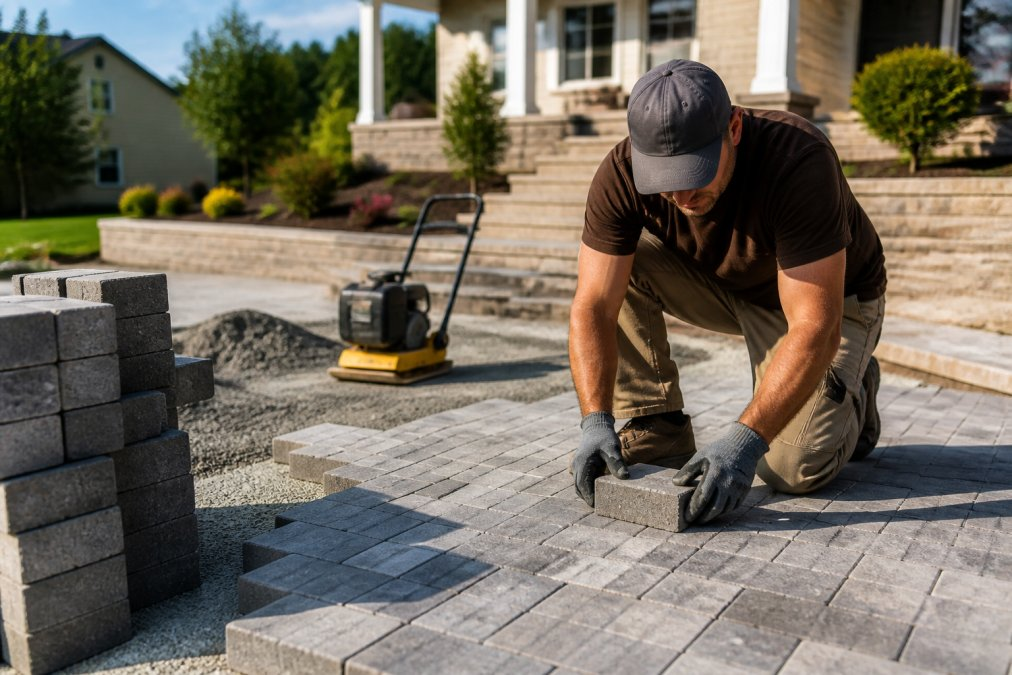
With the screeded sand bed ready, the crew lays interlocking pavers from a fixed reference point. Paver alignment is checked constantly with string lines and levels. Pattern complexity matters: a simple running bond goes faster than herringbone or basket-weave, which require more cuts and precision.
Cutting pavers to fit edges and curves requires a wet saw or angle grinder. Edge restraints are installed around the perimeter to lock the paver field in place and prevent lateral movement. A straightforward 300-square-foot rectangular patio can be laid in a single day by an experienced crew. Add curves, angles, or inlaid patterns, and that same square footage might take two days.
Joint Sand, Sealing, and Final Inspection
The final phase involves sweeping joint sand into gaps between pavers, compacting the surface to lock everything in, and sealing. Most professional installations use polymeric sand, which activates with water and hardens to resist weeds and ants.
Sealing is optional but strongly recommended. It protects from staining, enhances color, and extends polymeric sand life. The sealer needs 24 hours to cure before foot traffic. A thorough final inspection checks for lippage, alignment, and low spots before the crew leaves.
Factors Affecting Patio Construction Time
Most timeline estimates assume ideal conditions. The real world rarely cooperates.
Project Scale and Square Footage
A 200-square-foot patio is a 2-day job for a skilled crew. A 1,000-square-foot patio with integrated outdoor kitchen pad and fire pit is a week-long project. The relationship isn’t perfectly linear because mobilization, setup, and cleanup time stay roughly constant regardless of size.
Soil Type, Drainage, and Site Accessibility
Clay-heavy soils, common across the greater Houston area, retain water and expand when wet. This directly affects excavation depth and base aggregate thickness needed for stability.
Sites with poor drainage or pooling water require additional drainage solutions, such as French drains or catch basins, before the base can be installed. Adding drainage can add a full day or more to the timeline. The USDA Web Soil Survey helps you understand soil composition before a project begins.
Narrow side yards, steep slopes, or limited equipment access slow excavation and material movement. What takes two hours with a skid steer takes six hours with wheelbarrows.
Paver Material and Pattern Complexity
Concrete pavers are fastest to install: they’re uniform, available locally, and easy to cut. Natural stone requires more skill to lay evenly and takes longer to cut precisely. The tradeoff is aesthetics and character.
Pattern complexity adds labor time directly. A standard grid or running bond is efficient. A diagonal herringbone or custom medallion requires constant measurement, more cuts, and careful alignment. On a 500-square-foot patio, a complex pattern can add a full day compared to a simple one.
Material Delivery, Lead Times, and Permitting
Here’s what catches most homeowners off guard: the wait before the crew shows up.
Standard concrete pavers are often available from local distributors within 3 to 5 business days. Specialty natural stone or custom-color pavers can take 2 to 4 weeks. If your project requires specific material that’s out of stock, your installation date moves accordingly.
Permitting adds another variable. Projects above a certain square footage, near property lines, or in HOA communities often require permits. Permit processing times vary by municipality and can range from days to weeks. A contractor who says permits are never needed isn’t giving complete information.
Work backwards from your target date. Account for permitting, material delivery, and contractor scheduling, then add a buffer for weather. Starting that conversation 6 to 8 weeks before your target date is reasonable for most projects.
Ask your contractor for the material lead time and permit requirement determination before signing a contract. These two factors alone can shift your project start date by 2 to 4 weeks.
How Soon Can You Walk on New Pavers After Installation?
Most newly installed paver patios can handle foot traffic within 24 hours of final compaction and joint sand activation. The pavers are solid immediately, but polymeric sand needs time to fully cure.

Here’s the practical curing timeline:
- 24 hours: Safe for light foot traffic once polymeric sand has been activated and dried
- 48-72 hours: Recommended wait before moving patio furniture back onto the surface
- 7 days: Minimum wait before placing heavy planters, grills, or outdoor kitchen equipment
- 30 days: Full cure for the base system; avoid vehicle traffic on any paved driveway extension until this point
Weather affects curing time. High humidity or rain in the 24 hours after polymeric sand installation can interfere with curing. A good crew will check the forecast before activating joint sand and may reschedule if rain is imminent. The Techniseal polymeric sand installation guidelines recommend protecting freshly activated joint sand from rain for a minimum of 24 hours.
Placing heavy furniture or a grill on a freshly installed patio before the base has fully settled can cause localized sinking. Wait at least 7 days before loading the surface with concentrated weight.
Post-Installation Care and Long-Term Maintenance Timeline
A well-built paver patio is one of the most durable outdoor surfaces available, but it requires periodic maintenance to stay that way.
Year 1: Settling and observation
Some minor settling in the first year is normal, particularly in clay soil areas or with significant seasonal temperature variation. Check the surface after the first heavy rain and after the first winter. Minor lippage or a slightly sunken paver can be corrected quickly if caught early.
Every 2-3 years: Re-sand and inspect
Polymeric sand gradually erodes from joint washing and foot traffic. Topping off joint sand every 2 to 3 years keeps weeds out and maintains structural integrity. This is a straightforward task most homeowners can handle themselves.
Every 3-5 years: Re-seal
Sealer breaks down over time from UV exposure and foot traffic. Re-sealing every 3 to 5 years restores the protective layer and refreshes appearance. Before re-sealing, clean the surface and remove any efflorescence. The Belgard paver care and maintenance guide provides useful reference for product-specific sealer compatibility and maintenance intervals.
As needed: Reset individual pavers
One genuine advantage of interlocking pavers over poured concrete is repairability. If a single paver cracks or a small section settles, it can be pulled up, the base corrected, and the paver reset without disturbing the rest of the surface.
The long-term maintenance timeline for a paver patio is predictable and manageable. The biggest cost of neglect isn’t replacement, it’s allowing minor settling to become major structural failure by waiting too long to address it.
| Maintenance Task | Frequency | DIY or Professional |
|---|---|---|
| Visual inspection | After each major rain event | DIY |
| Joint sand top-off | Every 2-3 years | DIY |
| Surface cleaning | Annually | DIY |
| Re-sealing | Every 3-5 years | Either |
| Individual paver reset | As needed | Professional recommended |
| Full base repair | Rare, if base fails | Professional required |
Planning a paver patio project means managing material lead times, permitting, soil conditions, and post-installation cure periods. Kingdom Paver brings 10 years of hardscape installation experience to every project, handling the full process from excavation and base preparation through final sealing and inspection. Contact Kingdom Paver for a project assessment and get a realistic timeline built around your specific site conditions and target date.
Frequently Asked Questions
How long does it take to install a paver patio?
Most residential paver patio installations take between 2 and 5 days of active work once the crew is on site. A small patio under 200 square feet can often be completed in 1 to 2 days, while larger projects exceeding 500 square feet typically require 4 to 7 days. Weather delays, permitting, and material delivery can add time before the crew even breaks ground, so the full elapsed time from contract signing to finished project is often 1 to 3 weeks.
How soon can you walk on pavers after installation?
You can generally walk on interlocking concrete or natural stone pavers within 24 hours of installation, once the polymeric sand has been swept in and compacted. However, you should avoid placing heavy furniture or driving vehicles on the surface for at least 72 hours to allow the joint sand to fully set. If a sealant was applied, most products require an additional 24 to 48 hours of curing time before normal use.
What factors cause delays in patio installation?
The most common causes of delay are weather, soil conditions, and material lead times. Heavy rain can halt excavation and compaction work, since wet soil compacts poorly and compromises the sub-base. Clay-heavy soil or poor drainage may require additional prep work, adding a day or more. Material shortages or custom-order pavers can push delivery timelines out by 1 to 2 weeks. Permitting requirements, while uncommon for patios, can also extend the overall schedule.
How much will pavers settle after compacting?
A properly built paver patio should show minimal settling over time. The sub-base aggregate is compacted in layers using a plate compactor, reducing void space before any pavers are laid. Minor surface settling of a few millimeters is normal within the first season as the base fully stabilizes. Significant sinking or shifting usually points to inadequate base depth, poor compaction, or drainage problems that allow water to erode the base material underneath.
This article was written using GrandRanker


