
Table of Contents
- Stone vs Concrete Pavers: A Side-by-Side Comparison
- Paver Driveway vs Concrete Cost: Breaking Down the Numbers
- Natural Stone Patio Installation Cost: What Drives the Price
- Concrete Paver Maintenance Tips for Long-Lasting Results
- Durability, Weathering, and Regional Climate Performance
- DIY vs Professional Installation: What Homeowners Should Know
- Conclusion: Choosing the Right Paver for Your Project
- Frequently Asked Questions
Last Updated: September 17, 2026
Stone vs Concrete Pavers: A Side-by-Side Comparison
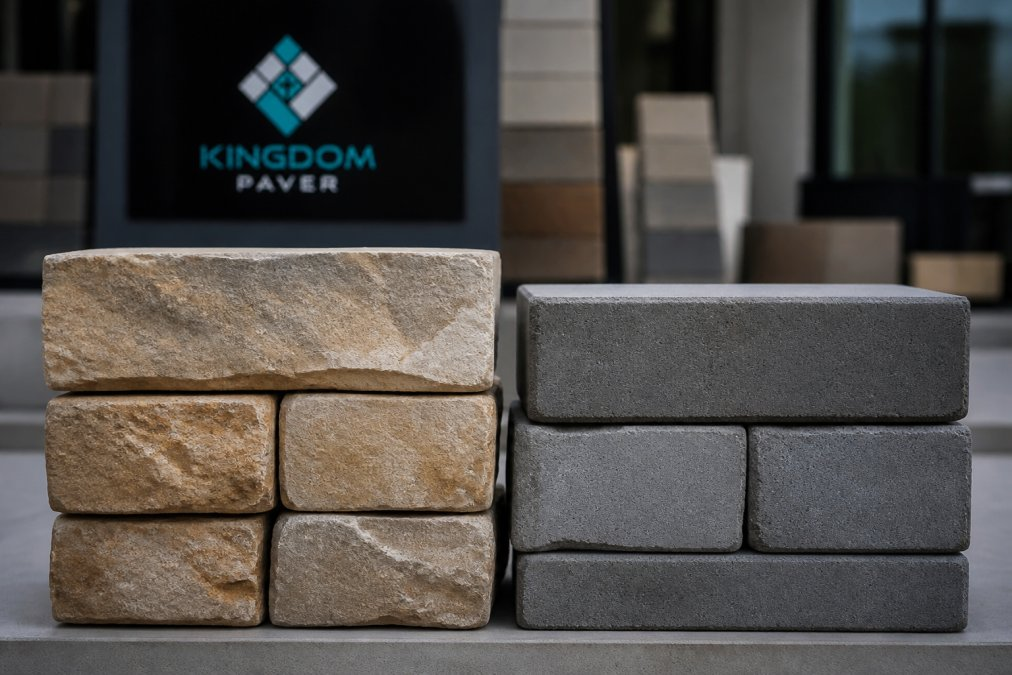
Choosing between natural stone vs concrete pavers comes down to one trade-off: stone costs more up front and lasts decades with almost no upkeep, while concrete pavers cost less initially but may fade or need sealing sooner. This Kingdom Paver guide breaks down the differences for your driveway, patio, or walkway.

Material Composition and Manufacturing
Natural stone forms over thousands of years, so every piece carries a unique grain, color, and density. Concrete pavers are molded, giving them consistent dimensions and predictable strength.
Strength, PSI Ratings, and Load Capacity
Granite and other dense natural stones regularly exceed 15,000 PSI in compressive strength, while standard concrete pavers typically fall in the 8,000 PSI range. The ASTM C936 standard for concrete pavers sets the baseline that reputable manufacturers build to.
| Factor | Natural Stone Pavers | Concrete Pavers |
|---|---|---|
| Compressive strength | 15,000+ PSI (granite) | ~8,000 PSI typical |
| Color consistency | Variable, natural | Uniform, manufactured |
| Upfront cost | Higher | Lower |
| Repair approach | Replace individual stones | Replace individual units |
| Best for | Long-term value, unique look | Budget-conscious projects |
Paver Driveway vs Concrete Cost: Breaking Down the Numbers
The paver driveway vs concrete cost gap starts with material: natural stone runs higher per square foot than manufactured concrete pavers, and the spread widens with installation labor, base prep, and long-term maintenance.
Concrete pavers win on upfront price. Natural stone wins on lifespan and resale appeal. The right call depends on how long you plan to stay in the home, and on whether you’re pricing the install or the full ownership window.
Material Costs Per Square Foot
Natural stone costs more per square foot because quarrying, cutting, and finishing add expense at every step, while concrete pavers benefit from mass production.
- Concrete pavers: roughly $3-$10 per square foot for material, depending on thickness, color, and shape.
- Natural stone pavers: roughly $8-$25+ per square foot for material, with granite, bluestone, and travertine at the upper end and thinner flagstone or sandstone at the lower end.
Installation Labor and Sub-Base Preparation
Labor often accounts for 40-60% of a finished paver project, and sub-base preparation matters most. A properly compacted base, typically 4 to 6 inches of aggregate for a residential driveway, plus 1 inch of bedding sand, prevents the sinking and cracking that plague poorly installed driveways.
The Cost Competitors Don’t Show You: Lifetime Ownership
Upfront price is only half the story. Over 20 years, the cost curves cross in ways the sticker price hides:
| Cost Category | Natural Stone Pavers | Concrete Pavers |
|---|---|---|
| Material (per sq ft) | ~$8-$25+ | ~$3-$10 |
| Installation labor | Higher (irregular units) | Lower (uniform units) |
| Sealing frequency | Every 3-5 years (varies by stone) | Every 2-3 years |
| Color fading | Minimal | Common in high-UV climates |
| Replacement units | Individual stones | Individual pavers |
| Expected lifespan | 50+ years with care | 25-30 years with care |
Ask any installer for a line-item quote that separates material, base prep, labor, and joint sand. A single lump-sum number hides where the real cost drivers are, and where you can negotiate.
What Actually Moves Your Quote
Four variables drive most of the price difference between similar projects:
- Site access. A backyard patio reachable only by wheelbarrow costs more than a driveway a skid steer can reach.
- Base depth and soil conditions. Clay or poorly draining soil requires more excavation and aggregate.
- Pattern complexity. A running bond is fast; a herringbone or radial pattern with tight joints is slow.
- Edge restraint and drainage. Proper edge restraints and a graded slope are non-negotiable and add cost, but skipping them is the fastest way to a failed install.
Natural Stone Patio Installation Cost: What Drives the Price
Skipping proper sub-base preparation to save money is the single most common reason patios sink within a few years. The base is not the place to cut corners.
Porosity and sealing also affect long-term cost. Some stones absorb water readily and need sealing to resist staining and freeze-thaw damage, so ask your installer which stone suits your climate.
Concrete Paver Maintenance Tips for Long-Lasting Results
Concrete paver maintenance tips start with a simple routine: sweep, rinse, re-sand joints, and seal on schedule. Pavers that get this care hold their color and structural integrity far longer than neglected ones.
Sealing, Joint Sand, and Cleaning Schedules
Sealing requirements vary by material and climate. In hot, sun-heavy regions, UV resistance matters because color fading is the most common complaint about concrete pavers. A quality sealer slows fading and helps joint sand stay put.
- Sweep debris monthly to prevent staining
- Rinse with a hose; avoid harsh pressure washing that strips joint sand
- Replenish joint sand annually or after heavy rain
- Reseal every few years, sooner in high-UV climates
Repairing Cracks, Stains, and Efflorescence
Efflorescence, the white haze on concrete and some stone, is a natural mineral deposit, not a defect. Most cases fade with time or wash away with a diluted cleaner.
Durability, Weathering, and Regional Climate Performance
Freeze-thaw performance separates good installations from great ones. Water that seeps into joints and freezes expands roughly 9% by volume, and repeated cycles can crack weaker materials or heave a poorly built base. Absorption rate is the best predictor of behavior.
Absorption Rates: The Number That Predicts Failure
Water absorption is measured as a percentage of dry weight. Lower is better in freeze-thaw and salt-heavy climates:
- Granite: roughly 0.1-0.5%, effectively non-absorbent, the gold standard for cold and coastal installs.
- Bluestone and dense limestone: roughly 0.5-2%.
- Sandstone and travertine: roughly 2-6%, beautiful, but they need sealing in freeze-thaw zones.
- Concrete pavers: typically under 5% per ASTM C936, and often lower with a quality sealer.
Regional Climate Performance
Extreme heat and high UV (Southwest, desert regions). Concrete pavers are most likely to fade, because their color comes from pigments in the cement matrix. A UV-stable sealer slows this, but expect some lightening over 10-15 years. Natural stone’s color is mineral, not pigment, so it does not fade, though light-colored stone can get hot underfoot, so choose lighter tones for pool decks.
Repairability: What Happens When One Paver Fails
A single damaged unit is a minor job for either material, but the steps differ:
Replacing one concrete paver:
- Pry the damaged unit out with two flat bars, working from the joints.
- Scoop out and re-compact the bedding sand.
- Set the replacement paver, check it sits flush with neighbors.
- Sweep joint sand into the gaps and mist to settle.
Replacing one natural stone slab:
- Score and cut the mortar or adhesive joint if the stone is set rigid.
- Lift the slab, this often requires two people, since a 2-inch granite slab can weigh 100+ pounds.
- Clean the bed, re-level with fresh mortar or sand, and reset.
- Match the joint width and finish to surrounding stones; color match is rarely exact.
Never pressure-wash a paver joint at full force. It strips the joint sand that holds the system together and is the leading cause of pavers shifting after a few seasons.
Aging: How Each Surface Looks in 10 Years
Concrete pavers age by fading and, in some climates, developing a chalky surface. Natural stone ages by developing patina, subtle color shifts and a softened surface most homeowners consider an improvement. If you want a surface that looks the same in year 10 as year 1, stone is the safer bet. If you want one you can refresh with a sealer and a few replacement units, concrete pavers are more forgiving.
DIY vs Professional Installation: What Homeowners Should Know
DIY paver installation is possible for small patios and walkways, but driveways and large patios are a different job. The work is heavy, the base prep is unforgiving, and mistakes show up months later as sinking or shifting.
Ask any installer how they compact the base and how deep they dig. If the answer is vague, that is your signal to keep looking.
Conclusion: Choosing the Right Paver for Your Project
The choice between natural stone vs concrete pavers is a question of budget, timeline, and how long you plan to stay. Stone rewards patience with decades of low-maintenance beauty; concrete pavers reward budget-conscious buyers with solid performance and easier repairs.
Frequently Asked Questions
Is natural stone more expensive than concrete pavers?
Yes, natural stone typically costs more upfront. The material itself is quarried and shipped, which raises the per-square-foot price compared to manufactured concrete pavers. Installation also takes longer because stone pieces vary in thickness and shape, increasing labor intensity. However, natural stone can last decades with minimal maintenance, so the long-term cost of ownership may balance out. For a precise quote on your project, contact a local paver contractor.
What are the downsides of concrete pavers?
Concrete pavers can fade over time from UV exposure, especially in darker colors. They may also develop efflorescence, a white mineral deposit that appears on the surface. While individual units are easy to replace if cracked, the joint sand between them needs periodic refilling. In freeze-thaw climates, improper sub-base preparation can lead to shifting. Overall, concrete pavers offer good value but require a maintenance schedule to keep them looking their best.
Do concrete pavers fade over time compared to natural stone?
Concrete pavers are manufactured with color pigments that can fade under prolonged UV exposure, though modern high-quality pavers resist fading better than older products. Natural stone, by contrast, has color that runs through the entire slab, so it does not fade in the same way. Stone may develop a patina or slight weathering over time, which many homeowners find attractive. If color longevity is a priority, natural stone has the edge.
Which material offers better longevity for high-traffic driveways?
Natural stone generally outlasts concrete pavers in high-traffic driveways. Granite and certain limestone varieties have compressive strengths that exceed 20,000 PSI, while concrete pavers typically range from 8,000 to 12,000 PSI. Stone also resists freeze-thaw cycles better when properly installed. That said, a well-installed concrete paver driveway with a solid sub-base can last 25 to 30 years. The key differentiator is installation quality and ongoing maintenance.
Are natural stone pavers slippery when wet?
Some natural stone surfaces, particularly polished granite or honed limestone, can become slippery when wet. However, most exterior stone pavers come with a flamed, cleft, or bush-hammered finish that provides good slip resistance. Concrete pavers also vary in texture. For pool decks and walkways, choose a textured finish and consider a penetrating sealer that maintains traction. Always test a sample wet before finalizing your material choice.


