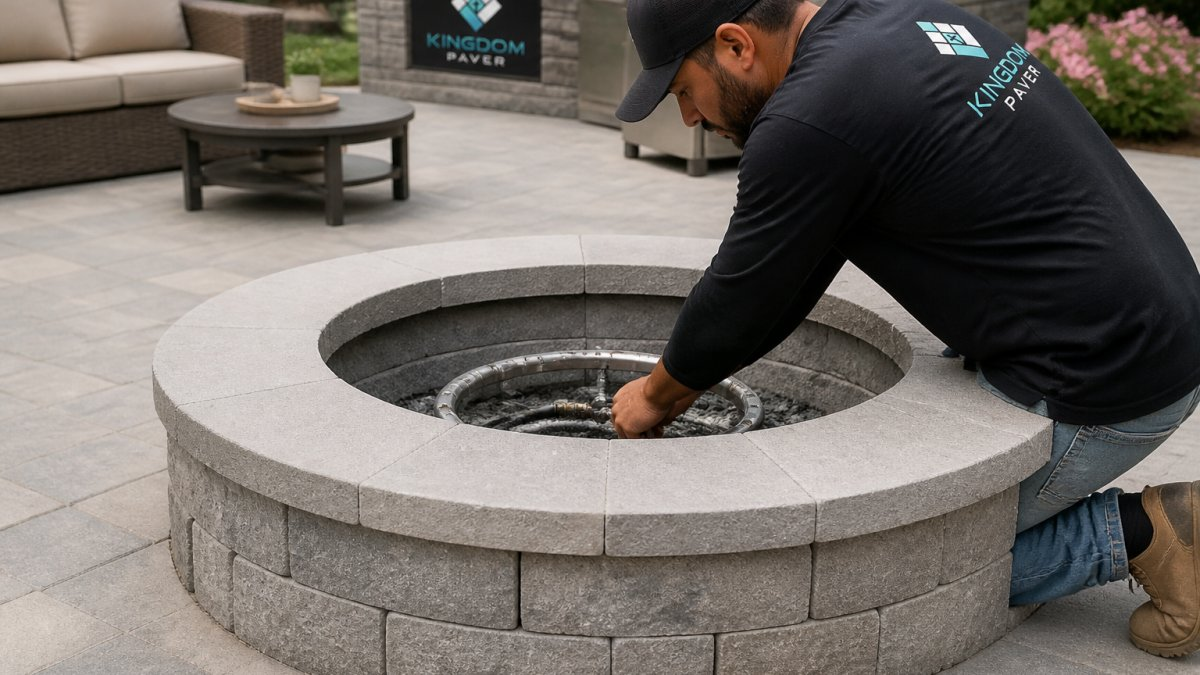
Gas fire pit installation requirements in Katy start with one hard truth: this is a job for licensed pros, not a weekend project.
A gas fire pit is an outdoor fire feature powered by natural gas or propane, connected through a permanent fuel line rather than wood or gel fuel.
Before you dig, line up these items:
A clear idea of where the fire feature will sit
Your home’s gas meter or propane tank location
Your community’s HOA design rules
The U.S. Consumer Product Safety Commission guidance on outdoor gas appliances is a good starting point for understanding why venting and clearance matter.
Step 1: Confirm Permit Requirements for a Gas Fire Pit
Most jurisdictions require a permit for gas fire pit installation, because the work involves a permanent fuel connection. A portable propane unit you wheel out on weekends usually needs no permit.
The hard part is not knowing that a permit may apply. It is figuring out which office issues it. In this region, that answer changes block by block, and getting it wrong is the most common reason a project stalls.
Identify Your Jurisdiction Before You Call Anyone
Three different authorities can govern the same fire pit, depending on where the property sits:
Inside a city limit: the city’s building department issues the gas and building permits, and the city fire marshal or a designated fire code official signs off on clearances and venting.
In unincorporated county land: the county permits office handles the building permit, and the county fire marshal’s office handles fire-code review. This is common on larger lots and acreage properties outside the city core.
Inside a master-planned community or municipal utility district: the city or county still permits the work, but the HOA or community association adds a separate architectural review that runs on its own timeline and can reject a location the code allows.
A property can sit a few streets from a city boundary and fall under a completely different office. Do not assume your neighbor’s process applies to you.
How to Verify the Current Requirements
Pull your address up on the county appraisal district or tax map to see whether you are inside a city limit or in unincorporated territory. That single check tells you which office to call.
Call the building department that has jurisdiction and ask directly: does a gas connection permit apply, does the fire feature itself need a separate building permit, and who performs the final inspection?
Ask the fire marshal’s office whether the appliance type triggers additional review, enclosed hearths and outdoor fireplaces often do, because venting is a fire-code matter, not just a building-code one.
Get the answers in writing, an email confirmation or a permit number you can reference. Verbal guidance is not defensible if an inspector later disagrees.
Check the HOA design guidelines separately. Architectural review is not a code requirement, but it can block a location the code would allow, and it usually takes longer than the permit itself.
What the Permit Application Typically Requires
Most offices want the same core package, though the forms differ:
A site plan showing the fire feature’s location relative to the house, property lines, and any overhead structures
The appliance make and model, so the reviewer can check it against the manufacturer’s listing
The gas line route from the meter or tank to the feature
Watch Out Skipping the permit is the most expensive shortcut in this process. Unpermitted gas work can void your homeowner’s insurance coverage on a fire-related claim and can force you to tear out finished masonry to expose the line for inspection.
Keep a single folder, digital or paper, with the permit number, the approved site plan, the inspection sign-offs, and photos of the line before backfill. That folder is what protects you at resale and what an adjuster asks for after a claim.
Step 2: Plan Outdoor Fire Pit Gas Line Installation
Outdoor fire pit gas line installation is the step that decides your budget, your timeline, and your layout. The fuel line runs underground from your existing gas supply point to the fire feature, and it must be sized, buried, and pressure-tested to code.
Natural Gas vs. Propane: Which Fuel Source Fits Your Yard
Natural gas wins when you already have a meter and a line nearby. It never runs out, and you never haul a tank. Propane makes more sense on larger lots or where the gas main sits far from the patio, since trenching costs climb with distance.
Factor
Natural Gas
Propane
Fuel source
Existing utility connection
On-site tank
Refueling
Never needed
Tank refills
Best for
Homes with a nearby meter
Remote patios, large lots
Line work
Tie-in to existing supply
Tank pad plus line
A licensed plumber sizes the line for your appliance type. Undersized piping starves the burner and produces a weak flame. The plumber also installs a shutoff valve within reach of the fire feature.
Step 3: Meet Gas Fire Pit Clearance Requirements
Gas fire pit clearance requirements protect your home, your fence, and your guests. Clearances are measured from the edge of the fire feature to anything that can burn, and the numbers come from two places: the manufacturer’s installation instructions and your local fire code.
Here is the rule that trips people up: the manufacturer’s listing and instructions govern the specific appliance, and the code sets the floor. If the manual calls for more clearance than the code minimum, the manual wins for that unit.
The Clearance Zones to Plan For
Exact dimensions vary by appliance, so treat these as the categories you must resolve against your specific model’s instructions and your jurisdiction’s adopted code:
Overhead: open sky or a listed vent hood. Never a low roof, an eave, a pergola with a combustible cover, or a tree limb. Heat rises and trapped exhaust is the failure mode.
Sides: measured from the burner edge to wood fencing, vinyl fencing, plants, and movable furniture. Furniture is the one people forget, a chair pushed too close during a party is a clearance violation in practice.
Below: a non-combustible base. Bare mulch, wood decking, and artificial turf are all combustible and all common mistakes.
Building setback: the distance from the house wall, eaves, and any attached structure. This is the number an inspector checks first.
How to Resolve the Numbers for Your Appliance
Find the installation manual for your exact make and model. Clearances are listed per unit, not per category. A manual for a similar-looking fire pit is not a substitute.
Check the listing. Look for a recognized listing mark on the appliance and confirm the model is rated for outdoor installation.
Compare the manual’s clearances against your jurisdiction’s adopted code and use the larger number.
Mark the clearances on the ground before the crew sets anything. Stakes and string make the zones visible and catch a bad location before masonry is laid.
Photograph the marked clearances and the finished install so the measurements are documented against the approved plan.
A backyard patio in a master-planned community with a newly installed gas fire pit burning, positioned well away from a wooden fence and the back wall of a house, with outdoor seating arranged around it in the evening
What the Inspector Looks At
A clearance inspection is not a guess. The reviewer is checking the installed feature against the approved site plan and the manufacturer’s instructions. Expect them to verify:
The distance from the burner to the house, eaves, and any combustible structure
The base material under and around the feature
Overhead clearance and, for enclosed designs, the venting configuration
That the appliance matches the model listed on the permit
Photograph the clearance measurements before the crew backfills the trench. Inspectors and future buyers both like seeing documentation that the install matched the approved plan, and it takes thirty seconds.
Clearance is not a single number you memorize. It is a per-appliance calculation you resolve against the manual and the code, then prove with photos. Get it wrong and the fix is demolition, not adjustment.
Step 4: Schedule Gas Fire Pit Permits and Inspections
Gas fire pit permits and inspections follow a set sequence, and the order is not flexible. The rough-in inspection happens before you cover the gas line.
Here’s the typical sequence:
Submit the permit application with a site plan
Get the permit issued and posted
Complete the gas line rough-in
Pass the rough-in inspection
Set the appliance and connect the burner
Pass the final inspection
Keep the signed card and photos on file
Build in buffer time. Inspectors get busy, and a single missed appointment can push your project a week. If you want the fire pit ready for a specific event, start the permit process first, not last.
Step 5: Understand Gas Fire Pit Installation Cost
Gas fire pit installation cost depends on four variables: line distance, fuel type, feature size, and permit fees. Because every yard is different, pricing depends on quantity, dates, and delivery.
What moves the number:
Trench length from the gas supply to the feature
Whether you choose natural gas or propane
The size and material of the fire feature itself
Permit and inspection fees set by your city
A simple portable unit costs far less than a permanent masonry feature with a long gas run. For a current quote on your project, contact Kingdom Paver directly. We build custom fire pits and outdoor kitchens across Katy and Cypress.
Common Mistakes to Avoid
The biggest mistake is treating a gas fire pit like a wood-burning one. They are not the same job. Gas appliances have connection, venting, and clearance rules that wood pits do not.
Other common traps:
Planting shrubs inside the clearance zone, then watching them scorch
Running the gas line too close to a sprinkler valve or irrigation line
Choosing a location under a roof overhang without checking venting
Buying the appliance first, then discovering the clearance rules rule out that spot
Each of these is cheap to avoid at the planning stage. Each is expensive to fix after the masonry is set.
Never test a new gas connection with a match or lighter. A licensed plumber pressure-tests the line and checks every joint for leaks before the burner ever sees a flame.
Frequently Asked Questions
Do you need a permit to install a gas fire pit in Katy?
Most gas fire pit installations that involve running a new gas line or modifying existing gas piping require a permit from the local authority having jurisdiction. Portable propane models that connect to a tank and are not permanently fixed in place typically do not need a permit. Confirm with the city or county before you buy, because permit requirements vary by jurisdiction and by whether the unit is a permanent fire feature or a portable one.
How far should a gas fire pit be from a house or other structures?
Clearance requirements depend on the appliance type and the manufacturer’s instructions. Many manufacturers specify a minimum of 10 feet from buildings, fences, and combustible materials, but that number changes by model. Local building codes and fire codes may set stricter distances. Always follow the manufacturer’s listed clearances and verify them against local code before finalizing your installation location.
Should a licensed professional install a gas line for a fire pit?
Yes. Gas piping work should be handled by a licensed plumber or a qualified gas fitter who knows local code. Connecting to an existing gas supply point involves shutoff valves, pipe sizing, leak testing, and inspection, all of which carry safety and liability risks if done incorrectly. A professional installation also makes the inspection process smoother and protects your property owner’s insurance coverage.
Can a gas fire pit be used during a burn ban?
Burn bans in Texas generally target open burning of wood and yard waste, not gas appliances. A gas fire pit with a controlled flame and an on/off valve is often allowed during a burn ban, but the rules are set locally and can change with drought conditions. Check with your county or city before using any fire feature during an active ban.
A gas fire pit turns a plain patio into the spot everyone gathers. The catch is that the fuel line, the clearances, and the paperwork all have to be right before the first flame. Kingdom Paver handles the whole project, from custom fire pit design and masonry construction to the patio and hardscape around it, backed by a decade of building outdoor living spaces in Katy and Cypress. Contact Kingdom Paver and let us build a fire feature you can enjoy for years.