Top Built-In Grills for Outdoor Kitchens in 2026: Quick Comparison
A built-in grill is a gas cooking unit permanently installed into a masonry or stone enclosure rather than a freestanding cart. This 2026 review compares ten models across price, build quality, and cooking performance so you can match a grill to your island before construction starts.
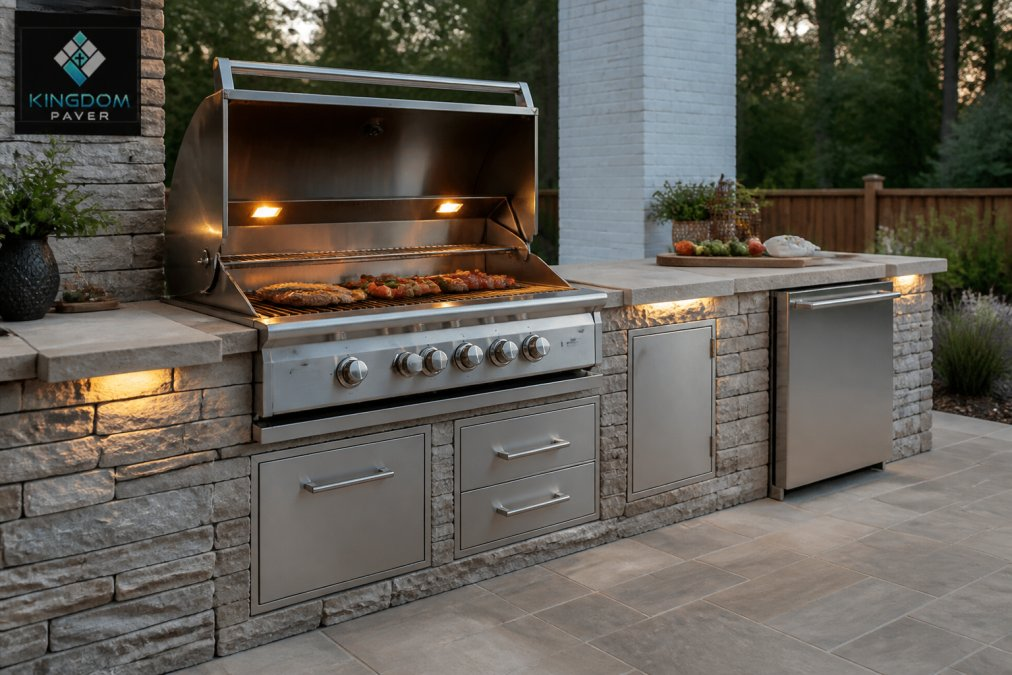
Stainless steel built-in grill integrated into a stone outdoor kitchen island with prep space on a sunny patio
Here is the short version before the details:
Model
Size
Starting Price
Best For
Blaze Professional LUX
34-inch
$2,200
Best value, commercial-grade build
DCS Series 9
36-inch
$4,500
Precision temperature control
Bull Angus
30-inch
$1,899
Mid-range family grilling
Bull Yukon 5
5-burner
Contact for pricing
Large gatherings
Hestan Aspire
36-inch
$5,999
Luxury design and performance
Twin Eagles Eagle One
36-inch
Contact for pricing
Top-tier luxury cooking
Napoleon 500
32-inch
Contact for pricing
First-time buyers
Coyote C-Series Gen 3
30-inch
Contact for pricing
Compact footprints
Blaze Premium LTE+
32-inch
Contact for pricing
Long-term reliability
Blaze Professional LUX 34-Inch: Best Value Commercial-Grade Build
The Blaze Professional LUX is a grill often recommended to homeowners who want professional-grade construction without a luxury price tag. It starts around $2,200 and uses commercial-grade 304 stainless steel throughout, including cast stainless steel H-burners and heat zone separators for independent cooking temperatures.
Pros:
Excellent value for the build quality
Highly durable materials
Cons:
Lacks some advanced luxury features found in higher-priced models
DCS Series 9 36-Inch: Precision Temperature Control for Serious Cooks
DCS targets the cook who treats the backyard like a second kitchen. The Series 9 36-inch starts around $4,500 and earns its price with precision port burners that hold even heat across the grate, plus double-sided cast stainless steel grates that sear hard and clean easily.
Higher price point compared to entry-level professional grills
Bull Angus 30-Inch and Yukon 5: Mid-Range Workhorses for Family Grilling
Bull’s two mid-range options cover opposite ends of the family cooking spectrum. The Angus 30-inch starts around $1,899 with four stainless steel burners, 75,000 BTU output, a dual-lined hood, and a piezo igniter, the dependable weeknight grill.
Pros:
Strong heat output and solid heat retention (Angus)
Massive cooking capacity and durable frame (Yukon 5)
Cons:
Standard feature set compared to luxury competitors
Yukon 5 requires a larger island footprint
Hestan Aspire and Twin Eagles Eagle One: Luxury Built-In Grills Worth the Investment
Luxury grills earn their price through engineering you notice every time you cook. The Hestan Aspire 36-inch starts at $5,999 with a spring-assisted hood, ceramic infrared rotisserie burner, halogen lighting, and heavy-duty stainless steel grates.
Pros:
Exceptional build quality and premium aesthetics (Hestan)
Precision engineering and zone control (Twin Eagles)
Cons:
Significant investment cost on both models
Napoleon 500 and Coyote C-Series: Compact and First-Timer-Friendly Options
First-time built-in buyers should look at these two. The Napoleon Built-In 500 Series (32-inch) uses stainless steel sear plates, the JETFIRE ignition system, an ACCU-PROBE temperature gauge, and ergonomic knobs, the easiest grill here to learn.
Watch Out Compact models like the Coyote 30-inch trade cooking surface for space efficiency. If you regularly cook for more than six people, size up to a 36-inch unit before you pour the island foundation.
Pros:
Easy ignition and consistent temperature monitoring (Napoleon)
Space-efficient design with good heat distribution (Coyote)
Cons:
May lack heavy-duty longevity of commercial-grade alternatives
Limited cooking surface area compared to 36-inch models
Built-In Grill Cutout Dimensions: Sizing Your Outdoor Kitchen Island
Cutout dimensions are the rough opening your mason builds into the island to accept the grill body. Get them wrong and the grill either will not fit or sits unsupported. Specs are not interchangeable, a 30-inch grill does not mean a 30-inch opening, since nominal sizing refers to cooking width, not the chassis.
What the numbers actually look like
Cutout specs are model-specific, but the pattern across major brands is consistent enough to plan around:
A nominal 30-inch built-in typically calls for a cutout in the neighborhood of 27 to 28 inches wide, 20 to 22 inches deep, and 9 to 11 inches tall.
A nominal 36-inch built-in usually lands around 33 to 34 inches wide, 21 to 23 inches deep, and 10 to 12 inches tall.
A nominal 32-inch unit sits between those two ranges.
Clearances and ventilation: the part most guides skip
Combustible-material clearance. Manufacturers publish a minimum clearance to combustible construction, commonly around 12 inches behind and 6 to 12 inches to the sides, varying by brand and whether the rear is open or closed. Wood framing must respect that clearance; non-combustible framing (steel stud, masonry, or concrete board) removes the constraint but not the ventilation requirement.
Watch Out If your island design has no vented access door and no louvers, stop and fix the plan before the stone goes on. Adding ventilation after the countertop is set means cutting finished masonry.
The pre-build checklist
Pull the cutout width, depth, and height from the manufacturer’s current spec sheet for your exact model
Confirm minimum clearance to combustible materials behind and beside the grill
Plan high and low ventilation openings in the enclosure (louvers, vented doors, or dedicated vents)
Add a small clearance buffer on all sides for the drop-in fit
Rough in the gas supply line and electrical run before the island is framed
Verify the finished counter height matches the grill’s installed height so the control panel sits at a comfortable reach
Confirm the island footprint leaves room for the hood to open fully without hitting a wall, pergola post, or overhead structure
Retrofitting a new grill into an existing island
Replacing an old built-in without rebuilding the island is possible only if the new grill’s cutout equals or exceeds the old opening in every dimension, a smaller grill in a larger hole leaves a gap trim cannot hide. Measure the existing opening first, then shop for a grill whose published cutout fits inside it, or accept that the countertop and front face will need modification.
Natural Gas vs Propane Built-In Grill: Which Fuel Type Fits Your Setup
Natural gas is better when a permanent supply line already runs to your patio; propane suits homes without that infrastructure or buyers who want fuel flexibility. Decide before the island is built, because it affects the gas line rough-in and ventilation design.
How the two fuels actually differ
Natural gas connects to your home’s supply, so you never swap a tank or run out mid-cook. The trade-off is heat density: natural gas delivers roughly 1,000 BTU per cubic foot versus propane’s roughly 2,500. That is why the same grill body is often rated at lower total BTU output on natural gas, a gap you notice on searing and heat recovery.
The conversion-kit caveat nobody mentions
Most major manufacturers offer a natural gas conversion kit for propane models and vice versa, but a conversion is not just a regulator swap, it usually involves different orifices sized for the fuel’s energy density, and sometimes a different gas valve or burner configuration. Confirm three things before you buy:
That a conversion kit exists for your exact model and production year.
That the kit is the manufacturer’s own, not a universal aftermarket part.
That converting does not void the warranty, some brands require a licensed technician to perform the conversion and document it.
Match the fuel to the enclosure, not just the house
This is where fuel choice and island design collide. Propane is heavier than air, so a leak pools at the bottom of the enclosure, and NFPA 58 requires LP-gas enclosures be ventilated at both high and low points. Natural gas is lighter and vents upward, so the opening strategy differs. Whichever fuel you choose, the island needs ventilation, but vent placement should follow the fuel.
Climate and material note
Fuel choice does not change stainless steel grade, but the environment does. Coastal salt air and sustained humidity are hard on 304 stainless, the grade most mid-range built-ins use. Grade 316 stainless, with molybdenum added, resists chloride pitting far better and is the grade to specify within a few miles of saltwater. Most budget and mid-range grills do not offer 316, so coastal buyers choose between a 304 grill with a shorter cosmetic lifespan or a brand offering 316 components.
Pro Tip If you are trenching for a gas line anyway, run conduit for electrical at the same time. Models like the Blaze Premium LTE+ need power for their LED knob illumination and internal halogen lights, and adding it later means cutting into finished stonework.
Quick decision guide
Existing natural gas stub at the patio: go natural gas. No refills, no tank storage, no ventilation-for-LP concern.
No gas stub, no plan to add one: go propane, and build the island with high and low vents.
Planning to move within a few years: propane with a confirmed conversion kit keeps your options open.
Coastal or high-humidity location: prioritize 316 stainless components regardless of fuel.
Frequently Asked Questions
Who makes the most reliable built-in grills for outdoor kitchens?
Blaze, DCS, Hestan, and Twin Eagles consistently earn top marks for reliability. Blaze uses commercial-grade 304 stainless steel and cast stainless H-burners, while DCS and Twin Eagles add precision port burners and seamless welded construction. For mid-range budgets, Bull’s Angus and Yukon 5 models offer solid heat retention with dual-lined hoods. Look for heavy-duty construction, quality ignition systems, and strong warranty coverage when judging long-term reliability.
Is a natural gas or propane built-in grill better for an outdoor kitchen?
Natural gas is more convenient because it connects directly to your home’s gas supply line, so you never refill a tank. Propane delivers slightly higher BTU output per burner and works where no gas line exists. If your outdoor kitchen is permanent and near a gas stub, natural gas wins. If you want flexibility or portability, propane is the practical choice. Many grill models offer a natural gas conversion kit.
What cutout dimensions do I need for a built-in grill?
Cutout dimensions vary by model and size. A 30-inch grill typically needs a cutout around 27 to 28 inches wide, a 34-inch model needs roughly 31 to 32 inches, and a 36-inch grill requires about 33 to 34 inches. Always check the manufacturer’s spec sheet for exact width, depth, and height. Your outdoor kitchen island must also allow clearance for the gas supply line, ventilation, and a drip tray.
Do built-in grills require specific ventilation for outdoor kitchens?
Yes. Built-in grills need ventilation to prevent heat buildup and gas accumulation inside the enclosure. Most manufacturers require vents in the island, typically two vents totaling at least 20 square inches per side. Without proper airflow, the grill can overheat and damage surrounding materials. Check your local codes and the grill’s installation manual for exact ventilation requirements before building the enclosure.