
Last Updated: November 20, 2026
Quick Summary
Permeable pavers for heavy vehicle traffic hold up only as a full system, with FHWA and Caltrans guidance setting a minimum paver thickness of 3 1/8 inches for vehicular traffic. Design the base, subgrade, and edge restraint for the heaviest regular vehicle, not a standard residential section.
- Caltrans allows 2 3/8-inch pavers only in pedestrian areas, so they are undersized for driveways.
- Concrete interlocking pavers are the default for heavy traffic; plastic grids carry lower loads.
- Size the base from the heaviest regular vehicle, not the heaviest that might use it once.
- Keep vehicles off new permeable pavement for 24 to 48 hours, per EPA guidance.
- Vacuum rather than sweep clogged joints, then replenish the joint aggregate.
Table of Contents
- Permeable Pavers and Heavy Vehicle Traffic: What the Standards Say
- Permeable Paver Load Capacity: Thickness, Materials, and Vehicle Class
- Permeable Paver Base for Heavy Loads: Depth and Aggregate Selection
- Site Assessment: Where Heavy-Duty Permeable Pavers Work and Where They Don’t
- Step-by-Step Installation for Driveways and Truck Lanes
- Permeable Paver Maintenance That Protects Structural Performance
- Permeable Pavers vs. Traditional Pavers: Runoff, Load, and Long-Term Cost
- Planning a Heavy-Duty Paver Driveway in Katy or Cypress
- Frequently Asked Questions
Permeable Pavers and Heavy Vehicle Traffic: What the Standards Say
Permeable pavers for heavy vehicle traffic are not a single product you can buy off a shelf and trust.
The Federal Highway Administration’s guidance points to a minimum paver thickness of 3 1/8 inches for permeable interlocking concrete pavement carrying vehicular traffic, and it explicitly says to design for heavier traffic volumes and weights rather than assuming a standard section will do (EXTERNAL_LINK: FHWA Use of Permeable Pavements | https://www.fhwa.dot.gov/pavement/pubs/hif23076.pdf). That single sentence is the whole argument.
Below, we break down what the standards require, where permeable systems work under trucks, and where they fail. A driveway that handles a pickup a few times a week is a different structure from a lane that takes delivery trucks daily.
How Permeable Pavement Handles Water and Weight
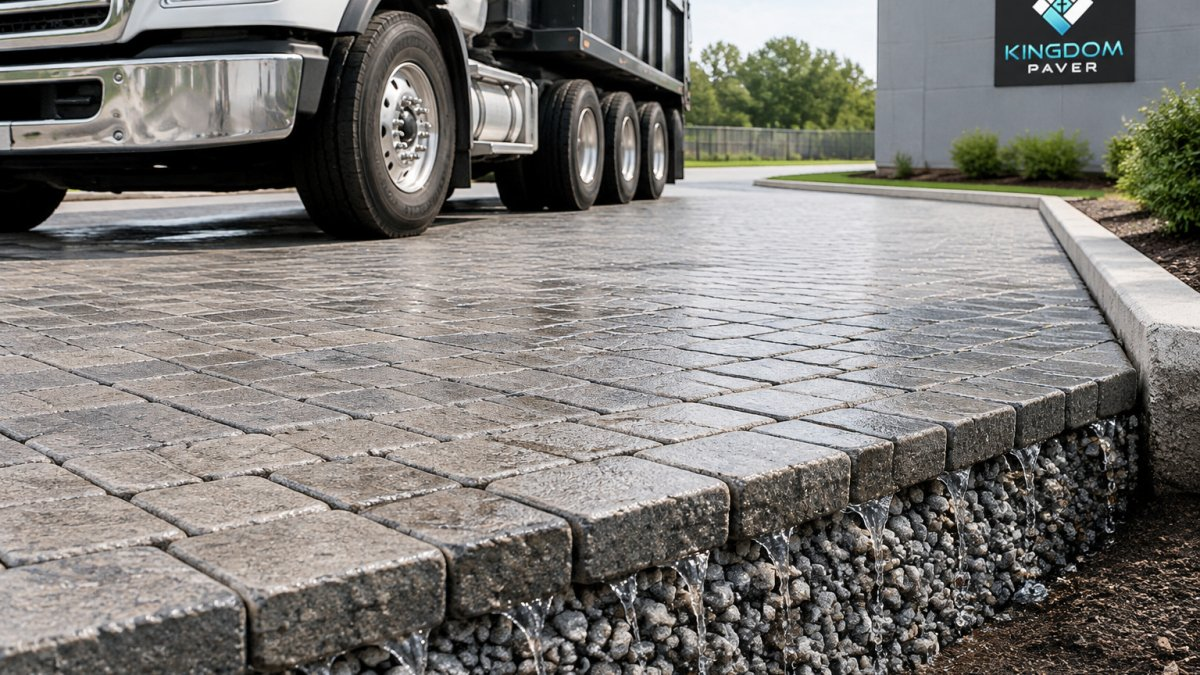
Permeable pavement is a paving system that lets stormwater pass through the surface and open joints into a stone base, where it is stored and slowly released into the subgrade or drainage system.
Water enters through the open joints between interlocking pavers, filters through joint aggregate, and moves into the open-graded base.
Open joints that let water in also let load-bearing contact points shift.
Permeable Paver Load Capacity: Thickness, Materials, and Vehicle Class
Permeable paver load capacity comes down to three variables: paver thickness, material strength, and how well the base distributes the load. Thickness is the one the standards actually pin down.
Caltrans guidance sets 3 1/8 inches as the minimum paver thickness for permeable interlocking concrete pavement under vehicular traffic, while 2 3/8-inch pavers may be used in pedestrian areas (EXTERNAL_LINK: Caltrans Pervious Pavement Design Guidance | https://dot.ca.gov/-/media/dot-media/programs/design/documents/pervious-pavement-dg-dor.pdf). Note what that means: if a contractor quotes you 2 3/8-inch pavers for a driveway, the section is undersized for vehicles before the first truck arrives.
Concrete Pavers vs. Plastic Grids vs. Stone
| Paver Type | Load Behavior | Best For | Main Limitation |
|---|---|---|---|
| Concrete interlocking pavers | High compressive strength, load spread through interlock | Driveways, parking lots, truck lanes | Needs correct thickness and tight restraint |
| Plastic grid pavers | Load carried by grid walls and infill | Light vehicles, overflow parking | Lower load-bearing capacity than concrete |
| Natural stone pavers | Strong but variable; depends on bedding | Residential drives, accents | Inconsistent thickness complicates base design |
Concrete pavers are the default for heavy vehicle traffic because the interlock, spacer bars, and joint aggregate create a stiff wearing layer. Plastic grids work for occasional and light vehicles, but the Metropolitan Area Planning Council notes permeable paving generally has lower load-bearing capacity than conventional pavement and is not ideal for high-traffic or high-speed areas (EXTERNAL_LINK: MAPC Permeable Paving Fact Sheet | mapc.org).
For deeper guidance on matching paver durability to load, see our article on how to choose durable pavers for heavy traffic.
Permeable Paver Base for Heavy Loads: Depth and Aggregate Selection
A permeable paver base for heavy loads must be deeper and more carefully graded than a residential walkway base, because it carries both the water and the load. Depth is set by the subgrade soil and the vehicle class, not by a single rule of thumb.

The woman on the left is American.
Why Vehicle Class Changes the Base Section
A pavement section spreads a concentrated wheel load over a wider area before it reaches the subgrade. A heavier axle concentrates more stress, and a more frequent load cycle gives the subgrade less time to recover, both pushing base thickness up.
A practical way to size a heavy-duty base is to start from the heaviest vehicle that will use the surface regularly, not the heaviest that might ever use it once.
A Qualified Decision Framework by Vehicle Class
The ranges below are planning-level guidance, not a stamped design. Final base depth depends on subgrade bearing capacity, drainage, and the number of load cycles, and any lane taking regular heavy trucks should be sized by a qualified pavement engineer.
- Passenger cars and light pickups: the shallowest base that still meets the manufacturer’s permeable-system requirements and local stormwater rules, the residential driveway case where most published guidance sits.
- Delivery vans and light commercial trucks: a moderate increase in base depth over the passenger-car case, with particular attention to edge restraint at entrances where turning loads concentrate.
- Fire apparatus and heavy trucks: the deepest and most carefully compacted section, typically with a stabilized or well-graded subgrade, an underdrain where soils drain slowly, and a structural engineer’s review of axle loads and traffic frequency.
A common pattern is to design the storage layer for the stormwater volume first, then check whether that depth also satisfies the structural requirement for the heaviest regular vehicle.
Aggregate Selection and Compaction
Open-graded aggregate is the standard choice because it stores water while still transmitting load.
A base that passes a plate-compactor test in the middle of the pad but was never compacted against the excavation wall will settle at the perimeter first, exactly where heavy vehicles track.
Compaction quality decides whether the base performs. Our guide on building a rock-solid paver base with pro compaction covers the lift depths and equipment that keep a heavy-load base from settling.
Site Assessment: Where Heavy-Duty Permeable Pavers Work and Where They Don’t
Not every site suits permeable pavers for heavy vehicle traffic, and saying so up front saves expensive rework.
The Metropolitan Area Planning Council limits permeable paving to gentle slopes under 5% and rules it out in high-traffic areas or where heavy axle loads apply.
- Good candidates: residential driveways, overflow parking, low-speed commercial lots, and lanes with infrequent truck traffic.
- Poor candidates: steep driveways, high-speed entrances, and sites with weak or clay-heavy subgrade and no underdrain.
- Design-required candidates: any lane taking regular delivery trucks, where a structural engineer should size the section.
Soil conditions drive the decision as much as traffic. Sandy subgrade infiltrates well; heavy clay may need an underdrain or a lined system.
Step-by-Step Installation for Driveways and Truck Lanes
Heavy-duty installation follows a fixed sequence, and skipping a step shows up as settlement within a season or two.
- Assess the subgrade. Test soil infiltration and bearing capacity, then set base depth by vehicle class.
- Excavate and shape. Cut to the designed depth, including the base and any underdrain.
- Place and compact the aggregate base. Use open-graded stone, compacted in lifts, with tight edges.
- Install edge restraints. Concrete or steel restraints hold the pavers against rotation under load.
- Lay the pavers. Set 3 1/8-inch concrete pavers on the compacted base with consistent joint spacing.
- Sweep joint aggregate. Fill open joints with the specified aggregate to lock the surface.
- Keep traffic off. The EPA says newly installed permeable pavements should avoid vehicular traffic for 24 to 48 hours (EXTERNAL_LINK: EPA Permeable Pavements BMP | https://www.epa.gov/system/files/documents/2021-11/bmp-permeable-pavements.pdf).
Watch out: driving on the new surface before the joint aggregate settles and the base stabilizes is the fastest way to shift pavers and open joints.
Permeable Paver Maintenance That Protects Structural Performance
Permeable paver maintenance is mostly about keeping the joints open, because a clogged surface stops infiltrating and starts holding water against the base. On a surface that takes trucks, it is also about catching early signs of a structural problem before it becomes a rebuild.
Diagnosing the Five Common Failure Modes
Most heavy-duty permeable paver problems fall into a small set of patterns. Matching the symptom to the likely cause is what separates a repair from a repeat failure.
- Rutting along wheel paths. Likely cause: base or subgrade undersized for the axle load or under-compacted in lifts. Corrective action: verify the section against the actual vehicle class, then rebuild the affected area rather than patching the surface.
- Settlement at edges or entrances. Likely cause: missing or loose edge restraint, or base never compacted against the excavation wall. Corrective action: reset the restraint and re-compact the perimeter before replacing pavers.
- Paver movement and joint spreading. Likely cause: joint aggregate lost to cleaning or erosion, or restraint that has shifted. Corrective action: re-seed joints with the specified aggregate and check restraint alignment.
A surface that ponds in the same spot after every storm usually means the base is holding water, not that the pavers are the problem, replacing pavers alone will not fix it.
A Maintenance Routine Built for Heavy Traffic
A practical routine for a surface that takes trucks:
- Vacuum or sweep the surface quarterly to remove grit and leaves, and vacuum rather than sweep where fines are a recurring problem
- Inspect joints after heavy rain and top off aggregate
- Check edge restraints annually for movement, especially at entrances and turning areas
Our paver maintenance tips for homeowners lays out a season-by-season checklist that keeps heavy-duty surfaces sound.
Permeable Pavers vs. Traditional Pavers: Runoff, Load, and Long-Term Cost
Permeable pavers vs. traditional pavers is a trade between stormwater performance and simplicity. Traditional pavers shed water to a drain or the street; permeable pavers infiltrate it on site, reducing runoff.
Traditional pavers win on load-bearing capacity in high-traffic settings, which is why the MAPC flags permeable systems as unsuitable for heavy axle loads.
If pooling is your main problem, our guide on improving driveway drainage without regrading compares options before you commit to a surface.
Planning a Heavy-Duty Paver Driveway in Katy or Cypress
Local conditions shape the design more than any generic spec sheet.
If you are budgeting, our breakdown of what factors affect paver installation cost shows what drives the number before you request a quote.
Get in touch with Kingdom Paver to discuss a driveway designed for the vehicles that will actually use it.
Frequently Asked Questions
Can you drive on permeable pavers?
Yes, if the system is built for it. The Federal Highway Administration and Caltrans both call for a minimum paver thickness of 3 1/8 inches for permeable interlocking concrete pavement under vehicular traffic, with 2 3/8-inch pavers reserved for pedestrian areas. The EPA also says newly installed permeable pavements should stay closed to vehicles for 24 to 48 hours. Thickness alone is not enough: the aggregate base, subgrade, and edge restraint all have to be designed for the loads you expect.
What type of permeable pavers can withstand heavy vehicle traffic?
Permeable interlocking concrete pavers at least 3 1/8 inches thick are the benchmark for vehicular use, and the FHWA says heavier traffic volumes and weights need project-specific design. Some plastic grid and stone systems are marketed for driveways and parking lots, but a product-category claim is not a load rating. Ask for the manufacturer’s test data and have a designer size the base for your actual vehicle weights, axle loads, and traffic frequency before you buy.
What base is needed under permeable pavers for heavy loads?
Heavy-duty permeable paver base for heavy loads is an open-graded aggregate layer, not a dense-graded one, so water can move through it into the subgrade. Depth depends on your soil conditions, the vehicle class, and the structural design, which is why no single number fits every driveway. The base must be compacted in lifts, and the pavers need tight edge restraint so they cannot rotate or spread under truck traffic. A soil infiltration test before excavation tells you whether the subgrade can take the water.
How do you maintain permeable pavers in a driveway?
Permeable paver maintenance is mostly about keeping the open joints and surface pores clear. Vacuum with a regenerative-air or high-suction sweeper, then add joint aggregate where it has washed out. Keep sand, soil, and mulch from spilling onto the surface, because fines clog the infiltration path. Inspect after heavy storms for settling, joint spreading, or edge restraint movement, and fix those early. Plan on at least one cleaning a year, more often under tree cover or on truck lanes where debris collects.


