
Last Updated: November 12, 2026
Quick Summary
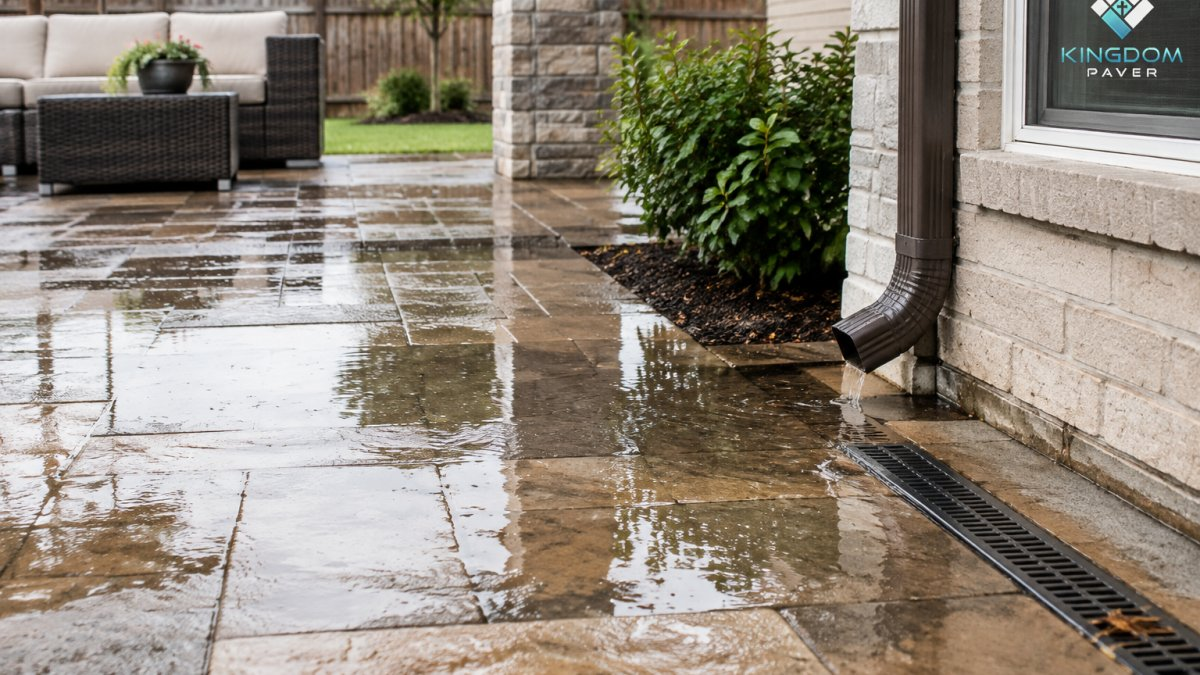
Water pooling on a patio after rain is the clearest sign of poor patio drainage, and it usually points to a slope, soil, or joint problem you can still fix. Puddles that linger for one to two days mean the surface is not draining, while soggy soil and erosion channels beside the patio signal runoff problems. Diagnose the cause with a 4-foot level and a hose water test before choosing a fix.
- A patio should shed water within a few hours of a heavy rain.
- Measure slope with a 4-foot level in at least four spots, dividing the gap by 48 for a percentage.
- Run a garden hose for five to ten minutes to see where water actually goes.
- Clear debris from channel and surface drains before assuming the slope is wrong.
- Never seal a patio before fixing the slope or base, or water gets trapped.
Table of Contents
- Signs of Poor Patio Drainage to Check After the Next Rain
- Why Water Pools on a Patio After Rain: Causes and Grading Problems
- How to Measure Patio Slope and Find the Source of the Problem
- Yard Drainage Solutions DIY: What You Can Handle Yourself
- Matching Fixes to Patio Materials and Joint Types
- The Cost to Fix Drainage Issues and What Drives the Price
- Who to Call for Drainage Problems in Your Yard
- Request a Patio Drainage Assessment from Kingdom Paver
- Frequently Asked Questions
Signs of Poor Patio Drainage to Check After the Next Rain
Water pooling on a patio after rain is the clearest sign of poor patio drainage, and it usually points to a slope, soil, or joint problem you can still fix. Drainage failures often start small, and catching them early keeps repairs simple.
Below, we walk you through the signs of poor patio drainage and solutions that hold up.
Standing Water and Puddles That Linger
Puddle duration tells you almost everything. A patio should shed water within a few hours of a heavy rain. If standing water sits for one to two days, the surface is not draining.
Walk your patio the morning after a rainstorm and check for:
- Puddles wider than a dinner plate
- Water that stays put for more than a day
- Pooling water against the house or along the patio edge
Soggy Patches, Muddy Soil, and Erosion Channels
Muddy soil and mushy areas beside the patio point to a bigger problem: runoff hits bare soil, carves erosion channels, and washes away mulch.
Look for these signs of poor drainage along the edges:
- Soggy patches in the lawn next to the patio
- Washed-away mulch or soil displacement
- Small gullies or erosion channels
These signs often mean runoff from higher areas is dumping onto your patio instead of away from it.
Why Water Pools on a Patio After Rain: Causes and Grading Problems
Water pools on a patio after rain because the surface is not sloping away from the house, the base soil is compacted, or the joints cannot move water fast enough. Most pooling comes down to grading and soil permeability.
The base under your pavers matters more than the pavers themselves.
Low Spots, Uneven Grading, and Compacted Soil
Low spots and uneven grading are the most common causes we find.
Compacted soil makes it worse: if the ground beneath the patio does not absorb water, every rainstorm becomes a puddle problem.
Watch out: water that pools near the foundation can lead to foundation cracks, basement leaks, or crawl-space moisture over time.
How to Measure Patio Slope and Find the Source of the Problem
You can measure patio slope in about ten minutes with a 4-foot level and a tape measure. The harder part is finding where the water comes from, because patio drainage failures have three sources: water that lands on the surface and cannot leave, water that enters through joints and edges, and water that arrives from a roof, downspout, or slope above the patio. Each needs a different fix, so diagnose before you dig.
Measure the surface slope
- Place a 4-foot level on the patio, pointing away from the house and perpendicular to the house wall.
- Lift the far end until the bubble centers.
- Slide a tape measure under the raised end and record the gap in inches.
- Divide the gap by 48 (the level length in inches) to get the fall as a decimal, then multiply by 100 for a percentage.
- Repeat in at least four spots: two near the house, two near the outer edge, and any spot where you have seen a puddle.
Hardscape practitioners generally aim for a fall away from the house, and a flat reading or one that tilts back toward the house means surface water has no reliable path off the patio.
Watch out: a level laid parallel to the house tells you almost nothing about drainage. Slope has to be measured on the axis running away from the building, and on an irregular patio you need several axes, not one.
Run a water test to see where it actually goes
A level shows the shape of the surface; a water test shows the behavior. On a dry day, run a garden hose at moderate flow onto the area where water usually pools and watch for five to ten minutes. Note where the water stalls, where it sheets off the edge, and whether it disappears into the joints, then repeat at the edge nearest the house and at the lowest corner.
Trace water arriving from roofs, downspouts, and uphill grades
Stand at the patio edge during or right after a steady rain and look up and uphill. Three patterns account for most “the patio won’t drain” calls that are not actually patio problems:
- Downspout discharge. A downspout that empties within a few feet of the patio dumps hundreds of gallons onto one spot during a typical storm. Look for a splash pad, stain, or scour mark at the outlet.
- Gutter overflow. A clogged or undersized gutter sends a sheet of water over the edge. Look for a vertical streak of mud or discoloration on the siding above the patio.
- Uphill runoff. Water running off a lawn, bed, or neighboring slope crosses the patio because nothing intercepts it. Look for a line of silt, washed mulch, or flattened grass pointing at the patio edge.
If any of those three is present, fixing the patio slope alone will not solve the problem. The water has to be intercepted or redirected before it reaches the patio.
Check the drain outlet itself
Before you conclude the slope is wrong, confirm the outlet is open. A channel drain or surface drain blocked with leaves, sediment, or root intrusion backs water up onto the patio and mimics a grading failure. For the full cleaning process, see our guide on how to clean and maintain trench drains.
Decide what the readings mean
Put the evidence together before you choose a fix:
- Low slope plus surface puddles plus a clear outlet: regrade or rebuild the affected section.
- Normal slope plus water vanishing at joints plus damp ground beside the patio: the base or joint system is the problem, not the surface pitch.
- Normal slope plus a wet streak from above: roof, gutter, or downspout water is the source; redirect it first.
For a full walkthrough on fixing sunken sections once you have confirmed the cause, see our guide on 7 steps to fix sunken paver patio sections like a pro.
Put the evidence together before you choose a fix.
| What the readings show | What it means | What to do |
|---|---|---|
| Low slope plus surface puddles plus a clear outlet | Surface is not draining | Regrade or rebuild the affected section |
| Normal slope plus water vanishing at joints plus damp ground beside the patio | Base or joint system is the problem | Fix the base or joint system, not the pitch |
| Normal slope plus a wet streak from above | Roof, gutter, or downspout water is the source | Redirect it first |
| Normal slope plus a backed-up drain | Outlet is blocked | Clear the outlet and re-test |
Yard Drainage Solutions DIY: What You Can Handle Yourself
Yard drainage solutions DIY work best when the problem is small and the cause is clear.

Start with these fixes:
- Clear debris from channel drains and surface drains
- Extend downspouts so water discharges away from the patio
- Re-sand joints to improve water runoff
If your trench drains are clogged, our guide on how to clean and maintain trench drains covers the full process.
What most guides miss is discharge. Water has to go somewhere safe, and dumping it onto a neighbor’s yard or toward your foundation just moves the problem.
Matching Fixes to Patio Materials and Joint Types
The right fix depends on your patio material and joint type, because each surface moves water differently. A paver patio with wide sand joints behaves like a permeable surface that also sheds; a solid concrete slab behaves like a roof with cracks in it; a gravel patio is permeable by design but silts up over time.
Paver patios with sand joints
Sand joints are one of the drainage paths on a paver patio, and washed-out or clogged joints can allow water to pool on the surface.
- Symptom: puddles in the middle of the field. Usually a settled low spot. Lift and reset the affected pavers, re-level the bedding layer, and restore the slope.
- Symptom: joints washing out after storms. The joint sand is too fine or the slope is too steep for the sand to stay put. Re-sand with a graded joint sand and check the slope.
- Symptom: damp ground beside the patio with no surface puddles. Water is leaving through the joints and the base is not draining. The base needs to be opened up or a drain added at the edge.
For joint sand selection, our article on the best sand for paver joints to improve water runoff explains which gradations keep water moving without washing out.
Paver patios with polymeric joints
Polymeric joint sand binds the pavers and resists washout, but it is not immune to clogging. Over time, dirt, pollen, and fine sediment fill the joint and reduce its permeability. The fix is usually cleaning rather than replacement: a stiff broom, a low-pressure rinse, and a top-up with fresh polymeric sand where the joint has receded.
Concrete slabs
A concrete slab sheds water almost entirely by slope, so cracks and flat spots are the enemy. Hairline cracks let water into the base, where freeze-thaw and soil movement widen them.
Natural stone and travertine
Stone and travertine are typically set tight with narrow joints, so they behave more like concrete than pavers: water sheds off the surface and any water reaching the edges has to be handled there. The common failure is water trapped at the perimeter, where the stone meets soil, mulch, or a wall.
Gravel and permeable surfaces
Gravel is permeable by design, but it silts up. When a gravel patio stops draining, remove the top inch or two, clean or replace the fines, and restore the grade. Permeable pavers work the same way, the open joints and open-graded base do the work, and both clog with sediment over time.
Match the fix to severity, not just material
Use the material as the first filter and severity as the second:
- Cosmetic or localized: clean joints, clear drains, re-sand, seal cracks. Low disruption, homeowner-doable.
- Moderate: lift and reset a section, regrade the edge, add a channel drain along one side. Best handled by a hardscape crew.
- Structural: base failure, widespread settling, water against the foundation. Requires excavation and a base rebuild, and sometimes a professional drainage design.
Watch out: sealing a patio before fixing the slope or the base traps water in the base layer and accelerates settling. Fix drainage first, then seal, never the other way around.
The Cost to Fix Drainage Issues and What Drives the Price
The cost to fix drainage issues depends on the cause, the size of the area, and whether the fix is surface-level or structural.
Pricing depends on quantity, dates, and delivery, and varies by project. For current prices or a quote, contact Kingdom Paver through the website.
We recommend getting a site assessment before you budget, since the scope of the work determines the cost.
Who to Call for Drainage Problems in Your Yard
Call a paver or hardscape contractor when water pools against the house, pavers have settled, or DIY fixes have not worked after two rainy seasons. A drainage problem tied to grading or base failure needs someone who understands both water and pavers.
Ask any contractor three questions before hiring:
- Will you inspect the base, not just the surface?
- Do you handle the whole job, or subcontract it out?
- What happens if the patio settles again after the fix?
To vet your options properly, read our guide on how to hire a paver contractor. It walks through the questions that separate reliable crews from the ones that disappear once work starts.
If you spot sunken or uneven pavers, our guide on how to level sunken patio pavers without removing them covers a less disruptive fix.
Request a Patio Drainage Assessment from Kingdom Paver
Water that sits on your patio after every rainstorm is a warning, not a small annoyance.
Kingdom Paver has ten years of experience serving Katy and Cypress, with affordable, durable building solutions for patios, driveways, walkways, flowerbeds, and custom outdoor kitchens.
Get started with Kingdom Paver and put an end to standing water on your patio.
Frequently Asked Questions
What are the signs of poor patio drainage?
The clearest signs are standing water or puddles that linger more than a day after rain, soggy or mushy patches along the patio edge, muddy soil, and erosion channels where runoff has washed away mulch or soil. You may also see white mineral deposits or efflorescence on the pavers, sinking or shifting stones, and moisture near the foundation, crawl space, or basement wall. Catching these early keeps a small grading fix from turning into a full patio rebuild.
Why does water pool on my patio after rain?
Water pooling on a patio after rain usually comes from one of three causes: a low spot or uneven grading that lets water collect instead of draining away, compacted soil underneath that absorbs water slowly, or runoff from a higher area or downspout that dumps onto the patio. Joints and edge restraints that have shifted can also trap water. A quick slope check with a level and a slow hose test will tell you which cause you are dealing with.
Do all patios need a drain?
No. A patio built with the correct slope away from the house, a solid base, and proper joint spacing often drains fine without a dedicated drain. A drain or channel drain becomes necessary when the patio sits against a wall, is enclosed by retaining walls, has a roof downspout emptying onto it, or covers a large area where surface water cannot escape fast enough. The right answer depends on the site, not a one-size rule.
Who should I call for patio drainage problems?
Start with a licensed landscape or hardscape contractor who installs patios and can regrade, reset pavers, and add channel or surface drains. If the problem involves the house foundation, basement leaks, or crawl-space moisture, bring in a drainage or foundation specialist as well. Ask for proof of insurance, a written scope, and a workmanship warranty.


