Top Materials for Outdoor Kitchen Countertops at a Glance
Choosing the best materials for outdoor kitchen countertops comes down to five surfaces that handle sun, heat, and rain: granite, porcelain slabs, quartzite, soapstone, and stainless steel. This guide breaks down how each performs and which fits your climate and cooking style.
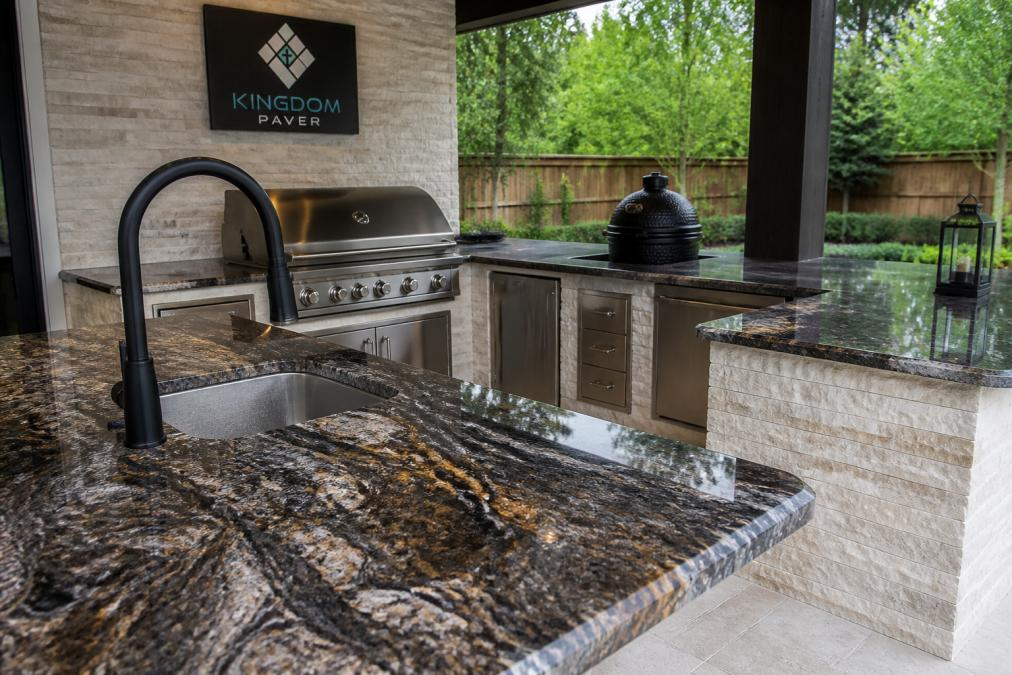
Polished granite outdoor kitchen countertops on a backyard island with a stainless steel grill and bar seating
Here’s how the leading options stack up:
Material
Heat Resistance
UV Stability
Porosity
Starting Cost (Installed)
Granite
High
Excellent
Low (needs sealing)
$50-$150/sq ft
Porcelain Slabs
High
Excellent
Non-porous
$60-$120/sq ft
Quartzite
High
Excellent
Low (needs sealing)
$80-$200/sq ft
Soapstone
Very High
Excellent
Non-porous
$70-$120/sq ft
Stainless Steel
Very High
Excellent
Non-porous
$80-$200/sq ft
Granite, Porcelain, and Quartzite: Heat, UV, and Weather Performance
Granite wins on raw heat tolerance: you can set a hot cast-iron pan directly on it without scorching, and it resists UV fading year after year. The catch is porosity, granite needs periodic sealing to keep oil, wine, and grease from soaking in.
Pro Tip For grilling stations, leave a small gap between the countertop edge and the grill body. This gives hot metal room to expand without pressing against the slab, which is where most thermal cracks start.
Outdoor Kitchen Countertop Cost Comparison: What Each Surface Really Runs
Prices vary by region, slab availability, and edge profile, so treat these as starting points. Fabrication and installation often add more to the final bill than the material itself.
Porcelain vs Granite for Outdoor Kitchens: Which Wins Your Setup?
Porcelain and granite are the two most common recommendations for outdoor kitchens, and they win for opposite reasons: porcelain on maintenance and moisture resistance, granite on uniqueness and repairability. The right choice depends on how much upkeep you’ll do and how exposed your island is.
Why Porcelain Resists Stains and Granite Doesn’t (Without Sealing)
The difference is structure. Porcelain slabs are fired at roughly 2,200°F, fusing clay and minerals into a dense, vitrified surface with water absorption under 0.5%, no open pores for wine, oil, or grease. Granite is a natural igneous rock with microscopic fissures between mineral grains, which give it depth and variation but also let liquids in. A penetrating sealer fills those fissures temporarily, and outdoors it wears off every 12-24 months.
Edge Behavior: The Most Overlooked Difference
Granite is solid through its full thickness, so a fabricator can often grind and re-polish a chip nearly invisible. Porcelain slabs are a thin, hard surface layer over a body that may be a different color, so a chipped edge exposes the body underneath and matching the color is difficult or impossible. That’s why edge profile matters more with porcelain: a bullnose or eased edge distributes impact better than a sharp square edge and reduces chipping risk.
Heat, UV, and Thermal Shock
Both handle direct sun and high heat without fading; the difference is thermal shock. Porcelain’s low absorption and high density resist it, so a hot grill lid or sudden rain shower is unlikely to crack it. Granite handles heat well too, but a hot pan on a cold slab in winter, or cold water on a sun-heated slab, can stress it enough to crack along a natural fissure.
Cost and Installation Reality
Installed costs overlap. The bigger difference is fabrication. Granite is cut by widely available stone fabricators, while porcelain requires diamond tooling and experience, not every fabricator handles it, and a botched cut isn’t repairable. In an area with limited porcelain fabricators, granite may be the more practical choice even at similar material cost.
A Simple Decision Framework
Choose porcelain if: your island is fully exposed to rain and humidity, you want zero sealing, you prefer a uniform modern look, and you have access to a fabricator experienced with porcelain slabs.
Choose granite if: you want a one-of-a-kind surface, you’re willing to seal every 12-24 months, you want the option to repair chips and scratches, and you have local stone fabricators available.
Choose neither if: your island is in a freeze-thaw climate and you won’t commit to sealing, soapstone or a properly installed porcelain slab is the safer bet.
Key Takeaway The honest answer is that both work outdoors. Porcelain trades repairability for near-zero maintenance; granite trades maintenance for uniqueness and the ability to be refinished. Pick based on which trade-off you’ll actually live with.
Maintenance Requirements for Outdoor Countertops: Sealing, Cleaning, and Repair
Outdoor surfaces need more attention than indoor ones because they face sun, rain, and temperature swings. A simple routine keeps them looking new for years.
Seal granite and quartzite every 12-24 months with a penetrating sealer
Wipe spills promptly on natural stone, even sealed slabs
Clean porcelain and stainless steel with mild soap and water
Avoid acidic cleaners on natural stone; they etch the surface
Reapply sealer sooner in high-traffic grilling zones
Inspect edges and seams each spring for chips or separation
Treat soapstone with mineral oil to even out its patina
Watch Out Never use vinegar, lemon, or other acidic cleaners on granite, quartzite, or soapstone. They eat into the surface and leave dull etch marks that require professional re-polishing to remove.
Climate, Installation, and Long-Term Aging: What Most Guides Skip
Most guides treat outdoor countertops as if every backyard has the same weather. The same slab that performs flawlessly on a covered patio can fail in three years on an exposed island elsewhere. Here’s how to match material to your actual conditions, plus what installation and aging really look like.
Climate-by-Climate Recommendations
Hot and humid (Gulf Coast, Southeast, Mid-Atlantic summers). The enemy is moisture that never dries. Porous stone stays damp, feeding mildew in seams and grout lines and accelerating stains. Non-porous surfaces, porcelain slabs and stainless steel, hold up best. If you want natural stone, granite and quartzite work, but seal every 12 months instead of 24 and inspect the underside of overhangs where condensation collects.
DIY vs. Professional Installation
Some materials are genuinely DIY-friendly. Others are not, and the difference usually comes down to whether the material arrives as a finished slab or as something you cut and finish on site.
DIY-feasible with care: Tile (set on a properly prepared cement backer board), concrete (poured in place with a mold), and some modular stainless steel units that bolt together.
Professional fabrication strongly recommended: Granite, quartzite, soapstone, and porcelain slabs. These arrive as large slabs that must be cut for sink and grill cutouts, edge-profiled, and seamed. A wrong cut means buying another slab, there’s no patching a mis-cut natural stone top.
Professional only: Stainless steel fabricated to custom dimensions. Welding, polishing, and forming require a metal shop.
How Materials Age Over 5-10 Years
New-countertop photos are misleading. What actually happens over time:
Soapstone: Develops a darker, softer patina as it’s oiled and used. Scratches can be sanded out or simply left, many owners prefer the lived-in look. It never looks “worn out,” just older in a way most people find attractive.
Granite and quartzite: Hold color and polish for decades. The main aging is in the sealer, not the stone. Skip resealing and you’ll see dull patches and absorbed stains that require professional re-polishing.
Porcelain: Stays visually uniform. The aging risk is edge chipping from impact and, in freeze-thaw climates, hairline cracks at seams if the substrate moves.
Stainless steel: Shows scratches, fingerprints, and water spots. Some owners like the patina; others find it looks commercial. It can be re-brushed by a fabricator, but most people just live with it.
Concrete: Cracks. It’s not a matter of if but when, and outdoor slabs crack sooner. Some owners embrace the cracks as character; others seal them and move on.
Pro Tip If you’re in a freeze-thaw region, ask your fabricator to specify a 3 cm slab rather than 2 cm. The extra thickness resists the internal stresses of freeze-thaw cycling far better, and the cost difference is usually modest compared to replacing a cracked top.
Watch Out Don’t assume a covered patio solves every climate problem. Wind-driven rain, morning condensation, and seasonal humidity still reach covered islands. The material still has to handle moisture, it just handles less of it.
How to Choose the Right Countertop for Your Outdoor Kitchen
Match the material to how you cook and how much weather your island takes. There’s no single winner, only the right fit.
Heavy grilling, exposed site: Porcelain or granite
Luxury look, higher budget: Quartzite
Rustic style, lots of hot pans: Soapstone
Commercial chef setup: Stainless steel
Covered patio, tight budget: Tile or laminate
Custom shapes and curves: Concrete
Key Takeaway The best material is the one that matches your climate and cooking habits. Non-porous surfaces win in humid, rainy regions; sealed natural stone wins where you want a unique look and will keep up with maintenance.
Frequently Asked Questions
Is granite or quartz better for outdoor kitchens?
Granite handles outdoor conditions better than quartz. The resins in engineered quartz can yellow and degrade under intense UV exposure, while granite keeps its color and structure. Granite also tolerates hot cookware directly. The tradeoff is that granite needs periodic sealing to prevent staining, while quartz does not. For a fully exposed outdoor kitchen countertop, granite is the safer long-term pick.
Do outdoor kitchen countertops need to be sealed?
It depends on the material. Natural stones like granite and quartzite are porous and need sealing every one to two years to block moisture and stains. Soapstone and porcelain slabs are non-porous and do not require sealer. Concrete should be sealed to limit moisture absorption and hairline cracking. Skipping sealer on porous stone leads to staining, mold growth, and freeze-thaw damage over time.
What is a good lightweight countertop for an outdoor kitchen?
Porcelain slabs and tile are the lightest practical options. Porcelain slabs weigh far less than granite or concrete, resist UV fading, and need no sealing. Tile is even lighter per piece and lets you replace individual sections if one cracks. Both work well on islands built from standard framing because they reduce the structural load compared to a thick stone slab.
How much does an outdoor kitchen countertop cost?
Installed pricing varies widely by material and project size. Final cost depends on slab size, edge profile, fabrication, and site access, so request a written quote based on your specific layout.
Picking a countertop is really about matching a surface to your climate, your cooking, and your tolerance for upkeep. Kingdom Paver handles the whole project, from custom outdoor kitchen design to professional installation of the countertop, island, and surrounding hardscape. With 10 years of experience and affordable, tailored building solutions, we build outdoor spaces made to last. Contact Kingdom Paver to plan your outdoor kitchen and get the surface that fits your backyard.