
Table of Contents
- Why Homeowners Are Moving Beyond Traditional Backyard Lighting
- Solar Backyard Lighting Ideas for Energy-Free Illumination
- Low-Voltage Landscape Lighting: Efficiency Without Hardwiring
- Outdoor Lighting Without Electricity: Battery and Manual Options
- Budget-Friendly Outdoor Lighting Ideas That Don’t Compromise Style
- String Lights, Lanterns, and Decorative Fixtures for Ambiance
- Safety, Installation, and Long-Term Performance Considerations
- Conclusion
- Frequently Asked Questions
Last Updated: October 6, 2026
Why Homeowners Are Moving Beyond Traditional Backyard Lighting
The shift toward alternatives to traditional backyard lighting reflects a fundamental change in how homeowners approach outdoor spaces. Traditional hardwired fixtures require licensed electricians, trenching, and permanent installation, expensive, inflexible, and often overkill for modern outdoor entertaining.
Lighting choices consistently decide how people actually use their patios, decks, and gardens.
This article explores practical alternatives to traditional backyard lighting, solar, battery-operated, string lights, and decorative fixtures, covering what works, what costs what, and how to avoid common pitfalls.
Solar Backyard Lighting Ideas for Energy-Free Illumination
Solar backyard lighting ideas have matured dramatically over the past five years. Modern solar pathway lights, spotlights, and string lights deliver genuine illumination without electricity costs or wiring.
Solar pathway lights work best in consistently sunny locations, charging by day and activating automatically at dusk. Most models produce enough light to navigate walkways and define garden edges, and installation takes minutes.
Solar spotlights offer directional accent lighting to highlight landscaping, architectural features, or garden focal points. They’re particularly effective with hardscaping projects Kingdom Paver installs, where uplighting showcases new patio edges or stone work.
The main limitation of solar lighting is weather dependency: cloudy climates or shaded yards reduce charging efficiency, and shorter winter days mean dimmer output. In these situations, battery-operated or hardwired alternatives deliver better results.
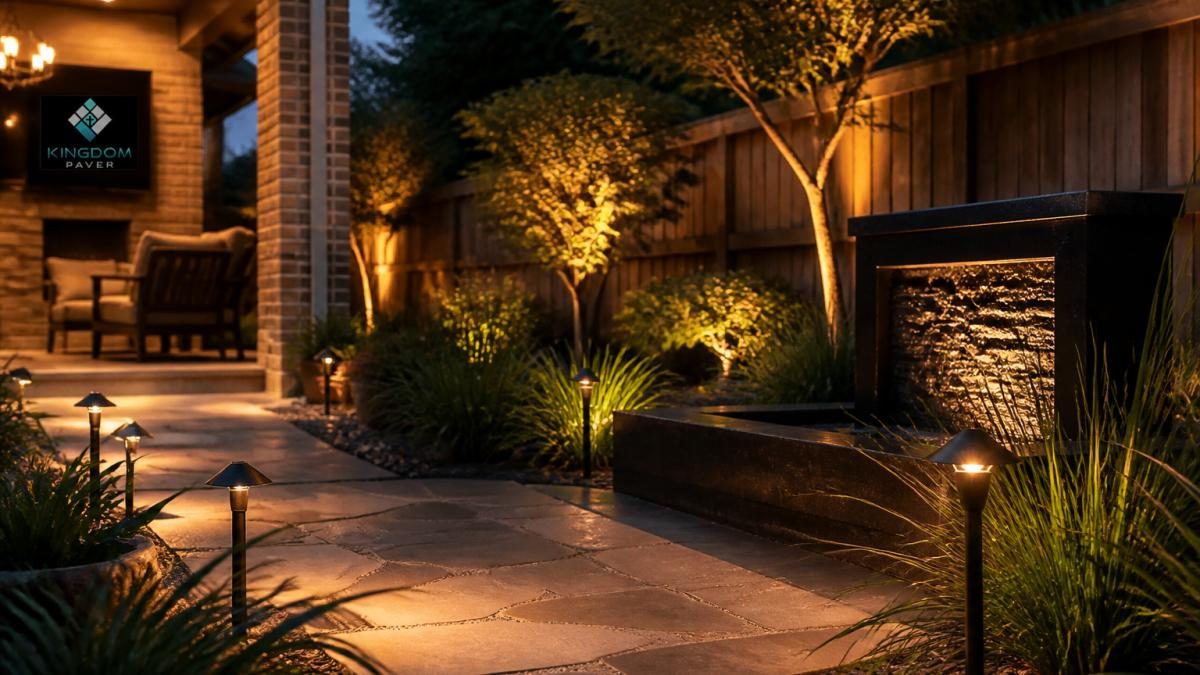
Low-Voltage Landscape Lighting: Efficiency Without Hardwiring
How the system actually works. A transformer plugs into a standard outdoor GFCI outlet and converts 120-volt household current to 12 volts. A main cable runs through the yard, and fixtures tap in with gel-filled connectors.
Where low-voltage wins the comparison.
- Brightness: A 12-volt system can drive fixtures in the 100-900 lumen range, meaningfully brighter and more consistent than most solar path lights and far more controllable than battery string lights. This is why landscape designers default to low-voltage for uplighting trees, washing walls, and lighting steps.
- Install effort: Moderate. You need an outdoor outlet, a transformer sized to total fixture wattage, and a cable-routing plan. Most homeowners finish a small system in a weekend; larger systems take longer.
- Upfront cost: Higher than solar or battery, lower than a full 120-volt hardwired install. Transformer, cable, connectors, and fixtures are the main line items, with fixture quality driving most of the spread.
- Lifespan and upkeep: Fixtures typically outlast solar and battery options, no battery to degrade, no panel to cloud over, and quality LEDs are rated for tens of thousands of hours. The transformer and connections need occasional attention.
Voltage drop is the detail most guides skip. On a 12-volt run, voltage drops as distance from the transformer increases, so fixtures at the end of a long cable look dimmer than those near the transformer.
Where low-voltage loses. It still needs power at the transformer, so a yard with no outdoor outlet isn’t a candidate without adding one.
If you already have an outdoor outlet near the patio, a low-voltage system is usually the best balance of brightness, reliability, and installation simplicity. If you do not, price the outlet and transformer together before comparing against solar or battery options, the outlet is often the hidden cost.
How it stacks up against the other alternatives. Solar is cheaper and needs no power source but is weather-dependent and dimmer. Battery lights are the most flexible and renter-friendly but require battery management. Traditional hardwired 120-volt lighting is brightest and most permanent but requires an electrician, trenching, and code compliance. Low-voltage sits in the middle: brighter and more reliable than solar or battery, simpler and safer than 120-volt.
Outdoor Lighting Without Electricity: Battery and Manual Options
Battery-operated outdoor lighting is the most flexible category of alternatives to traditional backyard lighting, requiring no wiring, outlets, or installation beyond placing the fixture.
Battery-powered LED lights come in dozens of styles: string lights, lanterns, spotlights, wall sconces, and pathway markers.
Look for at least 100+ lumens for meaningful illumination. Solar-rechargeable batteries reduce replacement frequency and operating costs, and many modern lights include remote controls or smart home integration.
Manual options, candles, oil lamps, and fire features, add ambiance without electricity or batteries.
Battery and manual lighting excel for renters, temporary installations, or anywhere permanent wiring isn’t practical, and for testing layouts before committing to permanent solutions.
Budget-Friendly Outdoor Lighting Ideas That Don’t Compromise Style
Budget-friendly outdoor lighting ideas focus on high-impact solutions requiring little investment. String lights remain the most popular budget option: affordable, visually appealing, and transformative.
Basic Edison-style string lights cost less than premium solar systems and deliver a warm, inviting atmosphere.
Lanterns, battery-powered, candle-based, or solar, provide localized light and decorative appeal. Grouping several creates visual interest while distributing illumination, and affordable options exist in every style, from modern geometric to traditional Moroccan.
Pathway and garden lights, especially solar, cost surprisingly little per fixture. Buying in bulk (10-20 units) spreads the cost while creating cohesive lighting that guides movement and highlights landscaping.
Uplighting and downlighting use inexpensive fixtures to dramatic effect: uplighting trees or architectural features creates depth, while downlighting from overhead structures provides practical illumination with minimal equipment.
String Lights, Lanterns, and Decorative Fixtures for Ambiance
String lights and lanterns are the most popular category of decorative outdoor lighting because they combine function with genuine visual appeal, transforming backyards into entertaining spaces that feel intentional and welcoming.

String light styles range from classic Edison bulbs to modern globe and fairy lights.
Hanging fixtures, chandeliers, pendant lights, and swag lights, add architectural interest with functional illumination. Outdoor chandeliers rated for wet environments create focal points on covered patios, and pendants work well from pergolas or overhead structures.
The key to successful decorative lighting is layering: combine string lights with lanterns, add pathway lights, and include accent spotlighting for depth.
Safety, Installation, and Long-Term Performance Considerations
Most lighting roundups stop at inspiration. The details that determine whether a system actually works, electrical safety, weather ratings, light pollution, and upkeep, are where homeowners get surprised.
Electrical safety and when to hire a professional
Traditional 120-volt hardwired lighting is the only category carrying real shock and fire risk if done wrong. It requires a licensed electrician in most jurisdictions, must comply with local codes, and typically needs GFCI protection outdoors. Adding a circuit, running conduit, or tying into your panel is electrician work.
Low-voltage 12-volt systems are far safer, too low to deliver a dangerous shock under normal conditions, which is why they’re commonly homeowner-installable. Still, the transformer plugs into 120-volt power, so the outlet should be GFCI-protected and the transformer rated for outdoor use and sized to total fixture wattage.
Solar and battery lights eliminate line-voltage risk entirely. The trade-offs shift to battery management and weather exposure, a failed battery light simply stops working rather than creating a hazard.
Never bury standard 120-volt cable without proper conduit and code compliance, and never splice household wiring with consumer connectors. If a project involves line voltage and you are not licensed, hire an electrician, the cost is small compared to the risk.
Weather ratings: what IP codes actually mean
Outdoor fixtures carry an Ingress Protection (IP) code, two digits, the first for solids and the second for water. For backyard lighting, the second digit matters most:
- IP44, splash-resistant; fine for covered porches and sheltered areas.
- IP65, dust-tight and protected against water jets; the practical minimum for fixtures exposed to rain.
- IP67, protected against temporary immersion; useful for fixtures near sprinklers or in low spots.
- IP68, protected against continuous immersion; rarely necessary for residential lighting.
A fixture without an IP rating, or with a vague “weatherproof” claim, is a gamble. Cheap fixtures often fail at the connector or seal, not the LED, so check where the cable enters the housing.
Light pollution, glare, and dark-sky-friendly design
A bright yard is not the same as a well-lit yard. Glare, light shining into eyes or a neighbor’s window, is the most common complaint about outdoor lighting, and it’s entirely avoidable.
Three practical moves reduce glare and light spill:
- Shield and aim. Use fixtures with shields, louvers, or hoods, and aim light downward at the surface you want lit. Uplighting a tree is fine; uplighting the sky is waste.
- Choose warmer color temperatures. Light in the 2700K-3000K range is easier on the eye and less disruptive to wildlife than the cool 4000K-5000K common in budget fixtures, and it flatters landscaping and gatherings.
- Control the schedule. Timers, motion sensors, and smart controls keep lights off when not needed, reducing energy use, extending fixture life, and limiting spill into neighboring yards.
These choices align with dark-sky-friendly principles: light only what you need, when you need it, as brightly as necessary.
Long-term performance and maintenance
Every alternative has a maintenance rhythm. Knowing it up front prevents the common disappointment of a system that looked great in month one and dim in month twelve.
- Solar: Clean panels periodically to remove dust, pollen, and bird droppings. Expect reduced winter and shaded-yard output, and battery replacement every couple of years.
- Battery: Use quality rechargeable batteries and remove them before long storage. Cheap proprietary batteries are the most common failure point.
- Low-voltage: Check connections after freeze-thaw cycles, keep the transformer ventilated and dry, and re-aim fixtures after storms or landscaping.
- String lights: Store during harsh winters if not rated for year-round exposure, and inspect for cracked insulation before rehanging.
- Decorative fixtures: Clean lanterns and glass periodically; candle and oil-lamp soot builds up quickly.
Planning lighting into a renovation
When lighting is an afterthought, homeowners retrofit outlets, re-route cable, or settle for mismatched fixtures. If you’re planning a patio, deck, or hardscaping project, decide the lighting layout alongside the space layout. That lets you place outlets, plan low-voltage runs, and choose fixture locations before surfaces are finished, almost always cheaper and cleaner than adding lighting later.
The best backyard lighting is not the brightest, it is the right light, in the right place, at the right time, with a maintenance plan you will actually keep up with. Safety, ratings, and glare control are what separate a system that works for years from one that disappoints in a season.
Conclusion
Choosing alternatives to traditional backyard lighting doesn’t mean sacrificing quality or ambiance. Modern solar, battery-operated, and decorative options deliver genuine functionality with flexibility permanent hardwired systems can’t match. The right choice depends on your situation: solar suits sunny yards, battery lights suit renters and temporary setups, and low-voltage systems balance reliability with reasonable installation complexity.
When you’re investing in your outdoor living space, a new patio from Kingdom Paver or a complete backyard transformation, lighting deserves equal planning attention. Our team has helped homeowners create outdoor spaces that are genuinely usable and visually compelling. The lighting you choose determines whether your patio becomes a gathering place or an unused investment. Contact Kingdom Paver to discuss how professional hardscaping and thoughtful lighting design can transform your backyard into the outdoor space you’ve imagined.
Frequently Asked Questions
What are the best alternatives to traditional backyard lighting?
The most popular alternatives include solar-powered lights, low-voltage LED systems, string lights, lanterns, and battery-powered fixtures. Solar lights require no wiring and work well for pathway and accent lighting. Low-voltage systems offer more brightness and control than solar while avoiding the expense of hardwired installation. String lights and lanterns provide ambiance for entertaining. The best choice depends on your lighting needs, budget, and whether you want permanent or flexible placement.
Are solar lights bright enough for backyard use?
Modern solar lights have improved significantly and work well for ambient and pathway lighting. However, they’re typically less bright than hardwired or battery-powered LED alternatives, especially on cloudy days or during winter months. Solar path lights are excellent for safety and navigation, while solar spotlights work best for accent lighting on landscaping. For task lighting on patios or decks where you need substantial brightness, low-voltage or plug-in LED systems are more reliable.
How can I light a backyard without installing wired fixtures?
Several options avoid permanent wiring: solar-powered lights (path lights, spotlights, string lights), battery-powered LED fixtures, plug-in string lights connected to exterior outlets, rechargeable lanterns, and decorative lights. Low-voltage systems require minimal digging and are far easier to install than traditional hardwired lighting. These alternatives give you flexibility to adjust placement seasonally and avoid the cost and disruption of trenching or running electrical conduit.
What’s the difference between solar and low-voltage landscape lighting?
Solar lights charge during the day and run independently at night, requiring no electrical connection or wiring. Low-voltage systems connect to a transformer that steps down standard household current to 12 volts, then distribute power through buried cables to multiple fixtures. Low-voltage lights are generally brighter and more reliable, especially in cloudy climates, while solar lights are easier to install and have zero operating costs. Low-voltage systems work better for permanent installations and task lighting; solar is ideal for flexibility and maintenance-free operation.


