
Last Updated: November 14, 2026
Quick Summary
Ask any paver repair contractor for written proof of licensing, insurance, and bonding, then request repair-specific references and before-and-after photos. Require a written diagnosis of what caused the damage, an itemized estimate covering base work and disposal, and warranty terms in writing before you sign.
- Verify the license number with the state or local licensing authority yourself, and confirm insurance is active with the insurer.
- Request three references from repair jobs, not installations, and ask whether each repair held up through a full year of weather.
- A written estimate should itemize labor, materials, equipment, disposal fees, and permit costs as separate lines.
- Repair suits isolated damage; replacement suits widespread failures, a compromised base, or pavers no longer manufactured.
- Ask whether the workmanship warranty covers only repaired units or the surrounding field, and what voids it.
Table of Contents
- What to Ask a Paver Repair Contractor Before You Hire
- Your Paver Repair Contractor Checklist: Credentials, Experience, and References
- How to Diagnose the Damage: Questions About Repair Scope and Method
- What a Paver Repair Estimate Should Include
- Paver Repair Timeline: Scheduling, Disruption, and Completion
- Paver Repair vs Replacement: Which Is Right for Your Patio or Driveway?
- Workmanship Warranties, Product Warranties, and Red Flags to Watch For
- Next Step: Get a Written Repair Quote from Kingdom Paver
- Frequently Asked Questions
What to Ask a Paver Repair Contractor Before You Hire
A sunken patio corner or a crack running through your driveway is more than an eyesore. It is a symptom, and how your contractor reads that symptom decides whether the repair lasts five years or five months. This guide from Kingdom Paver covers the exact questions to ask a paver repair contractor before you sign anything, from credentials to warranties.
The questions below are the ones a homeowner should ask any paver repair contractor before hiring.
Most guides on this topic are written for new installations. Repair is different. You are not buying a fresh surface; you are buying a diagnosis and a fix for whatever caused the failure. That distinction shapes every question that follows.
Your Paver Repair Contractor Checklist: Credentials, Experience, and References
Start with the basics: is the contractor licensed, insured, and bonded, and can they prove it in writing? A legitimate paver contractor will hand over documentation without hesitation. Anyone who dodges the question is telling you something.
Licensing, Insurance, and Bonding
Ask for the license number and verify it with the state or local licensing authority yourself. Request a certificate of insurance showing general liability and workers’ compensation coverage, and call the insurer to confirm the policy is active. Bonding protects you if the contractor fails to complete the work or violates permit terms. Get all three in writing before work begins.
Experience, References, and Project Portfolio
Ask how many years they have worked specifically with pavers, not general landscaping. Request three references from repair jobs, not just installations, and actually call them. Ask each reference whether the repair held up through a full year of weather. Then ask to see a portfolio with before-and-after photos of repairs that match your problem.
How to Diagnose the Damage: Questions About Repair Scope and Method
The right repair starts with an honest diagnosis, so ask your contractor to explain what caused the damage before quoting a fix. Most installation-oriented guides skip this step entirely. Repair is a diagnostic purchase: you are paying someone to read the failure and correct its cause, not just to drop a new paver into a hole.
Use this symptom-to-cause map to steer the conversation. Ask your contractor to walk through each symptom you see and name the likely mechanism before discussing price.
| What You See | Common Underlying Causes | Questions to Ask |
|---|---|---|
| Sunken or dipped section | Thin or poorly compacted base, settling soil, water pooling under the surface, buried organic debris | How deep will you excavate, and how will you re-compact the base? Will you re-level the subgrade or just add sand? |
| Shifted or spread pavers | Missing or failed edge restraint, inadequate joint sand, lateral creep on slopes | Will you reset the edge restraint and re-sand the joints? What holds the perimeter in place? |
| Cracks through units | Point loading from an unstable base, root intrusion, freeze-thaw or thermal stress, heavy vehicle traffic on a pedestrian-rated build | Is the crack a symptom of base movement? Will you replace the cracked unit or reset the surrounding field? |
| Loose, rocking, or wobbly pavers | Bedding sand washed out, joint sand loss, drainage directing water under the surface | How will you correct the drainage so the bedding stays put? |
| Efflorescence or staining | Moisture migrating through the slab or base, poor drainage, certain cleaning chemicals | Is this a moisture problem, and what will you do about the source? |
| Weeds or vegetation in joints | Failed joint sand, organic material in the base, poor edge containment | Will you re-sand with polymeric sand, and how do you prevent regrowth? |

Questions About Repair Method and Material Matching
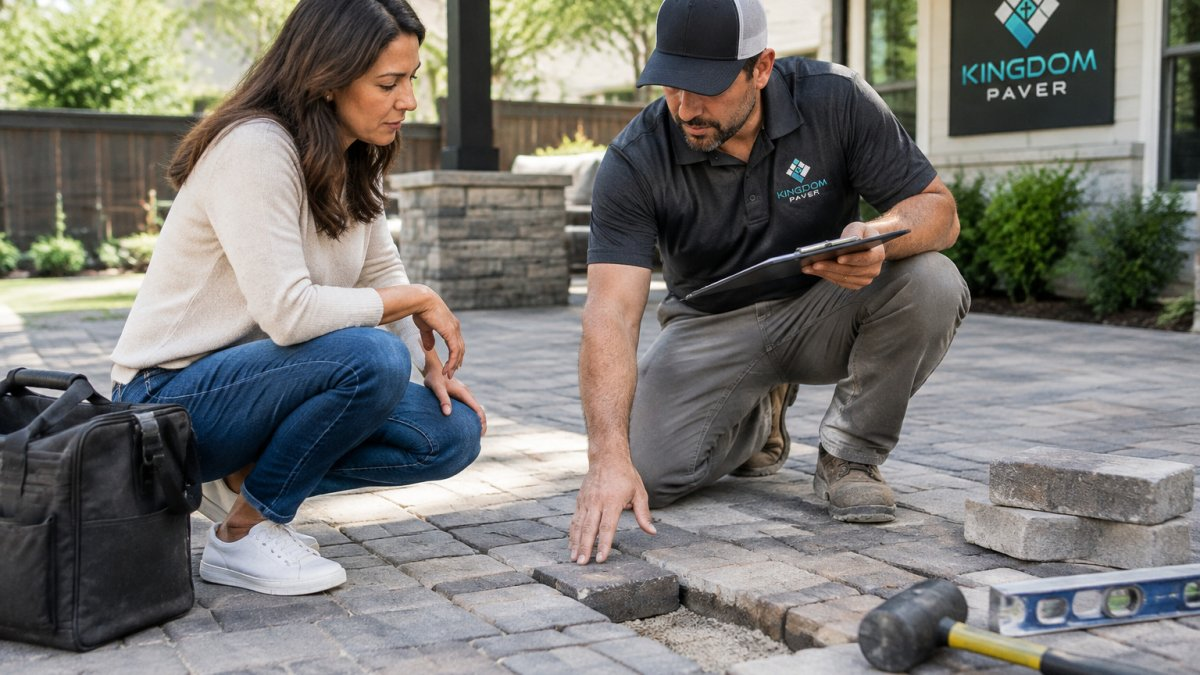
Once the cause is named, pin down the method. See how sunken paver sections are fixed step by step so you can evaluate the proposed approach. Ask specifically: Will you lift and reset individual pavers, or replace whole sections? How will you match replacement pavers to the existing color, style, and thickness? Exact matches are not always available for older or discontinued lines, so ask what the fallback is, a close current production run, reclaimed units, or a deliberate border or accent detail that makes the difference look intentional.
Ask what happens to the base under the repaired area. A thorough answer covers excavation depth, base gravel gradation, compaction method, bedding sand depth, and joint sand. If the answer is “we’ll just reset the pavers,” the same failure is likely to return.
Questions About Documentation and Repair Boundaries
Ask how the contractor will document existing damage before work starts. Ask how the contractor will document existing damage before work starts, and ask for before-and-after photos of the finished repair so you can compare the blend and the grade.
Watch out: a contractor who cannot name a cause, cannot explain the base work, and will not put the repair boundaries in writing is quoting a patch, not a repair.
What a Paver Repair Estimate Should Include
A written estimate should break down labor, materials, equipment, disposal fees, and any permit costs as separate line items. Vague lump sums hide problems. Ask whether the quote includes cleanup, property protection, and hauling away old material.
Use this table to compare quotes side by side:
| Estimate Item | What to Look For | Red Flag |
|---|---|---|
| Labor | Hours or square footage, itemized | One vague lump sum |
| Materials | Paver type, sand, base gravel listed | “Misc. materials” with no detail |
| Base repair | Depth of excavation stated | No base work mentioned |
| Disposal and cleanup | Included and priced | Added later as a surprise |
| Permits | Named if required | “We’ll handle it” with no detail |
| Warranty terms | Written, with duration | Verbal promises only |
Ask each contractor to explain any line that differs sharply from the others. A lower quote often means skipped base work, and that is exactly how patios sink twice.
Paver Repair Timeline: Scheduling, Disruption, and Completion
Ask for a written project timeline with a start date and a completion date, not just a duration. Then ask how many other active jobs the crew is juggling during your window. A crew spread across five sites moves slowly on yours.
Clarify who will be on site daily: the owner, a project manager, or a subcontractor. Ask how they will protect your landscaping, keep the work area safe, and handle unexpected issues like hidden root damage. Any change to scope should come as a written change order with a price attached before the work proceeds.
Paver Repair vs Replacement: Which Is Right for Your Patio or Driveway?
Repair makes sense when damage is isolated: a handful of sunken pavers, one cracked section, or a single drainage low spot. Replacement makes more sense when failures are widespread, the base is compromised across the whole surface, or the pavers are no longer manufactured.
Ask your contractor to walk you through both options with reasoning, not just a preference. Why do pavers crack in the first place? Often the base or drainage is the culprit, and patching cracks without fixing the cause guarantees a repeat. A contractor who explains the trade-offs honestly is worth more than one who quotes the biggest job by default.
Workmanship Warranties, Product Warranties, and Red Flags to Watch For
Ask for warranty terms in writing for the repair work, including what each warranty covers, its duration, what voids it, and whether it transfers if you sell the house.
Repair-Specific Warranty Limits to Clarify
Ask these questions about repair warranties before you sign:
- What exactly does the workmanship warranty cover, the repaired units only, or the surrounding field as well?
- How long does it last, and does the clock start at completion or at final payment?
- Does it cover labor, materials, or both, and who pays for disposal on a callback?
- Is recurring movement caused by drainage, soil conditions, or tree roots excluded? Many repair warranties exclude failures that trace back to site conditions the contractor did not correct.
- Does the warranty require you to perform maintenance, re-sanding joints, clearing drains, sealing, and does skipping it void coverage?
- Is the warranty transferable to a future owner, and is there a fee?
- What is the claims process, and what response time is promised?
Comparing Warranty Terms Across Quotes
Put the warranty terms side by side when you compare estimates. A longer warranty from a contractor who excludes the cause of your failure is worth less than a shorter warranty that covers the repair method you actually need. Ask each contractor to state, in the written estimate, the warranty duration, what is excluded, and whether the manufacturer product warranty is registered in your name.
Red Flags to Watch For
- Demands for large cash deposits before any work begins
- No written contract or estimate
- Pressure to decide on the spot
- No physical business address or verifiable references
- Reluctance to put warranty terms in writing
- A warranty that covers installation only and says nothing about repair work
- Verbal promises that the repair “will never move again”
Before signing, read our guide to guarantees for professional paver installation so you know what a solid warranty should cover, then ask the repair contractor which of those terms apply to your repair and which do not.
Next Step: Get a Written Repair Quote from Kingdom Paver
The questions above separate contractors who diagnose from contractors who patch. Ask them all, and do not settle for verbal answers on credentials, scope, or warranties.
Kingdom Paver brings 10 years of experience and custom building solutions to patios, driveways, and walkways. We serve the Katy and Cypress area. For current pricing, visit the Kingdom Paver website or request a quote. Get started with Kingdom Paver and request your written repair quote today.
Frequently Asked Questions
What should I ask a paver repair contractor before hiring them?
Ask for proof of licensing, insurance, and bonding, then request two or three recent repair references with photos of the finished work. Ask how they diagnose sinking or uneven pavers, which repair method they recommend, and whether the written estimate separates labor from materials. Confirm who will do the work, whether subcontractors are involved, and what workmanship warranty covers the repair. A contractor who answers these clearly and puts them in writing is a safer hire than one who gives verbal assurances.
How do I know if my pavers need repair or replacement?
Repair is usually the right call when damage is isolated: a few cracked or loose pavers, one sunken corner, or joint sand washing out in a small area. Replacement makes more sense when the base has failed across the whole surface, when pavers are crumbling throughout, or when more than roughly a quarter of the field is affected. A paver repair contractor can pull up a section, check the base material, and tell you which side of that line your project falls on.
Can a contractor match my existing pavers?
Often, yes, but it depends on whether the original manufacturer still produces that paver and in the same dye lot. Ask the contractor to identify the make and style, then confirm a sample before ordering. Even a perfect match can look slightly different on a weathered surface. If an exact match is unavailable, ask about a border or accent pattern that turns the difference into a design feature.
Do paver repairs come with a warranty?
Ask for warranty terms in writing for the repair, including what each warranty covers, what voids coverage, and whether it covers only the repaired section or the surrounding field.


