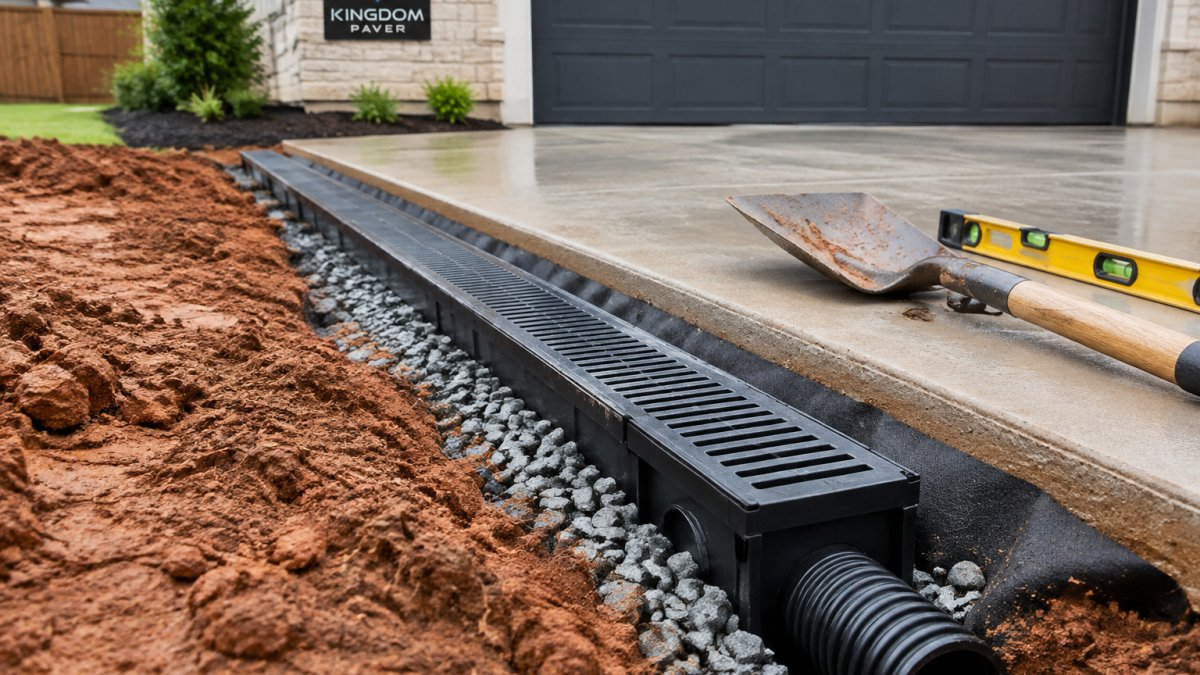
Clay soil drainage is slow because clay particles are tiny and packed tightly, so rain pools on the surface instead of soaking away. The most effective fixes redirect water first: regrade the driveway to slope away from the house, redirect downspouts, and add a channel drain at the low point. A French drain can help when designed for clay with a lawful outlet.
A common guideline is a slope of about 1/4 inch per foot for pavers and concrete.
Dig a 12-inch test hole and fill it with water; if it stays full over a day, clay is likely the issue.
Extend downspouts at least 6 feet from the driveway.
French drain trenches in clay are typically 12 to 18 inches wide and 18 to 24 inches deep.
Channel drains should be sloped about 1 percent toward the outlet so water keeps moving.
Is standing water ruining your driveway?Kingdom Paver designs and installs drainage-smart driveways across Katy and Cypress.
Driveway drainage problems in clay soil usually come down to one thing: water has nowhere to go, and clay soil drainage is slow by nature. Clay particles are tiny and packed tightly, so water moves through them very slowly. On a driveway, that means rain sits on the surface and pools instead of soaking away. Clay is common in the Katy and Cypress area, and standing water is a frequent problem for homeowners there.
Clay has a few traits that make it hard on driveways. It swells when wet and shrinks when dry, which can shift the base under your pavers or concrete. It also holds water in its structure for long periods. Over time, that saturated base can soften, settle, and crack.
Here’s what that looks like in practice:
Puddles that stay for hours or days after a storm
Edges that sink or heave with the seasons
Mud or wet spots along the sides of the driveway
Cracks or uneven sections in the surface
Clay doesn’t hold water because you did something wrong. It’s simply how the soil behaves. The good news is that once you understand the cause, the fixes become much clearer.
Diagnosing Standing Water Before You Buy Anything
Before you pick a fix, figure out where the water is coming from and where it’s going. Many homeowners buy a drain only to find the real problem is the slope or a downspout dumping onto the driveway.
Homeowner in rubber boots standing by a puddle on a sloped driveway, signaling the need for clay soil drainage.
Start with a rainy day. Watch how water moves across the surface. Note where it collects, how long it stays, and whether it flows toward the street, the yard, or the house.
Use this quick checklist:
Find the low point where water pools
Check whether water runs toward the garage or house
Look for roof downspouts or gutters draining onto the driveway
Note how long puddles last after rain stops
Dig a small test hole near the low spot to see how quickly it drains
A test hole is a simple way to check the soil. Dig about 12 inches deep, fill it with water, and time how long it takes to empty. If it stays full for more than a day, clay is likely the main issue.
Watch out: Don’t assume a single puddle means you need a French drain. Surface water often needs grading or a channel drain first.
Grading and Surface Fixes That Redirect Runoff
Often the cheapest fix is to change where the water flows. Proper grading means the driveway slopes away from the house and toward a safe outlet, such as a street gutter or a lawn area that can absorb it. For step-by-step guidance, see grading a driveway for proper water flow.
A common guideline is a slope of about 1/4 inch per foot for pavers and concrete. For a broader overview of paver driveway drainage solutions, see paver driveway drainage solutions. Too flat, and water sits. Too steep, and it can be hard to walk or park on.
Surface fixes that help include:
Regrading low spots and adding fill where needed
Redirecting downspouts away from the driveway
Using permeable pavers that let water pass through the surface
Sealing cracks so water doesn’t seep into the base
For more on how grading works on a sloped surface, see University of Florida IFAS guidance on residential yard drainage.
Does a French Drain in Clay Soil Work?
A French drain can work for clay soil drainage, but only when it is designed for clay conditions and has a clear, lawful outlet. In clay, the trench does not rely on water soaking into the surrounding soil, clay accepts water too slowly for that. Instead, the drain acts as a collection channel: water enters the gravel envelope, flows into the perforated pipe, and is carried to a discharge point.
The main design challenge is that clay drains slowly, so the trench must be wide enough and deep enough to intercept water before it reaches the driveway base. A common pattern is a trench 12 to 18 inches wide and 18 to 24 inches deep, lined with geotextile fabric, filled with washed gravel, and containing a 4-inch perforated pipe with a slight slope toward the outlet.
Pros of a French drain in clay soil:
Collects water from a wide area, including roof runoff and lawn sheet flow
Can be routed around the driveway perimeter to intercept water before it reaches the surface
Hidden from view once gravel and sod or pavers are restored
Works well when paired with grading and a channel drain at the low point
Cons:
Costs more than grading alone and requires more excavation
Can clog with sediment over time, especially if geotextile is omitted or the gravel is not washed
Needs a discharge point, a pop-up emitter, a daylight outlet, a dry well, or a lawful connection, which may require approval from your city or county
Performs poorly if the outlet is lower than the trench or if the pipe slope is insufficient
Installed costs vary by length, depth, and outlet. Pricing depends on the specifics of your site, so request a site-specific quote from Kingdom Paver.
Watch out: Do not route a French drain outlet to a neighbor’s property, a sanitary sewer, or a storm drain without checking local rules, many jurisdictions prohibit or restrict these connections, and an illegal discharge can create liability and require removal.
The table below sums up the French drain pros, cons and design points covered in this section.
Item
Value
Note
Trench width
12 to 18 inches
Wide enough to intercept water before the driveway base
Trench depth
18 to 24 inches
Deep enough to catch slow-moving clay water
Pipe size
4-inch perforated
Sloped slightly toward the outlet
Lining
Geotextile fabric
Keeps clay fines out of the gravel and pipe
Gravel
Washed
Keeps the trench draining and resists clogging
Main risk
Clogging
Sediment builds up over time, especially without fabric
Outlet requirement
Needed
Pop-up emitter, daylight outlet, dry well or lawful connection
Channel Drains for Driveways: Sizing, Placement and Trade-offs
A channel drain is a narrow, grated trench placed across the driveway to catch surface water before it pools. It is one of the most effective tools for driveways, especially when water flows toward the garage or a low point at the apron. Unlike a French drain, which collects subsurface water, a channel drain intercepts water at the surface and moves it quickly to an outlet.
Sizing matters. Look at the width, depth, and flow rate the drain can handle. As a rule of thumb, size the drain for the peak flow from the contributing area, driveway, roof, and any uphill lawn, not for the average rain.
Placement tips:
Install across the path of water flow, not parallel to it
Place it just above the garage door or at the low point, where water would otherwise pool
Slope the channel bottom toward the outlet at about 1 percent so water keeps moving
Set the grate slightly below the driveway surface so water enters rather than passes over
Connect the outlet to a proper discharge, a pop-up emitter, a daylight outlet, or a lawful storm connection
Channel drains cost more than a simple grate, and the trench must be sloped so water keeps moving. They are also easy to clean, but grates can clog with leaves and debris. Learn how to clean and maintain trench drains over time.
Watch out: A channel drain that is installed flat or with a reversed slope will hold water and become a mosquito-breeding trough, verify fall with a level before setting the grate.
Learn more about cleaning and upkeep in [PAGE:1], which covers maintenance steps.
DIY Driveway Drainage Solutions for Clay Soil, Step by Step
If you’re comfortable with basic yard work, you can handle some of these steps yourself. Always call 811 before digging to have underground utilities marked.
Identify the low point. Watch where water collects during rain.
Check the slope. Use a level and string line to measure fall.
Redirect downspouts. Extend them 6 feet or more from the driveway.
Regrade the low spot. Add base material and compact it in layers.
Install a gravel trench (optional). Dig a trench sloped toward an outlet, line it with fabric, add gravel, and set a perforated pipe.
Test the flow. Run a hose and confirm water moves away from the driveway.
Keep your expectations realistic. DIY grading helps with light problems, but structural issues or large areas of standing water often need professional help.
Choosing Your Driveway Drainage Plan and Getting a Quote from Kingdom Paver
The right plan depends on your slope, soil, and how much water you’re dealing with. A small grading fix may solve the problem, while a combined approach using grading, a channel drain, and permeable surfacing may be needed for heavier runoff.
Kingdom Paver has about a decade of experience serving Katy and Cypress. We install the full project, so you’re not left coordinating multiple contractors.
Pricing depends on the size of the driveway, the drainage method chosen, and the site conditions. You can request a quote from Kingdom Paver for a site-specific estimate. To get an accurate number, visit kingdompaver.com for current pricing or request a quote. Contact us today to schedule an inspection and get a plan built around your driveway.
Frequently Asked Questions
What is the best drainage solution for clay soil?
There is no single best option. Clay drains slowly, so the first step is to find out where water comes from and where it collects. For driveways, the most reliable approaches are regrading the surface so runoff moves off the pavement, adding a channel drain across the low point, and using a French drain only where water is moving through the ground rather than sitting on top. Permeable surfacing can help, but it does not fix water arriving from uphill. Get the diagnosis right first, then choose the matching fix. A contractor or site visit can confirm the slope and outlet options on your lot.
Do French drains work in clay soil?
French drains can work in clay, but they are often not the best first choice. Clay has low permeability, so a trench filled with gravel only helps if there is an outlet where the collected water can go, such as a storm sewer connection, a dry well that drains properly, or a lower area that allows discharge. Without an outlet, the trench fills and stays wet. French drains are most useful for intercepting groundwater or subsurface seepage. For water sitting on the driveway surface, grading or a channel drain usually solves the problem more directly. Check local rules on discharge before connecting to any storm system.
Are channel drains effective for clay soil?
Channel drains are effective for clay soil when they catch surface runoff at the point where water collects, such as across the bottom of a sloped driveway or at a garage threshold. Because they collect water from the pavement surface, they do not depend on the soil absorbing it. The drain still needs a discharge path, and the trench below must be sized and sloped so water exits instead of backing up. The outlet and slope must still be planned for your site.
How should a driveway be graded to drain properly?
A driveway should slope away from the house and garage, generally falling at least about 1% to 2% so water runs off rather than pooling. Avoid grading that sends runoff toward the foundation or the neighbor’s property. Check the low points where water collects, since these usually need either a channel drain or a regraded path to an outlet. Grading changes can be done with compacted base material and proper edging so the new slope holds over time. Coordinate any changes with the existing lawn drainage so you do not move the problem somewhere else.