Motion sensor backyard lighting options pay off because they use far less power than lights burning all night, startle intruders with sudden illumination, and light only the zones you need, such as the driveway, garage, or back entrance. The trade-off is coverage: a sensor light protects a zone rather than a whole property.
Solar units need a panel in direct sun for much of the day to deliver reliable overnight output.
Mount wall fixtures roughly 6 to 8 feet up, angled slightly downward, and aim the sensor across the path of approach.
Plan coverage by zone first, then buy fixtures to fill them, since one floodlight rarely covers a path, gate, and patio.
Match lumens to the job: lower output for pathways and steps, higher output for driveways and entrances.
Angle sensors away from hot driveways, HVAC vents, and swaying branches to stop false triggers.
Why Motion Sensor Backyard Lighting Options Pay Off
The global market for outdoor motion sensor lights was valued at USD 2.4 billion in 2025 and is projected to reach USD 4.1 billion by 2032, according to Strategic Market Research’s outdoor motion sensor lights market report. That growth tells you something: homeowners are treating motion sensor backyard lighting as a practical upgrade, not a gadget. At Kingdom Paver, we plan lighting alongside patios and walkways because the two decisions depend on each other.
Motion sensor backyard lighting options pay off for three reasons. First, a light that only switches on when something moves uses far less power than one burning all night. Second, sudden illumination startles intruders in a way a steady glow does not. Third, you get light exactly where you need it, at the driveway, the garage, or the back entrance, without washing the whole yard in glare.
The trade-off is coverage. A sensor light is dark until triggered, so it protects a zone rather than a whole property. Below, we break down the power choices, the placement math, and the brightness numbers that decide whether your setup works or frustrates you.
That last point is where most installations fail. Not the fixture. The plan.
Solar Motion Sensor Lights for Backyard Use: What They Can and Can’t Do
Solar motion sensor lights for backyard use are the easiest option to install because they need no wiring: mount the panel, aim the head, done. They suit fences, sheds, and pathway edges where running conduit would mean tearing up landscaping. Readers working within a tight budget can learn how to install solar landscape lighting on a budget.
What they can’t do is promise year-round output. Panel placement, shade, and winter daylight all affect how much charge a unit stores. A fixture under a dense tree canopy will underperform one in open sun.
What the specs actually mean
Three numbers decide whether a solar unit holds up in a backyard:
Lumen output on high. This is the brightness at full activation, not the dim standby glow. A unit rated for a high number but a small panel will only hit that number on a full charge.
Battery capacity, in watt-hours (Wh). This is the real runtime budget. A larger battery carries a fixture through cloudy stretches; a small one does not.
Panel wattage. This sets how fast the battery refills. A 5W panel and a 2W panel can feed the same light head, but the 5W recovers far faster after a dark day.
A solar security light generally needs a panel in direct sun for much of the day to deliver reliable overnight output. If your only mounting spot is shaded, a hardwired or plug-in fixture is the safer choice.
Panel placement rules that matter
Aim the panel south (or toward the longest sun exposure on your lot) and tilt it to match your latitude.
Keep the panel clear of roof eaves, fence shadows, and tree canopies that grow into the path of the sun.
Run the panel cable so it is not pinched at a gate hinge or stretched across a walkway.
Clean the panel a few times a season; dust and pollen cut harvest more than most owners expect.
Solar vs. the other power options
This is the trade-off table most roundups skip. Compare by what you can actually install, not by what looks best in a product photo.
Power type
Install effort
Upfront cost pattern
Ongoing cost
Best backyard use
Solar
Lowest, no wiring
Moderate per fixture
Battery replacement every few years
Fences, sheds, path edges, rental yards
Battery (non-solar)
Low, mount and go
Low to moderate
Frequent battery swaps
Gates, storage doors, temporary zones
Plug-in
Low, needs an outdoor outlet
Low
Electricity draw
Patios and pergolas near an outlet
Hardwired
Highest, junction box or new circuit
Highest with electrical work
Electricity draw only
Entrances, driveways, security layers
Pricing depends on the fixture, so check current listings or contact Kingdom Paver for guidance before you commit. Buying from brands that publish lumen and battery specs makes it easier to compare output. A unit that lists watt-hours and panel wattage gives you more to evaluate than one that lists only “up to” lumens.
Hardwired Outdoor Motion Sensor Lights: Reliability When You Need It
Hardwired outdoor motion sensor lights deliver consistent brightness because they draw from your home’s power, not a battery. Hardwired fixtures avoid the panel shading, charge management, and seasonal dimming that affect solar units.
The catch is installation. A hardwired fixture needs an existing junction box or a new circuit run, which means an electrician in most cases. If your patio or garage wall already has wiring, the job is simple.
For a backyard entrance or garage wall, hardwired is often a sound choice when the light is your security layer.
Outdoor Motion Sensor Light Placement: Coverage, Height, and Angles
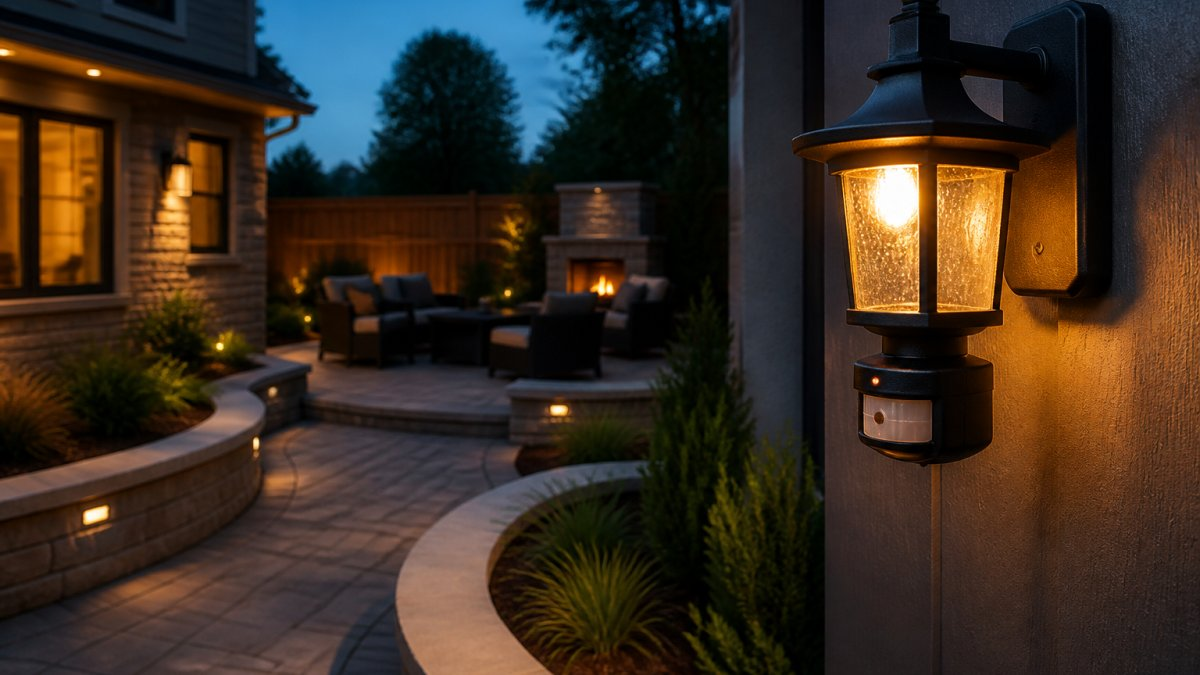
A wall-mounted motion sensor backyard lighting fixture illuminating a stone patio and garden path at dusk.
Outdoor motion sensor light placement decides whether your fixture works. Mount it too high and the sensor misses movement near the ground; too low and passing pets trigger it constantly. The fix is to plan coverage by zone before you buy a single fixture, the step most product roundups leave out.
Start with a zone map, not a fixture
Sketch your yard and mark four things: the approach paths, the doors and gates, the parked vehicles, and the obstructions (trees, sheds, HVAC units, fence corners). Then assign each area to one of three zone types:
Approach zones, walkways, side gates, and the path from driveway to back door. These need wide, low-level detection so someone walking toward the house is caught early.
Asset zones, driveways, garage aprons, and storage areas. These need a narrower, brighter beam aimed at the vehicle or door.
Living zones, patios, decks, and seating areas. These need softer, warmer light with dimming or standby so the yard is usable, not startling.
A backyard often needs several fixtures to cover these zones without overlap. One floodlight on the back wall rarely covers a path, a gate, and a patio at once.
A practical starting point: mount wall fixtures roughly 6 to 8 feet up, angled slightly downward, so the detection pattern covers the walkway and door rather than the treetops. Aim the sensor across the path of approach, not straight out, so someone walking toward the light crosses the detection zone rather than moving directly at it.
Height interacts with range. A passive infrared sensor’s published range is measured along its center line; tilt the head down and the effective ground coverage shrinks. That is why a fixture rated for a long range can still miss a person at the base of the wall.
Match the fixture to the yard
Yard situation
Placement approach
Fixture style to favor
Small urban yard, one gate
One fixture at the gate, aimed across the approach
Wide-angle wall light, moderate output
Mid-size yard with patio and path
Two fixtures: one at the door, one at the path edge
One wide wall light, one directional path light
Large lot with driveway and outbuilding
Three or more fixtures, zoned by asset
Narrow-beam floods on assets, wide lights on approaches
Heavily treed or obstructed yard
Lower mounts, more fixtures, shorter throws
Multiple small units rather than one long-throw flood
Detection range and angle vary by model, so check the published specs before you buy. Obstructions matter as much as angle: a fence corner, a grill, or a parked trailer can block a sensor’s line of sight even when the spec sheet says the range is long enough. Walk the yard at night with the light on and note the dark pockets.
Layout drives this. Plan the zones first, then buy fixtures to fill them, not the other way around.
Motion Sensor Light Lumens: How Bright Should Your Backyard Be?
Motion sensor light lumens should match the job. A pathway or step needs enough light to see footing, while a driveway or back entrance needs more punch to reveal a face or a vehicle.
As a working guide:
Zone
Target output
Why
Pathway and steps
Lower output, wide spread
Safe footing without glare
Patio and seating area
Moderate output
Usable light for evening hosting
Driveway and entrance
Higher output
Security and identification
Garage side and gates
Higher output, narrow beam
Pinpoint coverage
Two adjustments matter as much as raw lumens. Color temperature shapes how the yard feels: warmer light suits patios, cooler light reads as security.
Govee’s outdoor spot lights, which Wirecutter’s smart outdoor lighting review reports at 500 lumens per light with app adjustment, show how app control lets you tune output without swapping fixtures.
Stopping False Triggers and Neighbor Complaints
False triggers come from three sources: heat, motion you didn’t intend to detect, and aim. Passive infrared sensors read body heat, so a fixture pointed at a hot driveway, an HVAC vent, or swaying branches will fire all night.
Fix the aim first. Angle the sensor down and away from reflective surfaces and moving foliage. Many units let you adjust sensitivity, so dial it back until pets and passing cars stop setting it off.
Light pollution is the neighbor problem. A floodlight aimed at a shared fence line spills into someone’s bedroom window. Shield the fixture, aim it downward, and keep the beam inside your property.
Planning Your Backyard Lighting Layout with Kingdom Paver
Lighting is a layout problem before it is a product problem. Where the patio sits, where the path runs, and where the garage wall faces all determine which fixture goes where, and getting that sequence right saves you from re-aiming sensors for months.
A backyard that lights correctly feels safer, entertains better, and looks intentional. Get started with Kingdom Paver and build an outdoor space where the lighting, patio, and pathways work as one plan.
Frequently Asked Questions
What type of motion sensor light is best for a backyard?
It depends on your wiring and coverage needs. Hardwired LED floodlights deliver steady brightness and suit backyards with existing electrical runs. Solar pathway lights work where trenching is impractical. Wall lights fit entrances and garage walls. Match the fixture format to the zone you are lighting, not the other way around.
Are solar motion sensor lights bright enough for a backyard?
For pathways and low-level navigation, yes. For wide security coverage, usually not. Solar fixtures depend on panel exposure and battery storage, so output can drop after cloudy stretches. If your goal is lighting a dark driveway or back gate, run hardwired outdoor motion sensor lights instead. A hybrid approach works well: solar on walking routes, hardwired floods on the perimeter. Check the rated motion sensor light lumens on the box before buying either type.
Where should motion sensor lights be placed outdoors?
Mount fixtures 6 to 8 feet high and aim the sensor across walkways rather than at them, so people walk into the detection zone instead of toward it. Keep sensors away from HVAC units, dryer vents, and tree branches that move in the wind. For outdoor motion sensor light placement on a typical backyard, cover the gate, patio edge, and garage side rather than flooding the whole lawn. Angling sensors slightly downward also reduces triggers from passing cars and pets.
How many lumens do I need for a backyard motion sensor light?
Brighter fixtures are not automatically better; overshooting can cause glare and light spill into neighboring yards. Match output to the zone and use a lower standby level for overnight visibility.