
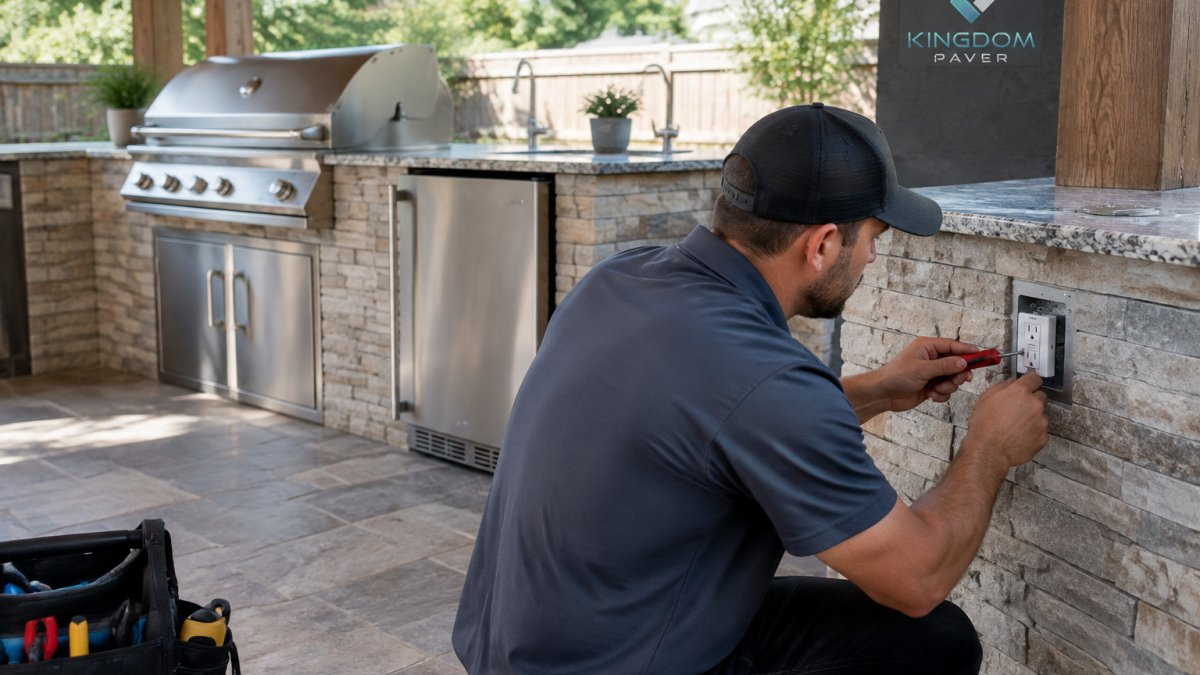
Quick Summary
Outdoor kitchen electrical work follows the National Electrical Code, but the edition and local amendments your building department enforces decide the final rules. Outdoor outlets need GFCI protection, and large appliances need dedicated circuits, so confirm the adopted code before any wire is pulled.
- Confirm the adopted NEC edition and local amendments with your building department before work begins.
- Protect every outdoor receptacle near the kitchen with GFCI, by receptacle, breaker, or module.
- Test each GFCI monthly and confirm power shuts off and resets.
- Use wet-location listings and in-use covers for outlets exposed to rain or sprinklers.
- Give large appliances like refrigerators their own circuits, and schedule a rough-in inspection before backfill.
Table of Contents
- How Outdoor Kitchen Electrical Code Requirements Are Set
- Outdoor Kitchen GFCI Outlet Requirements
- Outdoor Kitchen Dedicated Circuit Requirements
- How to Run Electrical to an Outdoor Kitchen
- Outdoor Kitchen Electrical Permit and Inspection Steps
- Planning Your Outdoor Kitchen Power Layout With Kingdom Paver
- Frequently Asked Questions
How Outdoor Kitchen Electrical Code Requirements Are Set
Last Updated: November 18, 2026
Outdoor kitchen electrical work is governed by the National Electrical Code (NEC), but the version your town enforces can differ.
Most jurisdictions adopt the NEC as a model code and then add local amendments. The authority having jurisdiction, usually your city or county building department, decides which edition is in force and how it reads.
Here is what that means in practice:
- The NEC sets the baseline for outlets, circuits, and wiring methods.
- Local amendments can tighten or loosen those rules.
- The inspector’s interpretation settles questions the code leaves open.
Because the 2026 NEC adds new outdoor requirements, check the current edition your county has adopted. The National Fire Protection Association publishes the NEC and summarizes changes from edition to edition (NFPA summary of 2026 NEC changes).
Do not assume indoor kitchen rules carry over unchanged. Whether the International Residential Code’s kitchen circuit rules apply to an outdoor space depends on how your jurisdiction classifies it.
Outdoor Kitchen GFCI Outlet Requirements
GFCI protection is a safety device that shuts off power within milliseconds when it detects current leaking to ground. It protects people from electric shock near water, and that is why outdoor outlets need it.
For outdoor work, the 2026 NEC change summarized by NFPA extends ground-fault protection to outdoor outlets rated 60 amperes or less (NFPA’s 2026 NEC summary on 210.8(F)). Outdoor kitchens typically have several receptacles, so plan GFCI protection for every one of them.
GFCI protection can be provided three ways, and the choice affects how you wire:
- A GFCI receptacle at the first outlet in the run, with downstream receptacles wired to its load terminals so they are protected too.
- A GFCI circuit breaker in the panel, which protects the entire branch circuit including the home run.
- A GFCI module or dead-front device for a dedicated appliance circuit where a receptacle-style device does not fit the installation.
Either approach satisfies the requirement as long as the protected portion of the circuit is correct.
A quick checklist for GFCI outlets:
- Install GFCI protection on every outdoor receptacle near the kitchen.
- Test each device monthly using its built-in test button, and confirm power shuts off and resets.
- Label which breaker or receptacle feeds each outlet so a tripped device can be found quickly.
- Confirm the adopted code edition with your local building department.
Watch out: a GFCI that trips repeatedly is signaling a real fault, often moisture in a box or a damaged cord, and should not be swapped for a standard receptacle.
Weatherproof Covers and Wet-Location Ratings
The code separates damp locations from wet locations, and the distinction drives which cover and receptacle you buy. A covered patio where rain does not beat directly on the outlet is typically a damp location.
Outlets exposed to rain, sprinklers, or splashing from the grill need weather-resistant receptacles and weatherproof covers.
Choose equipment listed for wet locations. Damp-location listings are not enough for spots that get direct water. Look for the “WR” marking on the receptacle and a cover marked for wet locations with the cord in use.
Watch out: a standard indoor receptacle installed outside will corrode and fail, and a weather-resistant receptacle behind a flat cover still fails when a cord is left plugged in during rain.
Receptacles Near Sinks and Water Sources
Outdoor sinks raise the same shock concern as indoor ones, and the code treats the area around them as a wet zone. Keep receptacles out of the splash zone and position them so a cord from a countertop appliance does not drape over or into the sink. Where a receptacle must sit near a sink, protect it with GFCI and an in-use cover, and route the cord so water cannot run down it into the device.
Testing, Reset, and Troubleshooting
Press the test button on each GFCI monthly and confirm the reset button pops and power returns when pressed. If a GFCI will not reset, the circuit still has a ground fault or the device has failed. If it trips only after rain, suspect moisture in a box, a cover that is not closing, or a cord left plugged in under a flat lid. Replace a failed GFCI with a listed device of the same rating rather than removing it, because an unprotected outdoor receptacle is both a shock hazard and an inspection failure.
The article’s GFCI points can be summarised at a glance:
| GFCI method | How it protects | Where it fits |
|---|---|---|
| GFCI receptacle | Protects downstream outlets wired to its load terminals | First outlet in the run |
| GFCI circuit breaker | Protects the entire branch circuit | Panel, whole branch |
| GFCI module or dead-front device | Protects a dedicated appliance circuit | Where a receptacle-style device does not fit |
| Monthly test | Confirm power shuts off and resets | Every GFCI device |
Outdoor Kitchen Dedicated Circuit Requirements
Large appliances need their own circuits. A refrigerator, ice maker, or outdoor fridge should not share a line with a blender or a string of lights. Sharing circuits trips breakers and can overheat wiring.
Plan the circuits before you build. Count each appliance’s amperage, add a margin, and confirm the total fits the panel. A licensed electrician can run that calculation for your specific equipment.
Choosing 15-Amp or 20-Amp Circuits for Appliances
A 15-amp circuit suits lights and low-draw items. A 20-amp circuit suits countertop cooking and refrigeration equipment with higher demand. Match the breaker and wire gauge to the circuit’s amperage, and never oversize a breaker to stop nuisance trips.
Check each appliance’s nameplate rating. The manufacturer’s instructions set the minimum circuit size, and the code sets the wiring rules.
How to Run Electrical to an Outdoor Kitchen
Running power to an outdoor kitchen takes planning, and the wiring method you choose sets the burial depth, the conduit, and the inspection sequence. If you are also weighing finishes for the structure those cables run through, compare stone veneer and stucco finishes for outdoor kitchens. The code does not give one number for “how deep”, it gives a depth per wiring method, so pick the method first and the depth follows.

Wiring Methods and Burial Depth
The table below reflects the commonly cited minimum cover requirements for the wiring methods most often used to feed an outdoor kitchen. Treat these as planning numbers and confirm them against the edition your jurisdiction has adopted, because depths have been revised across editions.
Required burial depth varies by wiring method and location, and the adopted edition of the NEC sets the figures for each. Confirm the minimum cover for your specific wiring method with your local building department.
Conduit, Cable Support, and Protection From Damage
Underground runs typically go in rigid or approved conduit, and the conduit must be listed for direct burial. Sweep the bends rather than using sharp elbows so the conductors pull without damage. Where the run rises out of the ground, protect the cable or conduit from physical damage, typically with rigid conduit or a listed sleeve up to at least 8 feet above grade, and cap the top so water cannot enter.
Above ground, support cable and conduit at the intervals the code requires for that method, and keep runs out of walkways and off surfaces where a string trimmer or ladder will hit them. Seal conduit penetrations into cabinets and structures so water and insects stay out.
Watch out: backfilling a trench before the rough-in inspection means the inspector cannot verify depth, and you may be asked to dig it back up.
Separating Power, Lighting, and Low-Voltage Runs
Keep line-voltage power, lighting, and any low-voltage lighting or speaker wiring in separate runs and separate boxes unless the equipment is listed for mixing. Low-voltage landscape cable can often be run at a shallower depth than branch-circuit wiring, but it still needs protection where it crosses a walkway or is likely to be cut. Document each run on the plan so the inspector can trace it.
Sizing the Feed and Planning the Panel
Before trenching, add up the load. List every appliance and its nameplate amperage, add the lighting and receptacle load, and apply the demand factors your electrician uses for the panel calculation. A small kitchen with a grill, a refrigerator, and lights may fit an existing panel; a kitchen with a pizza oven, an ice maker, and infrared heaters often needs a subpanel or a service upgrade. Decide that before the trench is dug, because the feeder size and conduit trade size depend on it.
Working With the Inspector
Keep the layout simple and well documented. Your inspector will want to see the route, the depths, the wiring method, and the connections. Photograph the open trench with a tape measure in frame before backfill, and keep the permit and approved plan on site. If your jurisdiction has adopted an edition with different depth or GFCI rules, note the edition on the plan so the inspection matches the code you built to.
Outdoor Kitchen Electrical Permit and Inspection Steps
Electrical work usually needs a permit. Most projects follow the same sequence:
- Confirm the adopted code edition and local amendments with the building department.
- Submit a permit application with your electrical plan.
- Schedule a rough-in inspection before walls, cover, or trench backfill are closed.
- Complete the work and request a final inspection.
Do not skip the rough-in inspection. Covering wiring before it is inspected can mean tearing it out later.
Planning Your Outdoor Kitchen Power Layout With Kingdom Paver
A good power layout starts with a list of every appliance and where it will sit. Place outlets so cords are not needed across walkways, and keep receptacles away from standing water and sink areas. Plan extra outlets for lighting, music, and future upgrades.
Kingdom Paver designs and builds custom outdoor kitchens and fire pits for homes in Katy and Cypress. Read our outdoor kitchen lighting and electrical planning guide for more detail on circuit layout. Before you pull any electrical work, review the permits needed for building an outdoor kitchen.
For a design that fits your cooking style, see how to design an outdoor kitchen with a pizza oven, since a pizza oven changes your power needs.
Planning outdoor power is where most homeowners run into trouble, and the code details are easy to miss. Kingdom Paver can help you lay out the kitchen, coordinate with your electrician, and build the hardscape around it. Contact Kingdom Paver to start planning your outdoor kitchen today.
Frequently Asked Questions
Do outdoor kitchen outlets need GFCI protection?
Yes. The National Electrical Code requires ground-fault circuit-interrupter protection for outdoor receptacles, with the exact scope set by the edition your jurisdiction has adopted. Outlets at an outdoor kitchen should be GFCI-protected, typically by a GFCI breaker or a GFCI receptacle. Confirm the exact edition your local jurisdiction has adopted with the authority having jurisdiction before installing.
Do outdoor kitchen appliances need dedicated circuits?
Many outdoor kitchen appliances, such as refrigerators, ice makers and built-in heating or cooking equipment, should run on dedicated circuits sized to their nameplate load. Check each appliance’s manufacturer instructions and the local code for the required circuit size. Planning circuits for each appliance early helps avoid overloading a shared line and makes permit review smoother.
Do I need 15-amp or 20-amp outlets in an outdoor kitchen?
The answer depends on the circuit and the adopted code. Residential kitchen countertop receptacles are commonly served by 20-amp small-appliance branch circuits under the National Electrical Code. Outdoor kitchen receptacles should be evaluated against the same code sections and the load of the appliances they serve, so ask your electrician to confirm the circuit rating for your layout.
Do I need a permit for outdoor kitchen electrical work?
In most jurisdictions, new outdoor kitchen wiring requires an electrical permit and inspection. The permit process confirms that wiring, GFCI protection, conduit and grounding meet the adopted code. Contact your local building department to confirm requirements, and consider having a licensed electrician pull the permit and schedule the inspection.


