
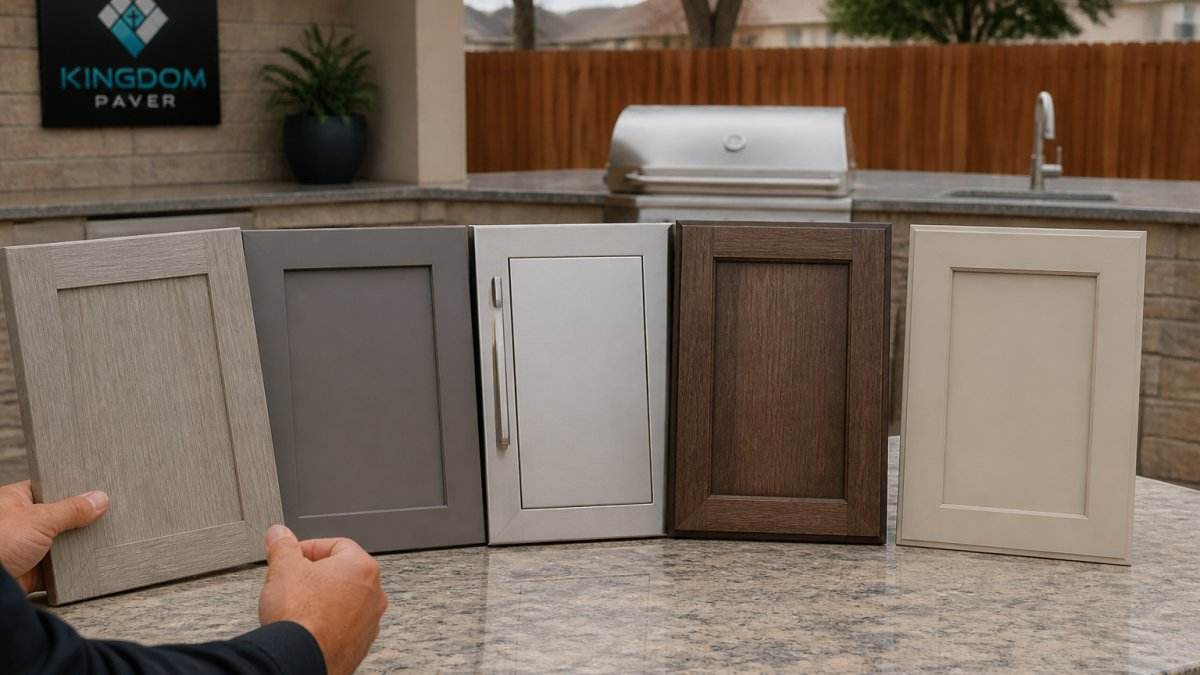
Table of Contents
- Choosing Weather Resistant Outdoor Kitchen Cabinets: What Actually Matters
- Material Comparison: Which Weather Resistant Cabinets Hold Up Best
- The Best Material for Outdoor Kitchen Cabinets in Humid Climates
- Outdoor Kitchen Cabinets for Humid Climates: Why Houston-Area Homes Need Extra Protection
- How to Protect Outdoor Kitchen Cabinets from Rain and Moisture
- Outdoor Kitchen Cabinet Maintenance: A Simple Seasonal Routine
- Factors to Consider Before You Buy
- Frequently Asked Questions
Last Updated: October 9, 2026
Choosing Weather Resistant Outdoor Kitchen Cabinets: What Actually Matters
Choosing weather resistant outdoor kitchen cabinets comes down to one thing: the material. Marine-grade HDPE, stainless steel, and powder-coated aluminum each handle heat, humidity, and rain differently, and the gaps between them show up years after installation, not on the showroom floor. This guide breaks down how each material performs and what maintenance it demands.
Here is the part most buyers get wrong: they shop for a finish, not a substrate. A cabinet can look identical to its neighbor on day one and be chalky, swollen, or rusted by year three.
Below, we walk through each material honestly, including where it falls short, so you can match the cabinet to your climate instead of your Pinterest board.
Material Comparison: Which Weather Resistant Cabinets Hold Up Best
Marine-grade HDPE cannot rust, rot, or absorb water. Stainless steel is a premium choice. Powder-coated aluminum and polymer composites sit in the middle: lighter on the wallet, but the coating is the weak point.

Here is how the three stack up before we get into the details:
| Material | Weather Resistance | Maintenance | Best For |
|---|---|---|---|
| Marine-grade HDPE | Excellent, non-porous | Rinse and wipe | Humid, coastal, rainy climates |
| Stainless steel | Very good, grade-dependent | Regular polishing | Covered kitchens, salt air with care |
| Powder-coated aluminum | Good until coating chips | Touch-up painting | Budget builds, covered patios |
Marine-Grade HDPE (High-Density Polyethylene)
Marine-grade HDPE is a dense polymer originally developed for docks and boardwalks, which tells you everything about its water tolerance. It does not absorb moisture, so it will not swell, warp, or feed mold the way wood-framed cabinets do.
NatureKast’s guide to outdoor kitchen cabinetry materials describes HDPE as a marine-grade polymer with excellent weather resistance, and that matches what we see in the field. Cabinet makers such as EXT Cabinets’ outdoor kitchen cabinet lineup build their boxes from marine-grade HDPE specifically to resist cracking, rusting, and peeling.
The honest drawback: HDPE costs more than entry-level composites, and it can fade slightly in relentless direct sun.
Stainless Steel
Stainless steel is the restaurant-kitchen answer to outdoor cabinets, and it earns its reputation. It handles heat, will not burn, and wipes clean in seconds.
The catch is the grade. Lower-grade steel pits and rusts near salt air or pool chemicals, and even good steel shows water spots and fingerprints that demand regular polishing. Stainless also gets uncomfortably hot in full sun, which matters when someone leans against a cabinet door mid-cookout. It performs best under a covered patio or pergola.
Powder-Coated Aluminum and Polymer Composites
Powder-coated aluminum is the value pick, and polymer composites sit in the same bracket. Both are lightweight, resist rust at the core, and cost less than HDPE or quality stainless.
The vulnerability is the coating itself. Once a chip or scratch exposes bare metal, moisture gets underneath and the finish starts lifting. These cabinets work well on covered patios where they dodge direct rain and hail, but we would not spec them for a fully exposed island.
Skipping an annual rinse on any of these materials lets pollen, pool salt, and grit settle into seams and hinges. That grime holds moisture against the surface and accelerates exactly the corrosion or staining you bought weather-resistant cabinets to avoid.
The Best Material for Outdoor Kitchen Cabinets in Humid Climates
Marine-grade HDPE is a strong option for outdoor kitchen cabinets in humid climates. Humidity is a bigger threat than rain because it never leaves. It works into every seam and stays there.
Wood-based and composite cabinets absorb that moisture and swell. Steel corrodes faster when the air itself carries salt and damp. HDPE simply does not care. It is non-porous, so there is nothing for humidity to soak into.
If HDPE is out of budget, powder-coated aluminum under a roof is a sensible second choice. Just budget for touch-ups after storm season.
Outdoor Kitchen Cabinets for Humid Climates: Why Houston-Area Homes Need Extra Protection
Outdoor kitchen cabinets for humid climates face a tougher test than the same cabinets in a dry region, and the Gulf Coast is a case study. Long humid summers, heavy spring downpours, and hurricane-season wind-driven rain put every seam and hinge under pressure for months at a time.
That combination is why we build outdoor kitchens with drainage and airflow in mind, not just looks. A cabinet that traps water against its own frame will fail no matter how good the material is.
Leave a small air gap between the cabinet back and any solid wall, and skip sealing the base to the slab. Trapped moisture behind a cabinet is the most common cause of premature failure we see, and airflow costs nothing to add during installation.
How to Protect Outdoor Kitchen Cabinets from Rain and Moisture
Protecting outdoor kitchen cabinets from rain and moisture is mostly about three moves: keep water off the top, keep it from pooling at the base, and let air move around the unit. Do those three things and most cabinets last years longer.
- Add a countertop overhang of at least 1 inch so runoff drips clear of the doors
- Slope the countertop slightly away from the wall so water never sits on the surface
- Set cabinets on a raised, level base rather than directly on the slab
- Seal seams and penetrations where pipes or gas lines enter the cabinet
- Leave the back open to airflow where the design allows
A covered pergola or a simple roof extension does more for cabinet lifespan than any sealant. Shade also keeps surface temperatures down, which slows fading and coating wear.
Outdoor Kitchen Cabinet Maintenance: A Simple Seasonal Routine
Outdoor kitchen cabinet maintenance does not need to be complicated. A short routine twice a year covers almost everything these materials require. The trick is consistency, not effort.
| Season | Task | Why It Matters |
|---|---|---|
| Spring | Rinse all surfaces, clear pollen from seams | Pollen holds moisture against finishes |
| Spring | Check hinges, latches, and fasteners | Loose hardware lets water into the frame |
| Fall | Wash with mild soap and water | Removes summer grime and pool salt |
| Fall | Inspect coating for chips and touch up | Exposed metal starts corroding fast |
| After storms | Rinse and dry, check for standing water | Wind-driven rain reaches every seam |
For HDPE, that is genuinely the whole list. Stainless steel needs an added polish with a stainless-specific cleaner to keep spots and fingerprints in check. Powder-coated aluminum needs the touch-up step most of all.
The single highest-return maintenance habit is a post-storm rinse. It takes ten minutes and removes the salt, grit, and pollen that do the most cumulative damage between seasons.
Factors to Consider Before You Buy
Before you buy, weigh five things: material, exposure, budget, layout, and installation quality. Material decides how the cabinet ages. Exposure decides how hard that material has to work.
- Exposure level: Fully uncovered, partially covered, or under a roof. This alone can rule out a material.
- Climate: Humid and rainy favors HDPE. Dry and mild opens up more options.
- Budget: HDPE and quality stainless cost more up front and less over time. Composites cost less now and more in touch-ups.
- Configuration: Pre-built sets versus custom sizing. Measure your space and appliance cutouts before ordering anything.
- Installation: A great cabinet on a bad base still fails. Level, drainage, and airflow are the installer’s job.
If you are building the whole kitchen, not just the cabinets, it pays to have one crew handle the patio, base, and cabinet install together. That is exactly the kind of project we take on at Kingdom Paver, from the paver patio and base work to the finished outdoor kitchen.
Frequently Asked Questions
What is the best material for outdoor kitchen cabinets?
Marine-grade HDPE (high-density polyethylene) is widely considered the best material for weather resistant cabinets. It resists cracking, rusting, and peeling, and handles humidity well without swelling like wood or MDF. Stainless steel is a strong second choice, though it can rust at welds in coastal or high-humidity areas. Powder-coated aluminum and polymer composites also perform well when properly finished. Avoid standard wood, particle board, and non-marine-grade metals, which deteriorate quickly outdoors.
Are polymer cabinets weather-resistant?
Yes, polymer cabinets made from marine-grade HDPE are among the most weather-resistant options available. NatureKast describes HDPE as a marine-grade polymer with excellent weather resistance. Because the material is non-porous, it does not absorb water, swell, or provide a food source for mold and insects. This makes polymer cabinets a practical choice for outdoor kitchen cabinets in humid climates where wood and metal alternatives struggle.
How do you protect outdoor kitchen cabinets from rain?
Protect weather resistant cabinets from rain by installing them under a roof overhang or pergola, sealing all seams and penetrations with marine-grade silicone, and ensuring the cabinet base sits at least 4 inches above the patio surface on a raised curb. Slope the countertop slightly away from the cabinet face so water runs off. Add clip-on covers for extended storms. Even HDPE cabinets benefit from these steps because standing water and splash-back shorten hardware life.
How does humidity affect outdoor kitchen cabinets?
Humidity causes wood and composite cabinets to swell, warp, and delaminate over time. Metal cabinets can develop surface rust, especially at welds and scratches. Marine-grade HDPE handles humidity best because it does not absorb moisture. For outdoor kitchen cabinets for humid climates, choose non-porous materials, ensure good airflow behind and beneath the cabinet, and avoid trapping moisture against the cabinet face with tight landscaping or solid backs.
What features should I look for in weather-resistant outdoor cabinets?
Look for marine-grade HDPE or 304 stainless steel construction, fully welded or sealed frames, stainless steel or polymer hardware (not plain steel), adjustable legs or a raised base to keep the cabinet off wet surfaces, and a manufacturer warranty that covers fading, cracking, and rust. Ask whether the cabinet is rated for direct sun and salt air. A published material specification and warranty are better indicators than a general weather-resistant label.
Building an outdoor kitchen that survives Gulf Coast humidity is a design problem before it is a shopping problem. Kingdom Paver brings 10 years of experience to Katy and Cypress backyards, with custom outdoor kitchen and fire pit builds, professional patio and walkway installation, and durable construction tailored to your space. Get started with Kingdom Paver and build an outdoor kitchen that still looks right after a decade of summers.


