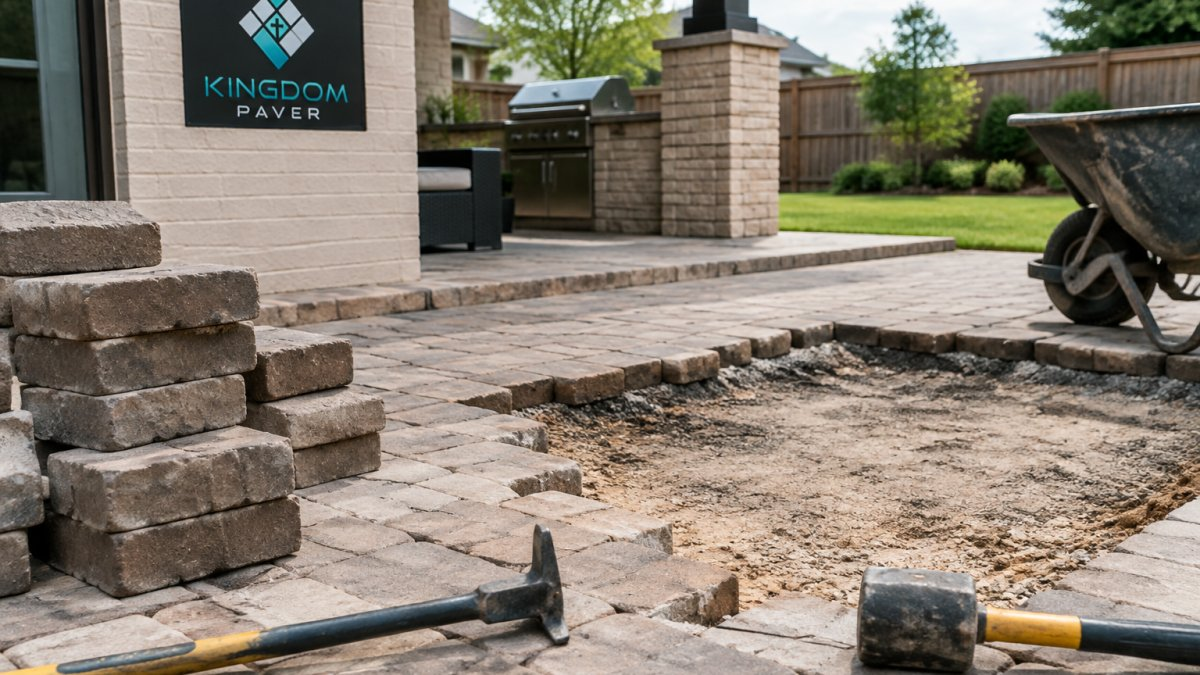
You should replace a paver patio when the base has failed, shown by widespread settling, ripples, or movement across more than about a third of the surface. A properly built paver patio lasts 25 to 50 years, so failure at 8 or 10 years usually means base failure, not worn pavers.
Fading and discoloration are cosmetic, so clean and seal instead of replacing.
A few cracked or loose pavers call for partial replacement, not a full tear-out.
Fix trip hazards of a quarter inch or more near steps and doors immediately.
Correct drainage and grading before any surface work to avoid repeating the failure.
A medium 450-square-foot patio replacement averages $17,750, ranging from $8,500 to $27,000.
Is your patio ready for replacement?Kingdom Paver diagnoses, repairs, and replaces paver patios across Katy and Cypress.
Most paver patios fail for reasons that have nothing to do with the pavers themselves. Knowing when to replace a paver patio starts with reading the right signals, and the surface is often the last place the real problem shows up. The pattern repeats across many patio projects: homeowners often blame the stone when the base is the culprit.
Here’s a benchmark worth knowing. According to Angi’s 2026 paver patio cost data, the national average installation runs $3,800, with a typical range of $2,400 to $7,000. That’s your baseline for weighing repair against replacement.
Watch for three categories of trouble:
Surface wear, fading, and discoloration
Cracked, broken, or loose pavers
Uneven and sunken sections
Each points to a different fix. Below, we’ll show you how to tell them apart before you spend a dollar.
Surface Wear, Fading, and Discoloration
Fading and discoloration are cosmetic, not structural. Concrete pavers chalk out over years of sun. Clay pavers hold color longer. Natural stone develops a patina some homeowners love and others don’t.
None of this means you need to replace a paver patio. A deep clean and fresh polymeric sand often restores the look. Seal the surface if you want color depth back.
But here’s what most guides miss: uneven fading in patches usually signals water sitting in one spot. That’s a drainage clue, not a color problem.
Cracked, Broken, and Loose Pavers
A few cracked pavers are a repair job. Widespread breakage is a different story. Carroll Landscaping notes that replacing damaged pavers is usually the simplest fix, while extensive damage may justify replacing the patio.
Loose pavers that rock underfoot deserve attention. They often mean joint sand has washed out or the bedding layer has shifted. Reset them early and you avoid bigger problems.
Uneven and Sunken Pavers
Sunken pavers are the most common reason people ask when to replace a paver patio. They’re also the most misdiagnosed. A dip in one corner is usually isolated. Rippling across the whole surface points to base failure.
A properly built paver patio can last 25 to 50 years, according to Colonial Newburgh’s paver repair guidance. That number assumes a correct base, proper compaction, and working drainage.
Lifespan varies by material:
Paver Type
Typical Lifespan
Notes
Concrete pavers
25-50 years
Best value, holds color well
Brick pavers
25-50 years
Classic look, resists freeze-thaw
Clay pavers
30-50+ years
Color runs deep, not a surface coat
Natural stone
50+ years
Most durable, highest cost
When a patio fails at 8 or 10 years, the pavers are rarely worn out. Base failure is a common cause of early patio problems, and that distinction matters for your decision.
Diagnosing Base Failure Versus Isolated Paver Damage
Base failure is a patio-wide problem; isolated damage is a local one. The difference matters because a failed base cannot be fixed by resetting surface pavers, and a sound base should never be torn out over a few loose stones. The cause is often visible on a careful walk of the patio if you know what to look for.
Use this four-step inspection to separate the two:
Map the movement. Walk the entire surface in a grid, pressing each foot down firmly. Mark every paver that rocks, dips, or sounds hollow with chalk. If the marks cluster in one area, the problem is local. If they scatter across more than about a third of the patio, suspect the base.
Check the joints. Look for joint sand that has washed out, widened, or sunk below the paver edge. Isolated joint loss near a downspout or slope is a drainage fix. Joints opening uniformly across the patio usually mean the bedding layer is moving.
Test the edges. Press a pry bar or screwdriver into the bedding sand at the patio perimeter. Soft, loose, or missing bedding at the edge points to erosion. Firm, compacted sand at the edge while the center moves points to poor initial compaction.
Look for ripples and lippage. A single low corner is isolated. A wave pattern across several courses, or height differences of roughly a quarter inch or more between adjacent pavers, is a base symptom.
A patio can fail early when the base was under-compacted or the subgrade was never graded to drain. In that case the pavers may still be sound and reusable.
Watch out: a hollow sound underfoot does not always mean base failure. It can also mean a thin bedding layer over a rigid slab, so confirm with the edge test before you commit to a tear-out.
If the pattern is widespread, replacement is often the honest answer. Patching a failing base is throwing money at a symptom. Our article on building a rock-solid paver base with pro compaction explains why the base decides everything.
Drainage, Water Pooling, and Erosion
Water is the quiet killer. Pooling after rain, erosion at the patio edge, and sand washing out of joints all point to grading problems. Fix the slope and drainage first. Sometimes that alone saves the patio.
A patio should shed water away from the house. If water stands after a storm, or if soil has eroded below the edge pavers, the grade may need correcting. Regrading and restoring the edge restraint can address movement without a full replacement in some cases.
Repair vs. Replace: A Decision Matrix
Use this matrix to sort your situation fast, then follow the decision tree below it to confirm the call.
Condition
Recommended Action
Why
Fading or discoloration only
Clean and seal
Cosmetic, not structural
A few cracked or loose pavers
Partial replacement
Localized fix, low cost
One sunken section
Relevel and reset
Base is sound elsewhere
Widespread settling or ripples
Full replacement
Base has failed
Water pooling across the patio
Regrade and improve drainage
Fix cause before surface
Trip hazards near steps or doors
Repair immediately
Safety comes first
Work through these questions in order:
Is anyone at risk of tripping? If a paver sits a quarter inch or more above its neighbor near a step, door, or walkway, fix it now regardless of the rest of the patio. Safety outranks budget.
Is the damage local or widespread? Fewer than about 10 percent of pavers affected and clustered in one area points to repair or partial replacement. More than a third of the surface moving points to full replacement.
Is the base sound? If the edge test and joint check from the previous section show firm bedding and intact joints, a reset is usually enough. If the base has failed, surface repairs will not hold.
Is water the cause? If pooling or erosion is present, correct the drainage before any surface work. Replacing pavers over a bad grade repeats the failure.
Does the cost of repair approach the cost of replacement? When repair estimates climb close to the cost of a new patio, replacement may deliver better long-term value. Request a quote to compare.
Watch out: a contractor who quotes a full replacement without walking the whole patio and testing the base is guessing. Ask for the inspection findings in writing before you sign.
The Cost to Repair Sunken Pavers Per Square Foot
Pricing for paver repair depends on the cause, the access, and how many pavers get reset. Contact Kingdom Paver through our website for current prices or a quote.
What drives the number up or down:
Whether the base needs repair or just the surface
How many pavers can be reused versus replaced
Access for equipment and haul-away
Matching new pavers to a weathered existing color
For a full replacement, Techo-Bloc’s 2026 landscaping cost report puts a medium patio of roughly 450 square feet at an average of $17,750, ranging from $8,500 to $27,000. That’s a useful ceiling to keep in mind.
We don’t publish flat rates because every yard is different. Reach out for a quote based on your actual patio.
Paver Patio Replacement Cost for a 450-Square-Foot Patio
Minimum cost $8,500
Average cost $17,750
Maximum cost $27,000
The Best Paver Removal Tool and When You Actually Need It
For a small reset job, a flat pry bar and a rubber mallet are common hand tools.
Where homeowners go wrong is renting a mechanical lift for a job that needs hand tools. A common mistake is prying pavers without scoring the joints first. You’ll chip edges and lose reusable pavers.
You actually need removal tools when:
Resetting a sunken section
Replacing cracked pavers
Accessing a failed base beneath the surface
For anything beyond a small patch, many homeowners find a professional crew to be the more practical choice.
Planning Your Paver Patio Replacement
Planning a replacement involves four decisions: scope, material, drainage, and contractor.
Start with scope. Is it a full tear-out or a partial replacement? Then pick material, keeping in mind that installation quality matters more than the stone you choose. Next, confirm the drainage plan, since the new patio should fix water problems, not repeat them. Finally, vet your contractor carefully.
Close-up of a gray-brown interlocking paver patio laid in a herringbone-style pattern, with a stacked brick corner and a light stone edge at right.
A note on timing: plan ahead of the summer entertaining season, since project schedules can fill up and rushed base work can lead to early failure.
Deciding when to replace a paver patio is really a question of cause. Fix the base and drainage and the surface lasts decades. Patch symptoms and you’ll be back here in a few years. Kingdom Paver brings 10 years of experience to patios, driveways, and walkways across Katy and Cypress, with custom solutions built around your yard. We offer patios, walkways, outdoor kitchens, and fire pits. Contact Kingdom Paver to discuss your outdoor space.
Frequently Asked Questions
How do I know if my paver patio needs to be replaced?
Look for widespread sunken or loose pavers, multiple cracks across different areas, water pooling that does not drain, and joints that will not hold sand no matter how often you refill them. If the problems cover more than a small patch and keep returning after repairs, the base is likely failing. In that case, replacing a paver patio makes more sense than patching the surface again.
How long do pavers last before they need replacing?
A properly built paver patio can last for decades when the base, compaction, and drainage are done correctly. When a patio fails early, the base is often the cause rather than the pavers. Installation quality and maintenance play a large role in lifespan.
Can sunken pavers be repaired without replacing the whole patio?
Yes, when the damage is isolated. A contractor can lift the affected pavers, recompact and regrade the base, then reset the same pavers. Replacing individual damaged pavers is often the simplest fix. Repair costs depend on the area and base condition, so request a quote through our website before assuming full replacement is needed.
Is it better to repair or replace a paver patio?
Repair wins when damage is limited to a small area, a few pavers, or cosmetic fading. Replace when the base has failed across the patio, water pools persistently, or repairs keep failing within a season or two. A full replacement also makes sense if you want a new layout, better drainage, or a different paver style for your outdoor living space.