
Last Updated: November 7, 2026
Quick Summary
Porcelain pavers are the strongest all-around outdoor kitchen flooring for durability because they absorb very little water and resist grease and stains. For heat around a grill, flamed granite and porcelain handle high temperatures best, while travertine stays cooler underfoot in covered areas. Whatever material you pick, durability depends on a stable subbase, slope away from the structure, and proper drainage.
- Every surface must pass five tests: water absorption, thermal movement, wear, stain and grease resistance, and slip resistance.
- Industry guidance commonly cites a wet COF of 0.60 or higher as slip-resistant.
- Seal stamped concrete to resist grease and moisture, and expect to reseal it over time.
- In freeze-thaw regions, low-absorption pavers with tight joints resist heaving better than porous stone.
- Porcelain and pavers can be lifted and reset individually, making cracked-unit repair a small job.
Table of Contents
- What Actually Determines Outdoor Kitchen Flooring Durability
- Porcelain Pavers: The Low-Absorption Workhorse
- Natural Stone Options: Granite, Travertine, and Limestone
- Concrete Patio Flooring: Stamped, Poured, and Sealed
- Waterproof Outdoor Kitchen Flooring Options and Moisture Control
- Slip-Resistant Outdoor Flooring: Ratings, Textures, and Grease
- Matching Materials to Cooking Zones, Climate, and Repair Needs
- Plan Your Outdoor Kitchen Floor with a Local Installer
- Frequently Asked Questions
What Actually Determines Outdoor Kitchen Flooring Durability
Durability in outdoor kitchen flooring comes down to how a material handles water, heat, weight, and grease over years of use. The failures that come back for repair almost always trace to one of those four forces. The best outdoor kitchen flooring options for durability are not simply the hardest materials. They are the ones matched to your climate, your cooking style, and your subbase.
Here is what most guides get wrong: they rank materials by hardness and stop there. A stone that resists scratches can still crack in a freeze-thaw cycle if water gets underneath it.
The Five Tests Every Material Has to Pass
Every surface we specify has to survive five tests. Skip one and the floor will fail early.
- Water absorption – how much moisture the material pulls in
- Thermal movement – how much it expands and contracts with heat and cold
- Wear resistance – how it handles foot traffic and dragged furniture
- Stain and grease resistance – how it reacts to splattered oil and dropped food
- Slip resistance – how it performs when wet
A material that wins four out of five will still cost you a replacement. The Tile Council of North America’s installation standards are a useful reference for how these properties are tested.
Porcelain Pavers: The Low-Absorption Workhorse
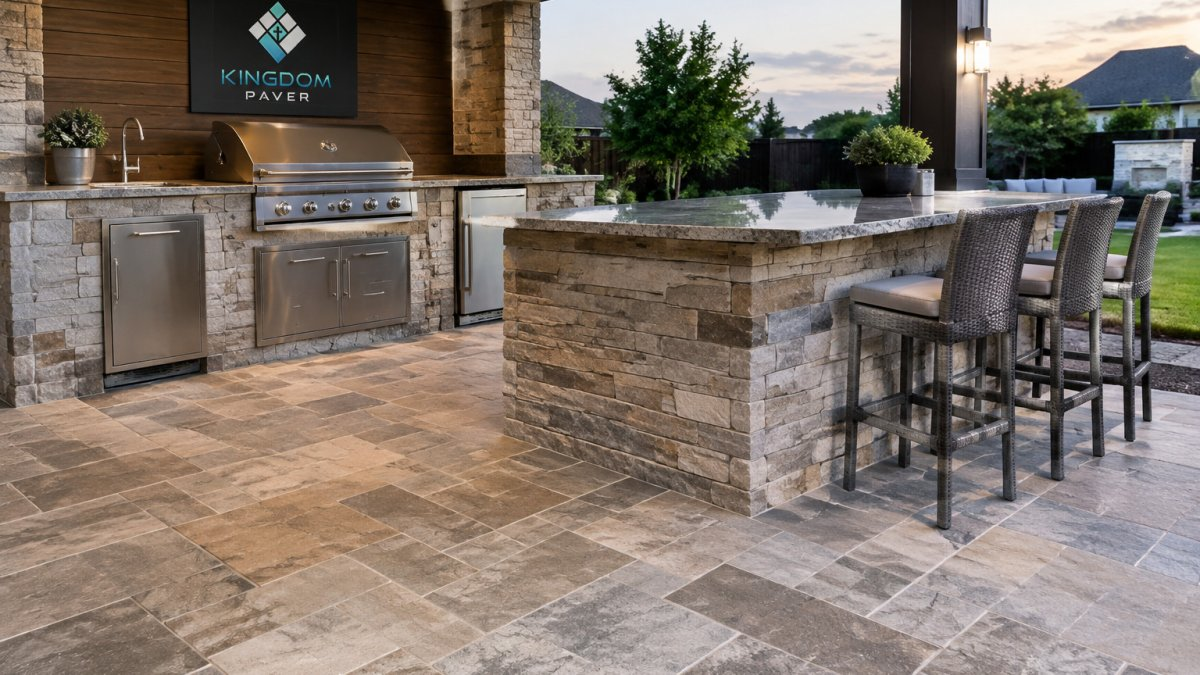
Porcelain pavers are the strongest all-around choice for most outdoor kitchens because they absorb very little water and hold their color.
The color body runs through the full thickness, so a chip is far less visible than on glazed ceramic tile.
Pros: low absorption, strong stain and grease resistance, color body hides chips, easy cleanup, wide style range
Cons: hard and unforgiving underfoot, requires a stable substrate, can feel slick when polished
Porcelain needs a properly prepared base. Set it on a shifting subbase and lippage and cracked edges can result, no matter how tough the tile is.
Natural Stone Options: Granite, Travertine, and Limestone
Natural stone brings character that manufactured pavers cannot copy, but each stone behaves differently under a grill. Granite is dense and heat-tolerant, which makes it a natural fit around a built-in cooking surface.
Sealing is generally recommended with stone, since unsealed travertine and limestone can absorb grease and stain. If you are weighing stone against manufactured options, our guide on how to choose the best paver materials for durability breaks down the trade-offs in more detail.
Pros: granite handles heat, travertine stays cooler, unique natural look
Cons: porous stones need sealing, limestone is softer, cost runs higher
Concrete Patio Flooring: Stamped, Poured, and Sealed
Concrete patio flooring is the budget-friendly option, and stamped concrete can mimic stone or brick convincingly. The catch is that plain concrete cracks, and it cracks more in a cooking zone where heat and weight concentrate.
Sealing changes the equation. A properly sealed stamped surface resists grease and moisture far better than bare concrete. If you want to understand the risk, read what happens if you don’t seal pavers and concrete surfaces over time.
Pros: lowest upfront cost, flexible design, fast install
Cons: cracks without control joints, needs resealing, heat can scorch unsealed surfaces
Waterproof Outdoor Kitchen Flooring Options and Moisture Control
No outdoor floor is truly waterproof, but some options are more moisture-resistant. Porcelain pavers and sealed natural stone are generally among the most moisture-resistant choices, and the installation underneath them matters as much as the surface.
Water control comes down to three things: slope away from the structure, a drainage layer under the surface, and joint material that lets water pass. Polymeric joint sand is the detail most homeowners overlook. The right sand improves runoff and stops weeds from pushing joints apart. Our breakdown of the best sand for paver joints and water runoff explains which type fits a wet cooking area.
Watch out: pooling water at the base of a grill cabinet is the fastest route to rust and rot. Grade the floor before you fall in love with a tile pattern.
Slip-Resistant Outdoor Flooring: Ratings, Textures, and Grease
Slip resistance is where outdoor kitchens differ from patios. A surface that grips fine when dry can turn dangerous once grease hits it. A common mistake is choosing a polished tile for an uncovered area. It looks great for a month and turns into a hazard after the first rainy season.
How Wet Traction Is Measured
The most common field metric is the coefficient of friction (COF). Industry guidance commonly cites a COF of 0.60 or higher as slip-resistant for wet areas. Another widely referenced metric is the static coefficient of friction (SCOF), where 0.50 or above is often cited as a minimum for accessible routes.
A tile rated well dry can drop sharply in slip resistance when a film of cooking oil sits on it. That is why texture matters as much as the number. A honed or flamed finish creates microscopic peaks that interrupt the water or grease film; a polished finish gives that film nowhere to go.
Texture by Zone
- Around the grill: flamed granite or a heavily textured porcelain paver. Grease splatter is constant, and a flamed surface keeps grit underfoot even when oil is present.
- At the sink and prep area: a honed or bush-hammered surface with a visible profile. Water and soap film are the main risks here, not heat.
- Pool edge and walkways: the highest texture you can tolerate barefoot. A brushed or grooved finish sheds water and gives toes something to grip.
- Dining area: a honed finish is usually enough, since grease exposure is lower and comfort underfoot matters more.
Reading the Surface Before You Buy
You can assess texture without a lab. Run a damp hand across a sample: a surface that feels slightly resistant, not glassy, is the right direction.
Watch out: a polished porcelain or smooth ceramic tile that scores well on stain resistance can still be the wrong choice for an uncovered cooking zone, because the same dense surface that resists stains also gives grease and rainwater nothing to grip.
| Material | Wet Slip Resistance | Grease Behavior | Best For |
|---|---|---|---|
| Porcelain paver, textured | High | Good, easy wipe | Main cooking zone |
| Honed travertine | Good | Needs sealing | Covered areas |
| Granite, flamed | High | Good | Around the grill |
| Stamped concrete, sealed | Moderate | Slick when greasy | Budget builds |
| Smooth ceramic tile | Low | Poor | Avoid outdoors |
The practical takeaway: pick texture for the wettest, greasiest moment the floor will see, not for how it looks dry.
Matching Materials to Cooking Zones, Climate, and Repair Needs
The right answer changes with where the floor sits, what your weather does, and how the base is built. Around a hot grill, granite and porcelain handle heat best. In a covered outdoor kitchen, travertine and limestone are comfortable and attractive. On an uncovered area, low-absorption porcelain wins.

Climate: What Actually Breaks a Floor
In freeze-thaw regions, water that seeps under a paver and freezes will heave it. The mechanism is simple: water expands as it turns to ice, and that expansion lifts the surface. A paver with low absorption and tight joints resists this far better than a porous stone with open joints.
Sun exposure drives fading and thermal movement. Dark surfaces absorb more heat and expand more, which stresses joints and edges. Unsealed dark concrete or stone can show surface checking and color loss sooner in hot climates than lighter, sealed surfaces.
Substrate, Slope, and Drainage
Durability is decided under the surface. Slope the floor away from the structure so water does not pond at the base of a grill cabinet.
Expansion joints matter too. A large uninterrupted field of tile or pavers will move with temperature, and without joints it cracks or tents. Control joints in concrete and perimeter joints in pavers give that movement somewhere to go.
Watch out: pooling water at the base of a grill cabinet is the fastest route to rust and rot, and no surface material can compensate for a base that drains toward the house.
Repairability and Replacement
Plan for repair before you need it. Porcelain and pavers can be lifted and reset individually, so a cracked unit is a small job. A cracked concrete slab often means a patch that never quite matches, or a full replacement if the crack runs through a control joint. Natural stone can be replaced unit by unit, but matching color and veining later is harder than with manufactured pavers.
| Priority | Best Choice | Why |
|---|---|---|
| Heat around grill | Granite, porcelain | Withstands high temps |
| Cool underfoot | Travertine | Stays cooler in sun |
| Lowest cost | Stamped concrete | Cheapest upfront |
| Easiest repair | Pavers, porcelain | Individual replacement |
| Wet climate | Porcelain | Lowest absorption |
| Freeze-thaw | Porcelain, tight-joint pavers | Low absorption, resists heaving |
The through-line: match the material to the zone, build the base for the climate, and choose a surface you can repair one piece at a time. That combination outlasts any single “hardest” material chosen in isolation.
Plan Your Outdoor Kitchen Floor with a Local Installer
Material choice is half the job. The other half is the subbase, slope, and joint work that keep the surface stable for years.
Kingdom Paver has ten years of experience and builds custom outdoor living solutions around each client’s needs. If you would rather compare stone and pavers side by side before deciding, our flagstone vs. pavers cost and pros comparison lays it out plainly.
When you are ready to stop researching and start grilling, request a quote from Kingdom Paver and we will walk your space and recommend the material that fits it.
The hardest part of an outdoor kitchen is not picking a pretty surface. It is getting the base, drainage, and material to work together so the floor still looks right after years of grease, rain, and foot traffic.
Frequently Asked Questions
What is the most durable outdoor kitchen flooring?
Porcelain pavers and natural stone are generally regarded as among the longest-lasting options. Porcelain wins on absorption because its low porosity resists stains, grease, and freeze-thaw damage. Granite is the toughest natural stone. Concrete is durable but depends on sealing and crack control. The right pick depends on whether your kitchen is covered, how much grease hits the floor, and how cold your winters get.
Are porcelain pavers durable enough for an outdoor kitchen?
Porcelain pavers are generally fired at high temperature, which gives them low water absorption and good resistance to stains and scratches. They handle dropped tongs, hot grease splatter, and grill-side foot traffic without chipping the way softer tiles can. Look for a color-body paver so chips do not show a lighter core, and choose a textured surface for the cooking zone. Set them on a properly prepared base so they do not rock or settle.
Which outdoor kitchen flooring is most waterproof?
Porcelain pavers are the most waterproof option for waterproof outdoor kitchen flooring, because their dense body absorbs almost no water. Natural stone varies: granite is near-impermeable, while travertine and limestone are porous and need sealing. Concrete is water-resistant only when sealed and crack-free. Whichever material you pick, the base and drainage matter as much as the surface. Water that pools under the floor will undermine any material over time.
How do you choose slip-resistant outdoor flooring around a grill?
Look for a measurable slip rating rather than a marketing claim. Look for a documented slip-resistance rating from the supplier. Texture matters too: brushed, flamed, or bush-hammered finishes grip better than polished ones, especially when grease or water is present. Avoid smooth porcelain and polished granite in the cooking zone. Test a sample wet before you commit, and keep a mat at the grill if your surface is borderline.


